


Related on Lably
Through Agriculture, Renewable energy and Middle East
Economy
Al-Jouf Province’s economy is primarily based on agriculture and renewable energy. The province is one of Saudi Arabia’s largest agricultural producers and is particularly known for olive cultivation. The Al-Jouf Agricultural Development Company operates the world’s largest organic olive farm, which holds two Guinness World Records: one for the largest organic olive farm, covering an area of 6,453 hectares (64.53 km²), and another for the world’s largest modern olive farm. Olive cultivation in Al-Jawf Province began on a small scale in 1980 and was scaled up dramatically following the 2007 introduction of intensive olive-farming methods. By 2023, the province contained approximately 25 million olive trees and produced around 18,000 tons of olives annually.
The province is also home to the Dumat al-Jandal Wind Farm, the first and largest utility-scale wind power project in the Middle East. The wind farm has a capacity of 400 MW and can supply electricity to approximately 70,000 homes.
Sign in to keep reading
4 more chapters are free with a Lably account.
Governorates
The province consists of three governorates, with Sakaka serving as the seat of the province.
Provincial government
The province is governed by a governor (Emir) appointed by the King of Saudi Arabia, assisted by a deputy governor.
Transportation
Air
Al-Jouf is served by Al-Jouf International Airport.
Rail
The province has two stations on the Riyadh–Qurayyat railway: Qurayyat station and Al-Jouf station. Qurayyat station is the northern terminus of the railway.
Historical sites
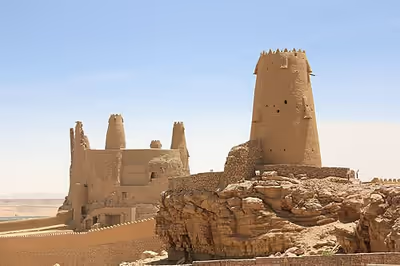
Al-Jouf Province has a long history, with archaeological and architectural remains found across the region, particularly in Dumat al-Jandal, one of its oldest settlements. These remains reflect successive historical periods, including the prehistoric era, as well as later civilizations such as the Canaanite, Nabataean, and Palmyrene periods. The region also contains evidence from the Rashidun, Umayyad, and Abbasid Islamic eras, in addition to remains from the Ottoman period.
Historical sites in the province include (but are not limited to):