


Related on Lably
Through Metamorphic rock, Igneous rock and Relative density
Allanite contains up to 20% rare-earth elements and is a valuable source of them. The inclusion of thorium and other radioactive elements in allanite results in some interesting phenomena. Allanite often has a pleochroic halo of radiation damage in the minerals immediately adjacent. Also highly radioactive grains of allanite often have their structure disrupted or are metamict. The age of allanite grains that have not been destroyed by radiation can be determined using different techniques.
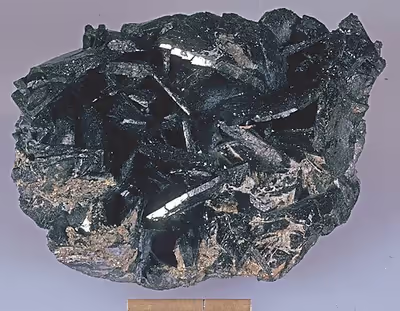
Allanite is usually black in color, but can be brown or brown-violet. It is often coated with a yellow-brown alteration product, likely limonite. It crystallizes in the monoclinic system and forms prismatic crystals. It has a Mohs hardness of 5.5–6 and a specific gravity of 3.5–4.2. It is also pyrognomic, meaning that it becomes incandescent at a relatively low temperature of about 95 °C.
It was discovered in 1810 and named for the Scottish mineralogist Thomas Allan (1777–1833). The type locality is Aluk Island, Greenland, where it was first discovered by Karl Ludwig Giesecke.