

Ammonium carbonate
Chemical used as leavening agent and smelling salt
- 3 min read
- 2 chapters

Related on Lably
Through Chemical formula, Nitrogen and Hydrogen
Production
Ammonium carbonate is produced by combining carbon dioxide and aqueous ammonia. About 80,000 tons/year were produced as of 1997.
- 2 NH3 + H2O + CO2 → [NH4]2CO3
An orthorhombic ammonium carbonate monohydrate is known ([NH4]2CO3·H2O). It crystallizes in an ammonia solution exposed in a carbon dioxide-rich atmosphere.
Decomposition
Ammonium carbonate slowly decomposes at standard temperature and pressure through two pathways. Thus any initially pure sample of ammonium carbonate will soon become a mixture including various byproducts.
Ammonium carbonate can spontaneously decompose into ammonium bicarbonate and ammonia:
- [NH4]2CO3 → [NH4]HCO3 + NH3
Which further decomposes to carbon dioxide, water and another molecule of ammonia:
- [NH4]HCO3 → H2O + CO2 + NH3
Sign in to keep reading
One more chapter is free with a Lably account.
Uses
Leavening agent
Ammonium carbonate may be used as a leavening agent in traditional recipes, particularly those from northern Europe and Scandinavia (e.g. Amerikaner, Speculoos, Tunnbröd or Lebkuchen). It was the precursor to today's more commonly used baking powder.
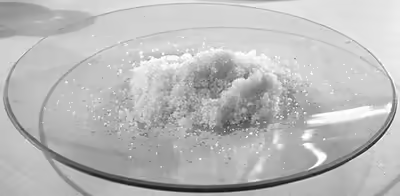
Originally made from ground deer horn and called hartshorn, today it is called baker's ammonia. It is prepared by the sublimation of a mixture of ammonium sulfate and calcium carbonate and occurs as a white powder or a hard, white or translucent mass. It acts as a heat activated leavening agent and breaks down into carbon dioxide (leavening), ammonia (which needs to dissipate) and water. It is sometimes combined with sodium bicarbonate to mimic as a double acting baking powder and to help mask any ammonia smell not baked out.
It also serves as an acidity regulator and has the E number E503. It can be replaced with baking powder, but this may affect both the taste and texture of the finished product. Baker's ammonia should be used to create thin dry baked goods like crackers and cookies. This allows the strong ammonia smell to bake out. It should not be used to make moist baked items like cake since ammonia is hydrophilic and will leave a strong bitter taste.
Its use as a leavening agent, with associated controversy, goes back centuries:
In the third kind of bread, a vesicular appearance is given to it by the addition to the dough of some ammoniacal salt, (usually the sub-carbonate,) which becomes wholly converted into a gaseous substance during the process of baking, causing the dough to swell out into little air vessels, which finally bursting, allow the gas to escape, and leave the bread exceedingly porous. Friedrich Accum, in his Treatise on Culinary Poisons, has stigmatized this process as "fraudulent," but, in our opinion, most unjustly. The bakers would never adopt it but from necessity: when good yeast cannot be procured, it forms an admirable and perfectly harmless substitute; costing the baker more, it diminishes his profit, while the consumer is benefited by the bread retaining the solid matter, which by the process of fermentation is dissipated in the form of ethanol and carbonic acid gas.
Other uses
Ammonium carbonate is the main component of smelling salts, although the commercial scale of their production is small. Buckley's cough syrup from Canada today uses ammonium carbonate as an active ingredient intended to help relieve symptoms of bronchitis. It is also used as an emetic. It is also found in smokeless tobacco products, and is used in aqueous solution as a photographic lens cleaning agent.
It is also used as bait for apple maggots, to monitor the spread of the infestation and adjust the borders of the Apple Maggot Quarantine Area in Washington State.