


Related on Lably
Through Morphology (biology) and Fossil
Description
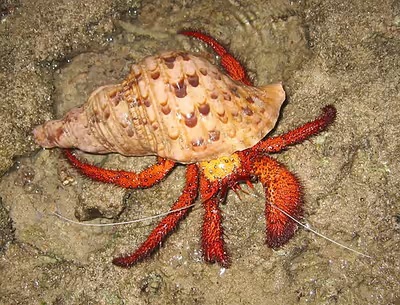
The name Anomura derives from an old classification in which reptant decapods were divided into Macrura (long-tailed), Brachyura (short-tailed) and Anomura (differently-tailed). The alternative name Anomala reflects the unusual variety of forms in this group; whereas all crabs share some obvious similarities, the various groups of anomurans are quite dissimilar.
The group has been moulded by several instances of carcinisation – the development of a crab-like body form. Thus, the king crabs (Lithodidae), porcelain crabs (Porcellanidae) and hairy stone crab (Lomisidae) are all separate instances of carcinisation.
As decapods (meaning ten-legged), anomurans have ten pereiopods, but the last pair of these is reduced in size, and often hidden inside the gill chamber (under the carapace) to be used for cleaning the gills. Since this arrangement is very rare in true crabs (for example, the small family Hexapodidae), a "crab" with only eight visible pereiopods is generally an anomuran.
Sign in to keep reading
2 more chapters are free with a Lably account.
Evolution
The infraorder Anomura belongs to the group Reptantia, which consists of the walking/crawling decapods (lobsters and crabs). There is wide acceptance from morphological and molecular data that Anomura and Brachyura ("true" crabs) are sister taxa, together making up the clade Meiura. Anomura likely diverged from Brachyura in the Late Triassic period, with the earliest discovered Anomuran fossil Platykotta akaina dating from the Norian–Rhaetian aged Ghalilah Formation of the United Arab Emirates.
The cladogram below shows Anomura's placement within the larger order Decapoda, from analysis by Wolfe et al. (2019).
Some of the internal relationships within Anomura are shown in the 2026 cladogram found below.
Classification
The infraorder Anomura contained seven extant superfamilies:
The oldest fossil attributed to Anomura is Platykotta, from the Norian–Rhaetian (Late Triassic) Period in the United Arab Emirates.