

Astoria–Megler Bridge
Bridge in Oregon and Washington, U.S.
- 4 min read
- 5 chapters

Related on Lably
Through North America
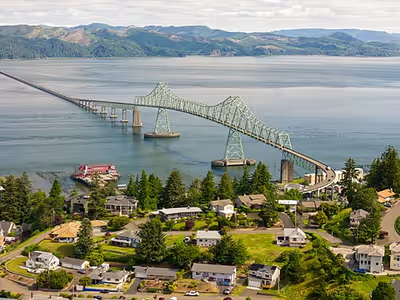
Lying 14 miles (23 km) from the river mouth at the Pacific Ocean, the bridge is four miles (6.5 km) in length, and was the final segment of U.S. Route 101 to be completed between Olympia, Washington, and Los Angeles, California.
History
Ferry service between Astoria and the Washington side of the Columbia River began in 1926. The Oregon Department of Transportation purchased the ferry service in 1946. This ferry service did not operate during inclement weather and the half-hour travel time caused delays. In order to allow faster and more reliable crossings near the mouth of the river, a bridge was planned. The bridge was built jointly by the Oregon Department of Transportation and Washington State Department of Transportation. Following construction, the Oregon Department of Transportation became the lead agency responsible for maintenance and operating the structure.
Construction on the structure began on November 5, 1962, and the concrete piers were cast at Tongue Point, four miles (6.5 km) upriver. The steel structure was built in segments at Vancouver, Washington, ninety miles (140 km) upriver, then barged downstream where hydraulic jacks lifted them into place. The bridge opened to traffic on July 29, 1966, marking the completion of U.S. Route 101 and becoming the seventh major bridge built by Oregon in the 1950s–1960s; ferry service ended the night before. On August 27, 1966, Governors Mark Hatfield of Oregon and Dan Evans of Washington dedicated the bridge by cutting a ceremonial ribbon. The four-day ceremony was celebrated by 30,000 attendees who participated in parades, drives, and a marathon boat race from Portland to Astoria. The cost of the project was $24 million, equivalent to $177 million in 2024 dollars, and was paid for by tolls that were removed on December 24, 1993, more than two years early.
Repainting the bridge was planned for May 2009 through 2011 and budgeted at $20 million, to be shared by the states of Oregon and Washington. A four-year planned paint stripping and repainting project was planned for March 2012 through December 2016.
In 2016, a colony of double-crested cormorants moved from nearby East Sand Island to the bridge, where they began nesting. Their presence caused issues with bridge inspections, as bird droppings and guano covered visual cracks, and nests obscured navigational lights used by ship traffic. The population of cormorants increased to 5,000 breeding pairs in 2020, prompting efforts by the Army Corps of Engineers to scare the birds from the bridge and relocate them back to East Sand Island.
Sign in to keep reading
4 more chapters are free with a Lably account.
Details
The bridge is 21,474 feet (4 mi; 6,545 m) in length and carries one lane of traffic in each direction. The elevated section, which is closest to the Oregon side and composed of three spans, is 2,468 feet (752 m) long, with the cantilevered central main span measuring 1,233 feet (376 m). It was built to withstand 150 mph (240 km/h) wind gusts and river water speeds of 9 mph (14 km/h). As of 2004, an average of 7,100 vehicles per day crossed the bridge. Designed by William Adair Bugge (1900–1992), construction of the cantilever truss bridge was completed by the DeLong Corporation, the American Bridge Company, and Pomeroy Gerwick.
The south end has the former toll plaza, at the end of a 2,130-foot (650 m) inclined ramp which forms a spiral bridge, going through a full 360-degree loop while gaining elevation over land to provide almost 200 feet (61 m) of clearance over the shipping channel (similarly to the Lincoln Tunnel Helix in Weehawken, New Jersey). The north end is an at-grade intersection with State Route 401. Since most of the northern portion of the bridge is over shallow, non-navigable water, it is low to the water.
Pedestrians
Normally, pedestrians are prohibited on the bridge—only motor vehicles and bicycles are allowed. There is no sidewalk and the shoulders are too narrow for pedestrians adjacent to 55-mile-per-hour (89 km/h) traffic. However, one day a year—usually in October—the bridge is host to the Great Columbia Crossing. Participants are taken by shuttle to the Washington side, from where they run or walk to the Oregon side on a six-mile (9.7 km) route across the bridge. Motor traffic is allowed to use only one lane (of two lanes) and is advised to expect delays during the two-hour event. For the first time, during the 2018 event, the Oregon Department of Transportation announced that the bridge would be closed to motor traffic.
Popular culture
The bridge itself is featured prominently in the movies Short Circuit, Kindergarten Cop, Free Willy 2: The Adventure Home, The Goonies, and Sometimes I Think About Dying. It stands in for the doomed fictional Madison Bridge in Irwin Allen's 1979 made-for-TV disaster movie The Night the Bridge Fell Down.