

Bay
Recessed, coastal body of water connected to an ocean or lake
- 3 min read
- 2 chapters

Learn it on Lably
A bay can be the estuary of a river, such as the Chesapeake Bay, an estuary of the Susquehanna River. Bays may also be nested within each other; for example, James Bay is an arm of Hudson Bay in northeastern Canada. Some bays are large enough to have varied marine geology, such as the Bay of Bengal (2,600,000 km2 or 1,000,000 sq mi) and Hudson Bay (1,230,000 km2 or 470,000 sq mi).
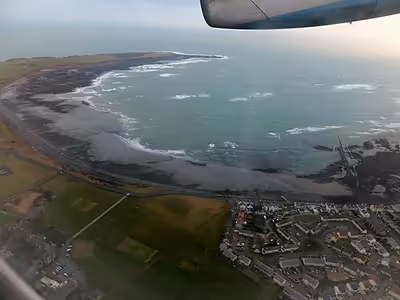
The land surrounding a bay often reduces the strength of winds and blocks waves. Bays may have as wide a variety of shoreline characteristics as other shorelines. In some cases, bays have beaches, which "are usually characterized by a steep upper foreshore with a broad, flat fronting terrace". Bays were significant in the history of human settlement because they provided easy access to marine resources like fisheries. Later they were important in the development of sea trade as the safe anchorage they provide encouraged their selection as ports.
Definition
The United Nations Convention on the Law of the Sea defines a bay as a well-marked indentation in the coastline, whose penetration is in such proportion to the width of its mouth as to contain land-locked waters and constitute more than a mere curvature of the coast. An indentation, however, shall not be regarded as a bay unless its area is as large as (or larger than) that of the semi-circle whose diameter is a line drawn across the mouth of that indentation – otherwise, it would be referred to as a bight.
Types
- Open – a bay that is widest at the mouth, flanked by headlands.
- Enclosed – a bay whose mouth is narrower than its widest part, flanked by at least one peninsula.
- Semi-enclosed – an open bay whose exit is made into narrower channels by one or more islands within its mouth.
- Back-barrier – a semi-enclosed bay separated from open water by one or more barrier islands or spits.
- Juridicial – a legal distinction defining a bay meeting certain criterion as inland waters, and thus the waters of a state, rather than international waters or the territorial waters of a national government a state may be sovereign to. Foremost among the criteria remains that the area impounded by the bay must be greater than that of a semicircle drawn across its mouth.Among the matters impacted by the definition are the right to the seabed and its minerals, control over fishing, the right of seafarers to innocent passage, and whether the affected coast is an international border or not.
Gulf
A gulf is a large inlet from an ocean or their seas into a landmass, larger and typically (though not always) with a narrower opening than a bay. The term was used traditionally for large, highly indented navigable bodies of salt water that are enclosed by the coastline. Many gulfs are major shipping areas, such as the Persian Gulf, Gulf of Mexico, Gulf of Finland, and Gulf of Aden.
Sign in to keep reading
One more chapter is free with a Lably account.
Formation
Bays form variously by plate tectonics, coastal erosion by rivers, and glaciers.
The largest bays have developed through plate tectonics. As the Paleozoic/early Mesozoic era super-continent Pangaea broke up along curved and indented fault lines, the continents moved apart and left large bays; these include the Gulf of Guinea, the Gulf of Mexico, and the Bay of Bengal, which is the world's largest bay.
Bays also form through coastal erosion by rivers and glaciers. A bay formed by a glacier is a fjord. Rias are created by rivers and are characterised by more gradual slopes. Deposits of softer rocks erode more rapidly, forming bays, while harder rocks erode less quickly, leaving headlands.