

Bismarck Archipelago
Archipelago in Papua New Guinea
- 2 min read
- 2 chapters

Related on Lably
Through Archipelago, Volcano and World War I
History
The first inhabitants of the archipelago arrived around 30,000–40,000 years ago. They may have traveled from New Guinea, by boat across the Bismarck Sea or via a temporary land bridge, created by an uplift in the Earth's crust. Later arrivals included the Lapita people, the direct ancestors of the Austronesian peoples of Polynesia, eastern Micronesia, and Island Melanesia.
The first European to visit these islands was Dutch explorer Jacob le Maire in 1616. The islands remained unsettled by western Europeans until they were annexed as part of the German protectorate of German New Guinea in 1884. The area was named in honour of the Chancellor Otto von Bismarck.
On 13 March 1888, a volcano erupted on Ritter Island causing a megatsunami. Almost the entire volcano fell into the ocean, leaving a small rim of the east side of the original island.
Following the outbreak of World War I, the Australian Naval and Military Expeditionary Force seized the islands in 1914 and Australia later received a League of Nations mandate for the islands. They remained under Australian administration—interrupted only by Japanese occupation during World War II—until Papua New Guinea became independent in September 1975.
Sign in to keep reading
One more chapter is free with a Lably account.
Geography
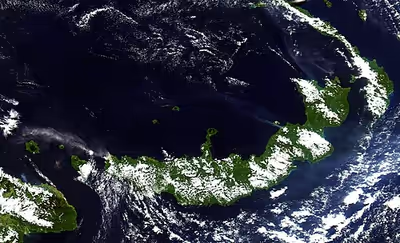
The Bismarck Archipelago includes mostly volcanic islands with a total land area of 49,700 km2 (19,189 sq mi). The archipelago surrounds the Bismarck Sea and sits upon the North Bismarck Plate, the Manus Plate and the South Bismarck Plate.
Islands are grouped here according to administrative province:
- Manus Province (see 9 on the map)
- Admiralty Islands, group of 18 islands including:
- Manus Island, main island
- Los Negros Island
- Lou Island
- Ndrova Island
- Tong Island
- Baluan Island
- Pak Island
- Purdy Islands
- Rambutyo Island
- St. Andrews Islands
- Western Islands, with:
- Aua Island
- Hermit Islands
- Kaniet Islands (Anchorite)
- Sae Island
- Ninigo Islands
- Wuvulu Island
- Admiralty Islands, group of 18 islands including:
- New Ireland Province (12)
- New Ireland or also Niu Ailan, main island
- New Hanover or Lavongai
- St Matthias Islands
- Tabar Group
- Lihir Group
- Tanga Group
- Feni Islands
- Dyaul Island
- East New Britain Province (4)
- New Britain or also Niu Briten, main island
- Duke of York Islands
- Duke of York Island
- Kabakon
- Kerawara
- Makada
- Mioko
- Mualim
- Ulu
- West New Britain Province (18)
- New Britain or also Niu Briten, main island
- Vitu Islands
- Morobe Province (11)
- Umboi Island
- Tolokiwa Island
- Sakar Island
- Ritter Island
- Malai Island
- Tuam Island
- Madang Province (8)
- Long Island
- Crown Island
- Karkar Island
- Bagabag Island
- Manam
- East Sepik Province (5)
- Schouten Islands
The passage of water between the islands of New Britain and New Ireland is called St. George's Channel after St. George's Channel in the British Isles between Great Britain and Ireland.