

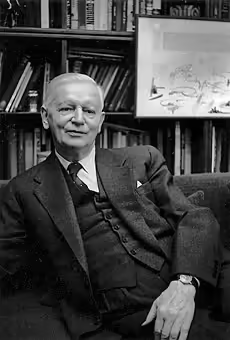
Carl Theodor Dreyer
Danish film director (1889–1968)
- 4 min read
- 2 chapters

Related on Lably
His 1928 movie The Passion of Joan of Arc is considered to be one of the greatest of all time, renowned for its cinematography and use of close-ups. It frequently appears on Sight & Sound's lists of the greatest films ever made, and in 2012's poll, it was voted the ninth-best film by critics and 37th by directors.
His other well-known films include Michael (1924), Vampyr (1932), Day of Wrath (1943), Ordet (The Word) (1955), and Gertrud (1964).
Life
Dreyer was born illegitimate in Copenhagen. His birth mother was an unmarried, Scanian maid named Josefine Bernhardine Nilsson, and he was put up for adoption by his birth father, Jens Christian Torp, a married Danish farmer living in Sweden who was his mother's employer. He spent the first two years of his life in orphanages until his adoption by a typographer named Carl Theodor Dreyer and his wife Inger Marie (née Olsen). He was named after his adoptive father, but in accordance with Danish practice, there is no Senior or Junior added to their names to distinguish them from each other.
His adoptive parents were emotionally distant, and his childhood was largely unhappy. He later recalled that his parents "constantly let me know that I should be grateful for the food I was given and that I strictly had no claim on anything since my mother got out of paying by lying down to die." He was a highly intelligent school student, who left home and formal education at the age of 16. He dissociated himself from his adoptive family, but their teachings influenced the themes of many of his films.
Dreyer was ideologically conservative. David Bordwell stated "As a youth he belonged to the Social Liberal party, a conservative group radical only in their opposition to military expenditures." Dreyer recalled "Even when I was with Ekstrabladet, I was conservative...I don't believe in revolutions. They have, as a rule, the tedious quality of pulling development back. I believe more in evolution, in the small advances."
In 1911, he married Ebba Larsen, with whom he had two children: Gunni Dreyer (1913-1990) and Erik Dreyer (1923-1978).
Dreyer died of pneumonia in Copenhagen at age 79. The documentary Carl Th. Dreyer: My Metier contains reminiscences from people who knew him.
Sign in to keep reading
One more chapter is free with a Lably account.
Career
Early works
As a young man, Dreyer worked as a clerk and a journalist, and he eventually joined the film industry as a writer of title cards for silent films and subsequently of screenplays. He was initially hired by Nordisk Film in 1913.
His first attempts at film direction had limited success, and he left Denmark to work in the French film industry. While living in France he met Jean Cocteau, Jean Hugo, and other members of the French artistic scene.
In 1928 he made his first classic film, The Passion of Joan of Arc. Working from the transcripts of Joan of Arc's trial, he created a masterpiece of emotion that drew equally on realism and expressionism. Because the Danish film industry was in financial ruin, Dreyer depended on private financing from Baron Nicolas de Gunzburg to make his next film, Vampyr (1932), a surreal meditation on fear. However, both films were box office failures and Dreyer did not make another movie until World War II.
Later career
By 1943, Denmark was under Nazi occupation, and Dreyer's film Day of Wrath had as its theme the paranoia surrounding witch hunts in the seventeenth century in a strongly theocratic culture. With this work, Dreyer established the style that would mark his sound films: careful compositions, stark monochrome cinematography, and very long takes.
Dreyer made two documentaries in the more than a decade before his next full-length feature film, in 1954, Ordet (The Word), based on the play of the same name by Kaj Munk. The film, which combines a love story with a conflict of faith, won the Golden Lion from the Venice Film Festival in 1955.
Dreyer's last film, based on a play of the same name by Hjalmar Söderberg, was 1964's Gertrud. Although seen by some as a lesser film than its predecessors, it is a fitting close to Dreyer's career as it deals with a woman who, through the tribulations of her life, never expresses regret for her choices. David Thomson says it "awaits rediscovery as Dreyer's finest film and vindication of his method." Thomson quotes Dreyer:
What interests me—and this comes before technique—is reproducing the feelings of the characters in my films...The important thing...is not only to catch hold of the words they say, but also the thoughts behind the words. What I seek in my films, what I want to obtain, is a penetration to my actors' profound thoughts by means of their most subtle expressions...that lie in the depths of his soul. This what interests me above all, not the technique of the cinema. Gertrud is a film I made with all my heart.
The great, never finished project of Dreyer's career was a film about Jesus. Although a manuscript was written (published in 1968), the unstable economic conditions and Dreyer's own perfectionism left the project undeveloped at his death.