

Celestial equator
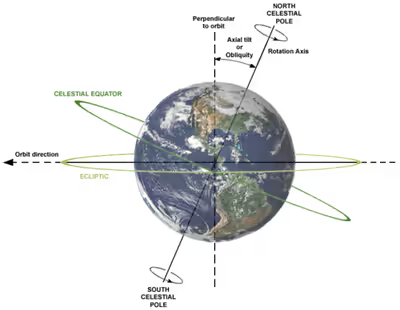
Projection of Earth's equator out into space
- 1 min read
- 1 chapters

Related on Lably
Through Great circle, Coplanarity and Earth
An observer standing on the Earth's equator visualizes the celestial equator as a semicircle passing through the zenith, the point directly overhead. As the observer moves north (or south), the celestial equator tilts towards the opposite horizon. The celestial equator is defined to be of infinite reach (since it is on the celestial sphere); thus, the ends of the semicircle always intersect the horizon due east and due west, regardless of the observer's position on the Earth. At the poles, the celestial equator coincides with the astronomical horizon. At all latitudes, the celestial equator is a uniform arc or circle because the observer is only finitely far from the plane of the celestial equator, but infinitely far from the edge of the celestial equator itself.
Astronomical objects near the celestial equator appear above the horizon from most places on the Earth, but they culminate highest near the equator. The celestial equator currently passes through these constellations:
Over thousands of years, the orientation of the Earth's equator and thus the constellations the celestial equator passes through will change due to axial precession.
Celestial bodies other than the Earth also have similarly defined celestial equators.