


Related on Lably
Through Protein and Order of magnitude
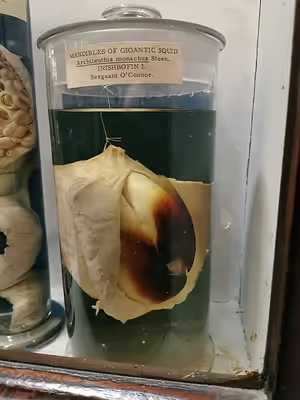
Fossilised remains of beaks are known from a number of cephalopod groups, both extant and extinct, including squids, octopuses, belemnites, and vampyromorphs. Aptychi - paired plate-like structures found in ammonites - may also have been jaw elements.
Composition
Composed primarily of chitin and cross-linked proteins, beaks are more or less indigestible and are often the only identifiable cephalopod remains found in the stomachs of predatory species such as sperm whales. Cephalopod beaks gradually become less stiff as one moves from the tip to the base, a gradient that results from differing chemical composition. In hydrated beaks of the Humboldt squid (Dosidicus gigas) this stiffness gradient spans two orders of magnitude.
Sign in to keep reading
One more chapter is free with a Lably account.
Measurements
The abbreviations LRL and URL are commonly used in teuthology to refer to lower rostral length and upper rostral length, respectively. These are the standard measures of beak-size in Decapodiformes; hood length is preferred for Octopodiformes. They can be used to estimate the mantle length and total body weight of the original animal as well as the total ingested biomass of the species.