

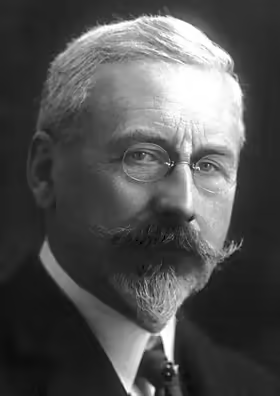
Charles-Édouard Guillaume
Swiss physicist (1861–1938)
- 2 min read
- 2 chapters

Related on Lably
Through Alloy, Thermal expansion and Elastic modulus
Personal life
Charles-Edouard Guillaume was born on 15 February 1861 in Fleurier, Switzerland, into a family of French descent. Guillaume received his early education in Neuchâtel, and obtained his Ph.D. in Physics from the Federal Polytechnic School in Zurich (now ETH Zurich) in 1883.
In 1888, Guillaume married A. M. Taufflieb, with whom he had three children.
Guillaume died on 13 June 1938 in Sèvres, Paris, at the age of 77. He was a Christian.
Sign in to keep reading
One more chapter is free with a Lably account.
Scientific career
Guillaume was head of the International Bureau of Weights and Measures. He also worked with Kristian Birkeland, serving at the Observatoire de Paris – Section de Meudon. He conducted several experiments with thermostatic measurements at the observatory.
Nickel–steel alloy
Guillaume is known for his discovery of nickel–steel alloys he named invar, elinvar and platinite, also known as red platinum. Invar has a near-zero coefficient of thermal expansion, making it useful in constructing precision instruments whose dimensions need to remain constant in spite of varying temperature. Elinvar has a near-zero thermal coefficient of the modulus of elasticity, making it useful in constructing instruments with springs that need to be unaffected by varying temperature, such as the marine chronometer. Elinvar is also non-magnetic, which is a secondary useful property for antimagnetic watches.
Space radiation
Guillaume is also known for the earliest estimation of the "radiation of the stars” in his 1896 article "La Température de L'Espace" ("The Temperature of Space"). This publication made him a pioneer in plasma cosmology, the study of conditions far from any particular star. The concept was later known as the Cosmic microwave background. He was one of the first people in history to estimate the temperature of space, as 5–6 K.
Horology
As the son of a Swiss horologist, Guillaume took an interest in marine chronometers. For use as the compensation balance he developed a slight variation of the invar alloy which had a negative quadratic coefficient of expansion. The purpose of doing this was to eliminate the "middle-temperature" error of the balance wheel. The Guillaume balance (a type of balance wheel) in horology is named after him.