


Related on Lably
Through Tropics and Seed dispersal
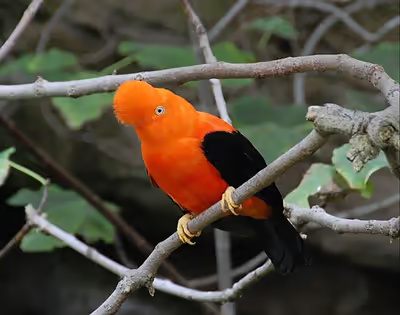
Both known species exhibit sexual dimorphism: the males are bright orange or red with a prominent fan-shaped crests. Like some other cotingids, they have a complex courtship behavior, performing lek displays. The females are overall brownish with hints of the bright colors of the males. Females build nests on rocky cliffs or large boulders, and raise the young on their own. They usually lay two or three eggs.
Studies and observations have shown that male cocks-of-the-rock are very territorial. While the females are taking care of their eggs and chicks, the male birds are in clans together, living and keeping an eye out for a certain arena. The females lived in their nests 625 feet away from their arena.
Except during the mating season, these birds are wary animals and difficult to see in the rainforest canopy. They primarily feed on fruits and berries and may be important dispersal agents for rainforest seeds.
Taxonomy
The genus Rupicola was introduced by the French zoologist Mathurin Jacques Brisson in 1760 with the Guianan cock-of-the-rock (Rupicola rupicola) as the type species. The genus name Rupicola is Neo-Latin for "cliff-dweller" and combines Latin rupes, rupis "rock" and -cola "dweller.
Sign in to keep reading
One more chapter is free with a Lably account.
Species
The genus contains two species: