

Convergent synthesis
Strategy to improve chemical synthesis
- 1 min read
- 1 chapters

Related on Lably
Through Chemistry, Efficiency and Yield (chemistry)
- A → B → C → D
Suppose the yield is 50% for each reaction; the overall yield of D is only 12.5% from A.
In a convergent synthesis
- A → B (50%)
- C → D (50%)
- B + D → E (25%)
the overall yield of E (25%) looks much better. Convergent synthesis is applied in the synthesis of complex molecules and involves fragment coupling and independent synthesis. This technique is more useful if the compound is large and symmetric, where at least two aspects of the molecule can be formed separately and still come together.
Examples:
- Convergent synthesis is encountered in dendrimer synthesis where branches (with the number of generations preset) are connected to the central core.
- Proteins of up to 300 amino acids are produced by a convergent approach using chemical ligation.
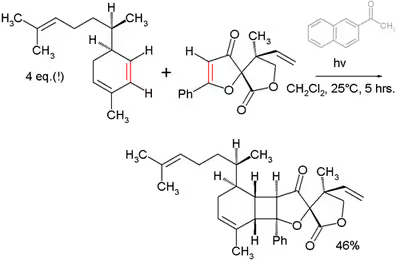
- An example of its use in total synthesis is the final step (photochemical [2+2]cycloaddition) towards the compound biyouyanagin A: