

Crystal system
Classification of crystalline materials by their three-dimensional structural geometry
- 4 min read
- 4 chapters
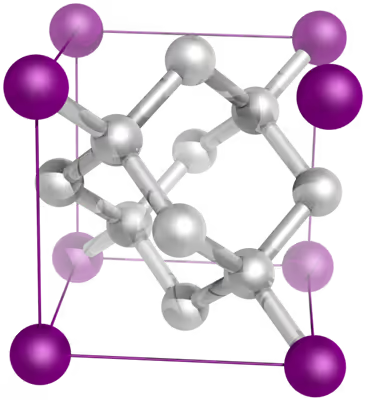

Explore on Lably
ToursExplore Lably’s 3D toursOverview
Crystals can be classified in three ways: lattice systems, crystal systems and crystal families. The various classifications are often confused as the term "crystal system" is sometimes used to mean "lattice system" or "crystal family".
Sign in to keep reading
3 more chapters are free with a Lably account.
In 2 dimensions
In two-dimensional space, the crystal families, crystal systems, and lattice systems are the same. There are four crystal families (oblique, rectangular, square, and hexagonal).
In 3 dimensions
In three-dimensional space, there are 6 crystal families, 7 crystal systems and 7 lattice systems. Five of the crystal systems are essentially the same as five of the lattice systems: triclinic, monoclinic, orthorhombic, tetragonal, and cubic. There are also trigonal and hexagonal crystal systems, and the restrictions of all the crystal systems are listed in the table below.
In the table, a, b and c means the lattice constants in three directions, while α, β and γ refer to the angle between b and c, the angle between a and c, and the angle between a and b, respectively. These values, a, b, c , and α, β, γ, are termed lattice parameters.
Of the 32 crystallographic point groups that exist in three dimensions, most are assigned to only one lattice system. However, 5 point groups have 7 corresponding space groups assigned to the rhombohedral lattice system and 18 corresponding space groups assigned to the hexagonal lattice system. These point groups are assigned to the trigonal crystal system.
The hexagonal and trigonal crystal systems differ from the hexagonal and rhombohedral lattice systems. These are combined into the hexagonal crystal family.
The relation between three-dimensional crystal families, crystal systems and lattice systems is shown in the following table:
- Note: The trigonal crystal system is often confused with the rhombohedral lattice system. There is no "trigonal" lattice system. To avoid confusion of terminology, the term "trigonal lattice" is not used.
Crystal classes
The 7 crystal systems consist of 32 crystal classes (corresponding to the 32 crystallographic point groups) as shown in the following table below:
Bravais lattices
There are seven different kinds of lattice systems, and each kind of lattice system has four different kinds of centerings (primitive, base-centered, body-centered, face-centered). However, not all of the combinations are unique; some of the combinations are equivalent while other combinations are not possible due to symmetry reasons. This reduces the number of unique lattices to the 14 Bravais lattices.
The distribution of the 14 Bravais lattices into 7 lattice systems is given in the following table.
Redundant and non-existent lattice centerings
Although pairing 7 lattice systems with 4 possible centering yields 7 × 4 = 28 theoretical combinations, only 14 are unique Bravais lattices. The remaining 14 combinations are excluded for one of two fundamental reasons:
1. Destruction of required crystal symmetry
Adding certain centerings breaks the characteristic symmetry operations required by that crystal system.
- Base-centered cubic (absent): Placing centering points on only one pair of opposite faces removes the threefold rotation axes (111) that define the cubic crystal system. The resulting lattice is not cubic, but rather a body-centered tetragonal lattice with a smaller unit cell.
2. Equivalence to a standard Bravais lattice via cell redefinition
Adding centerings produces a grid of lattice points that can be re-described as an existing, simpler Bravais lattice.
- Face-centered tetragonal (redundant): Generates an array of points that forms an equivalent body-centered tetragonal lattice rotated by 45° around the c-axis, with a unit cell volume halved.
- Base-centered tetragonal (redundant): Centering the base of a tetragonal cell along the xy-plane (C-centering) forms an equivalent primitive tetragonal lattice rotated by 45° around the z-axis, with a unit cell volume halved.
- Body-centered monoclinic (redundant): Can be mapped to a standard base-centered monoclinic (C) lattice through an oblique choice of axes within the mirror/twofold plane.
In 4 dimensions
In four-dimensional space there are 23 crystal families, 33 crystal systems and 33 lattice systems. The relation between four-dimensional crystal families, crystal systems, and lattice systems is shown in the following table.
Enantiomorphic systems are marked with an asterisk. The number of enantiomorphic pairs is given in parentheses. Here the term "enantiomorphic" has a different meaning than in the table for three-dimensional crystal classes. The latter means, that enantiomorphic point groups describe chiral (enantiomorphic) structures. In the current table, "enantiomorphic" means that a group itself (considered as a geometric object) is enantiomorphic, like enantiomorphic pairs of three-dimensional space groups P31 and P32, P4122 and P4322. Starting from four-dimensional space, point groups also can be enantiomorphic in this sense.
The names here are given according to Whittaker. They are almost the same as in Brown et al., with exception for names of the crystal families 9, 13, and 22. The names for these three families according to Brown et al. are given in parentheses.