


Related on Lably
Through Continental drift, Sedimentary rock and Rose
Formation
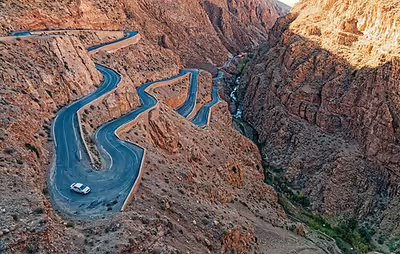
The area which now forms the Dadès Gorges lay at the bottom of the sea millions of years ago. Great quantities of sediment were deposited around giant coral reefs, and over time this material became compacted into a variety of sedimentary rocks such as sandstone and limestone. Eventually, the movement of the Earth's crust caused the region to rise above the sea, forming the Atlas Mountains and surrounding landscape.
The Dadès River established its course quite early in this upheaval, and the flowing water began to erode away the porous sedimentary rock of the mountains. For the majority of the year, the Dadès has a relatively weak flow, owing to the dryness of the area's climate. However, during the storm season, enormous quantities of water can be forced into the river at once, creating raging torrents with enormous erosive power. These torrents carry large amounts of debris from the source all the way down to the end of the river's source, and each piece scrapes away at the softer rock in the gorge walls, gradually enlarging and deepening the gorge with every flood season.
Sign in to keep reading
One more chapter is free with a Lably account.