

Daniel Gabriel Fahrenheit
Physicist and engineer (1686–1736)
- 6 min read
- 2 chapters

Related on Lably
Through Invention, Thermometer and Temperature
Biography
Early life
Fahrenheit was born in Danzig (Gdańsk), then in the Polish–Lithuanian Commonwealth. The Fahrenheits were a German Hanse merchant family who had lived in several Hanseatic cities. Fahrenheit's great-grandfather had lived in Rostock, and research suggests that the Fahrenheit family originated in Hildesheim. Daniel's grandfather Reinhold Fahrenheit moved from Kneiphof in Königsberg (then in the Duchy of Prussia) to Danzig and settled there as a merchant in 1650. His son, Daniel Fahrenheit (the father of Daniel Gabriel), married Concordia Schumann, the daughter of a well-known Danzig business family. Daniel was the eldest of the five Fahrenheit children (two sons, three daughters) who survived childhood. His sister, Virginia Elisabeth Fahrenheit, married Benjamin Krüger and was the mother of Benjamin Ephraim Krüger, a clergyman and playwright.
As a young adult, Fahrenheit "showed a particular desire for studying," and was scheduled to enroll in the Danzig Gymnasium. But on 14 August 1701, his parents died after eating poisonous mushrooms. Fahrenheit, along with two brothers and sisters, was placed under guardianship. In 1702, Fahrenheit's guardians enrolled him in a bookkeeping course and sent him to a four-year merchant trade apprenticeship in Amsterdam.
Upon completing his apprenticeship, Fahrenheit ran off and began a period of travel through the Holy Roman Empire, Sweden, and Denmark in 1707. At the request of his guardians, a warrant was issued for his arrest with the intention of placing him into the service of the Dutch East India Company.
Work with thermometers, Fahrenheit scale
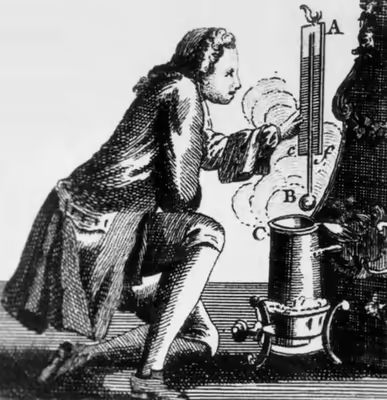
By around 1706, Fahrenheit was manufacturing and shipping barometers and spirit-filled thermometers using the Florentine temperature scale. In 1708, Fahrenheit met with the mayor of Copenhagen and astronomer, Ole Rømer, and was introduced to Rømer's temperature scale and his methods for making thermometers. Rømer told Fahrenheit that demand for accurate thermometers was high. The visit inspired Fahrenheit to try to improve his own offerings. Perhaps not coincidentally, Fahrenheit's arrest warrant was dropped around the time of his meeting with Rømer.
In 1709, Fahrenheit returned to Danzig and took observations using his barometers and thermometers, traveled more in 1710 and returned to Danzig in 1711 to settle his parents' estate. After additional travel to Königsberg and Mitau in 1711, he returned to Danzig in 1712 and stayed there for two years. During this period he worked on solving technical problems with his thermometers.
Fahrenheit began experimenting with mercury thermometers in 1713. Also by this time, Fahrenheit was using a modified version of Rømer's scale for his thermometers which would later evolve into his own Fahrenheit scale. In 1714, Fahrenheit left Danzig for Berlin and Dresden to work closely with the glass-blowers there. In that year Christian Wolff wrote about Fahrenheit's thermometers in a journal after receiving a pair of his alcohol-based devices, helping to boost Fahrenheit's reputation in the scientific community.
In addition to his interest in meteorological instruments, Fahrenheit also worked on his ideas for a mercury clock, a perpetual motion machine, and a heliostat around 1715. He struck up a correspondence with Leibniz about some of these projects. From the exchange of letters, we learn that Fahrenheit was running out of money while working on his projects and asked Leibniz for help obtaining a paid post so he could continue his work.
In 1717 or 1718, Fahrenheit returned to Amsterdam and began selling barometers, areometers, and his mercury and alcohol-based thermometers commercially. By 1721, Fahrenheit had perfected the process of crafting and standardizing his thermometers. The superiority of his mercury thermometers over alcohol-based thermometers made them very popular, leading to the widespread adoption of his Fahrenheit scale, the measurement system he developed and used for his thermometers.
Later life and controversy
Fahrenheit spent the remainder of his life in Amsterdam. From 1718 onward, he lectured in chemistry in Amsterdam. He visited England in 1724 and was elected a Fellow of the Royal Society on 5 May. In that year, he published five papers in Latin for the Royal Society's scientific journal, Philosophical Transactions, on various topics. In his second paper, "Experimenta et observationes de congelatione aquæ in vacuo factæ", he provides a description of his thermometers and the reference points he used for calibrating them. For two centuries, this document was the only description of Fahrenheit's process for making thermometers. In the 20th century, Ernst Cohen uncovered correspondences between Fahrenheit and Herman Boerhaave which cast considerable doubt on the veracity of Fahrenheit's article explaining the reference points for his scale and that, in fact, Fahrenheit's scale was largely derived from Rømer's scale. In his book, The History of the Thermometer and Its Use in Meteorology, W. E. Knowles Middleton writes,
I believe that much of the confusion [over the Fahrenheit scale] has resulted from believing that [Fahrenheit] meant exactly what he said [in his Royal Society article], and discounting the natural tendency of an instrumentmaker to wish to conceal his processes, or at least to obfuscate his readers.
— W. E. Knowles Middleton, The History of the Thermometer and Its Use in Meteorology
From August 1736 to his death, Fahrenheit stayed in the house of Johannes Frisleven at Plein Square in The Hague in connection with an application for a patent at the States of Holland and West Friesland. At the beginning of September, he became ill and on the 7th his health had deteriorated to such an extent that he had notary Willem Ruijsbroek come to draw up his will. On the 11th, the notary came by again to make some changes. Five days after that, Fahrenheit died at the age of fifty. Four days later, he received the fourth-class funeral of one who is classified as destitute, in the Kloosterkerk in The Hague (the Cloister or Monastery Church).
Sign in to keep reading
One more chapter is free with a Lably account.
Fahrenheit scale
According to Fahrenheit's 1724 article, he determined his scale by reference to three fixed points of temperature. The lowest temperature was achieved by preparing a frigorific mixture of ice, water, and a salt ("ammonium chloride or even sea salt"), and waiting for the eutectic system to reach equilibrium temperature. The thermometer then was placed into the mixture and the liquid in the thermometer allowed to descend to its lowest point. The thermometer's reading there was taken as 0 °F. The second reference point was selected as the reading of the thermometer when it was placed in still water when ice was just forming on the surface. This was assigned as 30 °F. The third calibration point, taken as 90 °F, was selected as the thermometer's reading when the instrument was placed under the arm or in the mouth.
Fahrenheit came up with the idea that mercury boils around 300 degrees on this temperature scale. Work by others showed that water boils about 180 degrees above its freezing point. The Fahrenheit scale later was redefined to make the freezing-to-boiling interval exactly 180 degrees, a convenient value as 180 is a highly composite number, meaning that it is evenly divisible into many fractions. It is because of the scale's redefinition that normal mean body temperature today is taken as 98.6 degrees, whereas it was 96 degrees on Fahrenheit's original scale.
The Fahrenheit scale was the primary temperature standard for climatic, industrial and medical purposes in English-speaking countries until the 1970s. The British Meteorological Office officially adopted "Centigrade" — the Celsius scale — as standard in 1963 but continued using Fahrenheit for public broadcasts into the 1980s. It is presently mostly replaced by the Celsius scale long used in the rest of the world, apart from the United States, where temperatures and weather reports are still broadcast in Fahrenheit.