


Related on Lably
Through India, World population and United Nations
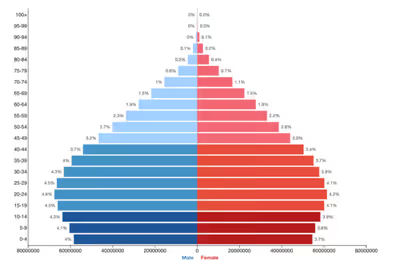
India remains a relatively young country, though it is undergoing a gradual demographic transition. As of 2024, the median age was approximately 29.8 years, compared to 40.2 in China. The United Nations Population Fund (UNFPA) estimates that 68% of the population is between 15 and 64 years old, creating a potential "demographic dividend" where a large working-age population can drive economic growth. However, the number of children is declining; the under-5 population peaked in 2007 and the under-15 cohort peaked in 2011.
Between 1975 and 2010, the population doubled to 1.2 billion. While the population continues to grow, the rate has slowed significantly from 2.3% annually (1972–1983) to roughly 0.89% in 2023. Current projections suggest the population will reach 1.7 billion by 2050.
India is highly diverse, hosting thousands of ethnic groups and four major language families: Indo-European, Dravidian, Austroasiatic, and Tibeto-Burman. The country also includes linguistic isolates such as Nihali and Burushaski, and distinct minority communities including Anglo-Indians and Siddi.
The human sex ratio has shown an upward trend after decades of decline, reaching 943 females per 1,000 males in 2011 and estimated at 1,060 males per 1,000 females (approx. 944 females/1000 males) in 2023.
History
Prehistory to early 19th century
The following table lists estimates for the population of India, including what are now Pakistan and Bangladesh, from prehistory up until 1820. It includes estimates and growth rates according to five economic historians, along with interpolated estimates and overall aggregate averages derived from their estimates.
Population of India over time
India's population has changed significantly due to migrations, technological advancements, and societal developments. Below is a table of historical population estimates:
The population grew from the South Asian Stone Age in 10,000 BC to the Maurya Empire in 200 BC at a steadily increasing growth rate, before population growth slowed down in the classical era up to 500 AD, and then became largely stagnant during the early medieval era up to 1000 AD. The population growth rate then increased in the late medieval era (during the Delhi Sultanate) from 1000 to 1500.
Under the Mughal Empire, India experienced a demographic upsurge, 15% of the population lived in urban centres, higher than the percentage of the population in 19th-century British India and contemporary Europe up until the 19th century. These estimates by Abraham Eraly and Paolo Malanima have been criticised by Tim Dyson, who considers them exaggerations and estimates urbanisation of the Mughal Empire to be less than 9% of the population.
Under the reign of Akbar (reigned 1556–1605) in 1600, the Mughal Empire's urban population was up to 17 million people, larger than the urban population in Europe. By 1700, Mughal India had an urban population of 23 million people, larger than British India's urban population of 22.3 million in 1871. Nizamuddin Ahmad (1551–1621) reported that, under Akbar's reign, Mughal India had 120 large cities and 3,200 townships. A number of cities in India had a population between a quarter-million and half-million people, with larger cities including Agra (in Agra Subah) with up to 800,000 people and Dhaka (in Bengal Subah) with over 1 million people. Mughal India also had a large number of villages, with 455,698 villages by the time of Aurangzeb (reigned 1658–1707).
Late 19th century to early 20th century
The total fertility rate is the number of children born per woman. It is based on fairly good data for the entire years. Sources: Our World in Data and Gapminder Foundation.
Life expectancy from 1881 to 1950
The population of India under the British Raj (including what are now Pakistan and Bangladesh) according to censuses:
Studies of India's population since 1881 have focused on such topics as total population, birth and death rates, geographic distribution, literacy, the rural and urban divide, cities of a million, and the three cities with populations over eight million: Delhi, Greater Mumbai (Bombay), and Kolkata (Calcutta).
Mortality rates fell in the period 1920–45, primarily due to biological immunisation. Suggestions that it was the benefits of colonialism are refuted by academic thinking: "There can be no serious, informed belief... that... late colonial era mortality diminished and population grew rapidly because of improvements in income, living standards, nutrition, environmental standards, sanitation or health policies, nor was there a cultural transformation...".
Sign in to keep reading
8 more chapters are free with a Lably account.
Languages
According to the 2001 census, 41.03% of the Indians spoke Hindi natively, while the rest spoke Assamese, Bengali, Gujarati, Maithili, Kannada, Malayalam, Marathi, Odia, Punjabi, Tamil, Telugu, Urdu and a variety of other languages. There are a total of 122 languages and 234 mother tongues spoken in India. Of these, 22 languages are specified in the Eighth Schedule of Indian Constitution, while 100 are non-specified.
The table below excludes Mao-Maram, Paomata and Purul subdivisions of Senapati District of Manipur state due to cancellation of census results.
Vital statistics
UN estimates
View source data. View source data. View source data. View source data. View source data.
Regional growth
Census of India: Sample Registration System
Life expectancy
Demographic and Health Surveys From the Demographic Health Survey:
Regional vital statistics
Neonatal and infant demographics
The table below represents the infant mortality rate trends in India, based on sex, over the last 15 years. In the urban areas of India, average male infant mortality rates are slightly higher than average female infant mortality rates.
India's 2011 census shows a serious decline in the number of girls under the age of seven – activists posit that eight million female fetuses may have been aborted between 2001 and 2011.
Ethnic groups
The national Census of India does not recognise racial or ethnic groups within India, but recognises many of the tribal groups as Scheduled Castes and Tribes (see list of Scheduled Tribes in India). For a list of ethnic groups in the Republic of India (as well as neighbouring countries), see South Asian ethnic groups. According to a 2009 study published by Reich et al., the modern Indian population is composed of two genetically divergent and heterogeneous populations which mixed in ancient times (about 1,200–3,500 BP), known as Ancestral North Indians (ANI) and Ancestral South Indians (ASI). ANI corresponds to the Indo-Aryan-speaking population of northern India, whereas ASI corresponds to the Dravidian-speaking population of southern India. 700,000 people from the United States of any race live in India. Around 150,000 Anglo-Indian people still live in India. India is a country with a vast diversity of ethnic groups, each with its own distinct culture, language, and traditions. The major ethnic groups in India include the Indo-Aryans, Dravidians, Sino-Tibetans, Austroasiatic peoples, and various indigenous tribes. These groups are spread across different regions of India, each contributing to the country's rich cultural mosaic.
Population size and structure
India occupies 2.41% of the world's land area but supports over 18% of the world's population. At the 2001 census 72.2% of the population lived in about 638,000 villages and the remaining 27.8% lived in more than 5,100 towns and over 380 urban agglomerations. By 2011, the share of the population living in rural areas decreased to 68.84%, while that of those living in urban areas increased to 31.16%. India's population exceeded that of the entire continent of Africa by 200 million people in 2010. However, because Africa's population growth is extremely high compared to the rest of the world, it is expected to surpass both China and India by the early 2030s. Comparative demographics
List of states and union territories by demographics
Literacy rate
Religion
Based on the latest Census Data
Population pyramid by religion
The table below summarises India's demographics (excluding the Mao-Maram, Paomata and Purul subdivisions of Senapati district of Manipur state due to cancellation of census results) according to religion at the 2011 census in per cent. The data are "unadjusted" (without excluding Assam and Jammu and Kashmir); the 1981 census was not conducted in Assam and the 1991 census was not conducted in Jammu and Kashmir.
Caste/tribe
Caste and community statistics as recorded from "Socially and Educationally Backward Classes Commission" (SEBC) or Mandal Commission of 1979, which was completed in 1983.
India has chosen not to officially count caste population since then.
The following data are from the Mandal report:
Largest cities of India
Charts
View source data. View source data. View source data.