


Related on Lably
Through Demography, Population (human biology) and Population density
Turks are the largest ethnic group, comprising 70–75% of the population while Kurds are the second largest with 19%. The others, including Armenians, Arabs, Assyrians, Albanians, Bulgarians, Bosniaks, Circassians, Chechens, Crimean Tatars, Georgians, Greeks, Hemshins, Jews, Laz people, Pomaks, Rum, Russians, Romani and others make 6–11% of the population according to a 2016 estimate by the CIA.
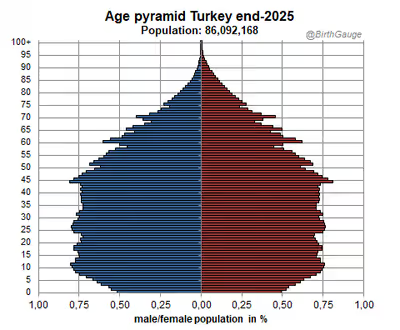
The population has been aging in recent years, with just 20.4% falling in the 0–14 age bracket (down from 26.4% in 2007). The population over the age of 65 is 11.1% (up from 7.1% in 2007). As of 2025, the median age of the Turkish population is 34.9 years (up from 28.3 in 2007). According to OECD/World Bank population statistics, from 1990 to 2008 the population growth in Turkey was 16 million or 29%.
Population
Historical population
Urbanization
According to the CIA World Factbook
- Urban population: 77.5% of total population (2023)
- Rate of urbanization: 1.11% annual rate of change (2020–25 est.)
According to TURKSTAT
- Population of densely populated urban areas: 67.5%
- Population of intermediate density urban areas: 15.8%
- Population of rural areas: 16.8% (2025)
Age structure
Structure of the population
Sign in to keep reading
7 more chapters are free with a Lably account.
Vital statistics
Turkey demographic table
Sources:
View source data. View source data. View source data. View source data.
Current vital statistics
Birth statistics of Turkey from 2001 onward are from the Central Population Administrative System (MERNIS) database which is available online. Birth statistics are updated continually because MERNIS has dynamic structure.
In 2025 Turkey had a crude birth rate of 10.4 per 1000 down from 20.3 in 2001. The total fertility rate (TFR) in 2025 was 1.42 children per woman down from 2.38 in 2001, The crude birth rate in 2025 ranged from 8.2 per 1,000 in West Marmara (TFR 1.25) (6.4;1.23 in 2025), similar to neighbouring Greece, to 18.4 per 1,000 in Southeast Anatolia (TFR 2.34) (23.5; 2.66 in 2025), similar to neighbouring Syria. Similarly, in 2025, the TFR ranged from 1.09 in Bartın, to 3.15 in Şanlıurfa. Death statistics from MERNIS are available as of 2009. Mortality data prior to 2009 are incomplete.
Demographic and health surveys
Fertility Rate (TFR) (Wanted Fertility Rate) and CBR (Crude Birth Rate):
Total fertility rate by region in Turkey by Turkish General Census (GNS) and Turkish population and health research (TNSA).
Fertility rate in Turkey as per GNS (2000) for Rural, Urban and Metropolitan areas.
UN estimates
The 2018 figures from the UN Department of Economic and Social Affairs:
Life expectancy
by regions
Data source: Global Data Lab
Regional data
Birth and death rates
Regional births and deaths
Regional natural increase
Regional median age value
Regional total fertility rate (TFR)
Ethnicity
Modern Turkey was founded by Mustafa Kemal Atatürk as secular (Laiklik, Turkish adaptation of French Laïcité), i.e. without a state religion, or separate ethnic divisions/ identities. The concept of "minorities" has only been accepted by the Republic of Turkey as defined by the Treaty of Lausanne (1923) and thence strictly limited to Greeks, Jews and Armenians, only based on religious affiliation, excluding from the scope of the concept the ethnic identities of these minorities as of others such as the Kurds who make up 15% of the country; others include Assyrians of various Christian denominations, Alevis and all the others. Provisions of the Lausanne Treaty were extended to Bulgarians in Turkey by the Turkey-Bulgaria Friendship Treaty (Türkiye ve Bulgaristan Arasındaki Dostluk Antlaşması) of 18 October 1925. According to the Ministry of Foreign Affairs (Turkey), as of 2008, there were 89,000 Turkish citizens belonging to one of the three recognized minorities, two thirds of Armenian descent. On 18 June 2013, the Ankara 13th Circuit Administrative Court unanimously ruled that the Assyrians were included as beneficiaries of the Lausanne Treaty, so that Assyrians were allowed to open the first school teaching in their mother tongue.
The word Turk or Turkish also has a wider meaning in a historical context because, at times, especially in the past, it has been used to refer to all Muslim inhabitants of the Ottoman Empire irrespective of their ethnicity.
According to the 2016 edition of the CIA World Factbook, 70–75% of Turkey's population consists of Turkish people, with Kurds accounting for 19% and other minorities between 6 and 11%. According to Milliyet, a 2008 report prepared for the National Security Council of Turkey by academics of three Turkish universities in eastern Anatolia suggested that there are approximately 55 million ethnic Turks, 9.6 million Kurds, 3 million Zazas, 2.5 million Circassians, 2 million Bosniaks, 500,000–1.3 million Albanians, 1,000,000 Georgians, 870,000 Arabs, 600,000 Pomaks, 80,000 Laz, 60,000 Armenians, 30,000 British, 25,000 Assyrians, 20,000 Jews, 15,000 Greeks, and 500 Yazidis living in Turkey.
According to a survey published in 2022 by Konda Research, Turks make up 77% of the population, while 19% self-identify as Kurd. Arabs (Syrian refugees included) make up 2%, and other ethnic groups are 2% of the population.
Since the immigration to the big cities in the west of Turkey, interethnic marriage has become more common. A recent study estimates that there are 2,708,000 marriages between Turks and Kurds.
According to a survey done in March 2020 by Area Araştırma, 20.4% of the total population of Turkey claim to be Kurdish (either Kurmanji speaking or Zazaki speaking).
Ethnolinguistic estimates in 2014 by Ethnologue and Jacques Leclerc:
Historical controversy
Ethnodemography in Turkey is politically contentious in significant part because demographic knowledge became historically entangled with the creation of the modern nation-state. Population statistics were used not only to describe communities but also to determine political representation, territorial claims, assimilation policy, deportation, and, in the Armenian case, genocidal demographic transformation.
The Turkish government has stated that it "does not collect, maintain or use either qualitative or quantitative data on ethnicity", explaining that it emphasizes commonalities rather than "measuring differences and making policies thereon". The UN Committee on the Elimination of Racial Discrimination (CERD) has expressed concern about the resulting lack of statistical data, while recording Turkey's position that constitutional principles prevent the state from identifying ethnic groups in censuses.
European anti-discrimination reports describe similar restrictions. A 2022 report for the European Commission states that official ethnic data are no longer publicly available and describes their collection as de jure prohibited, citing a Ministry of the Interior circular restricting public institutions from producing statistics on race and ethnicity. An Istanbul Bilgi University report likewise states that a Ministry circular issued in the 1990s prohibited the State Institute of Statistics from collecting statistics based on region and ethnic origin. ECRI reported in 2025 that the precise number of Roma remains unknown because Turkish authorities do not collect ethnicity-based population statistics, and recommended equality-data collection based on informed consent, self-identification, and confidentiality. ECRI had already reported in 2011 that Turkey lacked a "coherent, comprehensive system of data collection" concerning minority groups and discrimination.
Historical scholarship places this sensitivity within a longer history of population policy. Historian Fuat Dündar argues that the census "is itself a political activity, subjective in nature", because decisions about which identities are measured and how they are classified are connected to state power. In the late Ottoman Armenian case, population ratios were tied to questions of political representation, reform, and territory. Dündar characterizes the statistical work surrounding the Armenian Question as "ethnic engineering" which eventually became "the reason, as well as the vehicle" for Young Turk policy.
Taner Akçam similarly places demographic policy at the center of the Armenian genocide. He argues that the demographic restructuring of Anatolia and fear of the 1914 Armenian reforms were intertwined, and that policies restricting dispersed minority populations to approximately five to ten percent of local populations "laid the groundwork" for genocide. He argues that these numerical ceilings could ultimately be achieved only through destruction, and concludes that Ottoman records demonstrate that "the genocide was implemented as a demographic policy".
The political character of demographic measurement during the Ottoman Empire continued during the establishment of the Republic of Turkey. Dündar argues that early Republican censuses sought to establish the "real number of Turks in Turkey" and that the 1927 census, which found a substantial non-Turkophone population, was followed by campaigns of linguistic assimilation such as "Citizen, Speak Turkish!" Linguistic data from the 1970, 1975, 1980, and 1985 censuses were not published, and Dündar argues that the state ceased publication as such information became politically useful to minority movements. A Library of Congress country study similarly states that Kurds were statistically obscured under categories such as "Mountain Turks" and reports that officials were prosecuted after preparing instructions allowing Kurdish to be recorded in the 1985 census.
The issue also intersects with historical memory and genocide denial. Fatma Müge Göçek describes a "Republican Defensive Narrative" that explicitly denies the Armenian genocide and contrasts it with scholarship concerned with silences in Turkish history and the country's ethnic composition. Üngör similarly describes a conflict of collective memory in which "Armenians wish to remember a history that Turks would like to forget".
The European Court of Human Rights has also documented the sensitivity of public discussion of 1915. In Altuğ Taner Akçam v. Turkey, the Court found that Turkish case law could expose persons expressing "unfavourable" views about the Armenian question to a "considerable risk of prosecution", producing a chilling effect on freedom of expression. ECRI likewise reported that peaceful minority identities could be perceived as threats to state unity and noted the sensitivity of political statements concerning Armenian genocide claims.
Languages
No exact data are available concerning the different ethnic groups in Turkey. The last census data according to language date from 1965 and major changes may have occurred since then. However, it is clear that the Turkish are in the majority, while the largest minority groups are Kurds and Arabs. Smaller minorities are the Armenians, Greeks and others.
A possible list of ethnic groups living in Turkey could be as follows:
- Turkic-speaking peoples: Turks, Azerbaijanis, Volga Tatars, Karachays, Uzbeks, Crimean Tatars, Kyrgyzs and Uyghurs
- Indo-European-speaking peoples: Kurds, Zazas, Bosniaks, Albanians, Pomaks, Ossetians, Armenians, Roma, Megleno-Romanians, Hamshenis, Goranis and Greeks
- Semitic-speaking peoples: Arabs, and Assyrians
- Caucasian-speaking peoples: Circassians, Georgians, Lazs and Chechens
- Ethnoreligious with different languages (e.g. Ladino): Jews
Religion
Turkey has officially been a secular country since its 1924 constitution was amended in 1928. This was later strengthened and entrenched with the wider appliance of laicism by founder Atatürk during the mid-1930s, as part of the Republican reforms.
There are no official statistics of people's religious beliefs nor is it asked in the census. According to the United States Department of State's International Religious Freedom Report 2008, the Turkish government considers 99 percent of the population is Muslim, the majority of which is Hanafi Sunni. A similar figure can be found in the current US Central Intelligence Agency (CIA) the World Factbook (99.8%). The remaining 0.2% is other – mostly Christians and Jews. However, these are based on the existing religion information written on every citizen's national ID card, that is automatically passed on from the parents to every newborn, and do not necessarily represent individual choice. Religious records can be changed or even blanked on the request of citizen, by filing an e-government application since May 2020, using a valid electronic signature to sign the electronic application. Any change in religion records additionally results in a new ID card being issued. Any change in religion record also leaves a permanent trail in the census record, however, record of change of religion is not accessible except for the citizen in question, next-of-kins of the citizen in question, the citizenship administration and courts.
In 2023, according to Ipsos, 83% are Muslim, 12% have no religion, 2% prefer not to say, 2% are Christian and 2% are other religions. In a similar survey in 2016, Islam comprised 82% of the total population, followed by 7% no religion, 6% Spiritual but not religious, 2% Christian, 1% Buddhist and 1% other.
In 2018, a poll conducted by Eurobarometer and KONDA Research and Consultancy and some other research institutes showed that 3% of those interviewed had no religion. In 2013, the same institutions showed that around 0.5% of the population had no religion.
Between 8 million and 20 million Turks are Alevis.
In 2006, in a poll conducted by Sabancı University, 98.3% of Turks revealed they were Muslim. In 2005, a Eurobarometer poll on Europeans views on ethics in science and technology reported 95% of Turkish citizens answered that "they believe there is a God", while about 2% responded "I believe there is some sort of spirit or life force", about 1% that "they do not believe there is any sort of spirit, God, or life force" and about 1% "DK" (that they don't know). Similar figures were found in some other European countries.
There is concern over the future of the Greek Orthodox Patriarchate, which suffers from a lack of trained clergy due to the closure of the Halki seminary. The state does not recognise the Ecumenical status of the Patriarch of Constantinople.
The percentage of non-Muslims in Turkey fell from 19.1% in 1914 to 2.5% percent in 1927. The drop was the result of the late Ottoman genocides, the population exchange between Greece and Turkey and the emigration of Christians. The 1942 Wealth Tax on non-Muslims, the emigration of many of Turkish Jews to Israel after 1948, and the 1955 Istanbul pogrom further contributed to the decline of Turkey's non-Muslim population.
Religiosity
In 2018, according to a KONDA survey, the religiosity was the following:
- 51% defined themselves as "a religious person who strives to fulfill religious obligations" (Religious)
- 34% defined themselves as "a believer who does not fulfill religious obligations" (Not religious).
- 10% defined themselves as "a fully devout person fulfilling all religious obligations" (Fully devout).
- 2% defined themselves as "someone who does not believe in religious obligations" (Non-believer).
- 3% defined themselves as "someone with no religious conviction" (Atheist).
Among those aged between 15 and 29 years old:
- 43% defined themselves as "a religious person who strives to fulfill religious obligations" (Religious)
- 45% defined themselves as "a believer who does not fulfill religious obligations" (Not religious).
- 5% defined themselves as "a fully devout person fulfilling all religious obligations" (Fully devout).
- 4% defined themselves as "someone who does not believe in religious obligations" (Non-believer).
- 4% defined themselves as "someone with no religious conviction" (Atheist).
According to the 2007 KONDA survey:
- 52.8% defined themselves as "a religious person who strives to fulfill religious obligations" (Religious)
- 34.3 % defined themselves as "a believer who does not fulfill religious obligations" (Not religious).
- 9.7% defined themselves as "a fully devout person fulfilling all religious obligations" (Fully devout).
- 2.3% defined themselves as "someone who does not believe in religious obligations" (Non-believer).
- 0.9% defined themselves as "someone with no religious conviction" (Atheist).
In a 2006 Pew Research Center survey, 69% of Turkey's Muslims said that "religion is very important in their lives". Based on the Gallup Poll 2006–08, Turkey was defined as More religious, in which over 63 percent of people believe religion is important.
Around 2007, according to the Turkish Economic and Social Studies Foundation, 62% of women wore the headscarf or hijab in Turkey.
Headscarf
The survey reported that 44.5% of women who lived in metropolitan areas wore the headscarf, increasing to 62.8% in towns and 74.1% in the countryside. There was also an increase in the percentage of women wearing headscarves going from west to east across the country.
Migration
Immigration
Immigration to Turkey is the process by which people migrate to Turkey to reside in the country. After the dissolution of the Ottoman Empire following Turkish War of Independence, and The 1923 Population exchange between Greece and Turkey, exodus by the large portion of Turkish (Turkic) and Muslim peoples from the Balkans (Balkan Turks, Albanians, Bosniaks, Pomaks), Caucasus (Abkhazians, Ajarians, Circassians, Chechens, Lezgins), Crimea (Crimean Tatar diaspora), and Crete (Cretan Turks) took refuge in present-day Turkey and moulded the country's fundamental features. Trends of immigration towards Turkey continue to this day, although the motives are more varied and are usually in line with the patterns of global immigration movements — Turkey, for example, receives many economic migrants from nearby countries such as Armenia, Moldova, Georgia, Iran, and Azerbaijan, but also from Central Asia, Ukraine and Russia. Turkey's migrant crisis during the 2010s saw high numbers of people arriving in Turkey, particularly those fleeing the Syrian civil war.
In 2022, nearly 100,000 Russian citizens migrated to Turkey, becoming the first in the list of foreigners who moved to Turkey, meaning an increase of more than 218% from 2021.
In order to obtain Turkish citizenship there is a range of legal grounds, which can include: reunification with their family, marriage to a Turkish citizen, for the purchase of real estate worth $400,000 from a Turkish citizen or company. The minimum investment amount was increased in May 2022, previously it was enough to invest $250,000. Also the basis is to work in Turkey, training, business, medical treatment, refugee status. More than 240,000 Syrian citizens acquired Turkish citizenship since 2011.
Population in Turkey by country of citizenship at the end of each years:
Net migration
Internal migration
Government initiatives
Turkish president Recep Tayyip Erdoğan has long been vocal about his desire for Turks to have more children. He has urged people to have at least four or five children. Turkey's birthrate peaked in 2014 and has since fallen below the replacement level of 2.1, reaching an all-time low of 1.42 in 2025. Demographers attribute this decline to the common, worldwide factors of urbanization, changing lifestyles, and the increased access to higher education, especially for women and phones. They also cite the ongoing Turkish economic crisis, which has caused persistently high inflation and low wages, as a reason for the decline because these factors make housing, childcare, and other necessities difficult to afford.
In an effort to reverse the declining fertility rate, the Turkish government declared 2025 the "Year of the Family", and the subsequent decade the "Decade of Family and Population". As part of this initiative, the government has extended parental leave for mothers and fathers, introduced payments for families with new children, and offered interest-free loans to young couples. However, parents have found these supports to be inadequate. For example, one mother noted that the monthly stipend only covers the cost of diapers. Demographers have also questioned the effectiveness of these initiatives, noting that younger generations prefer the ideal of one child and two incomes. Erdoğan's push for women to have more children stems from his conservative Islamic vision for Turkish society. He has also said that for women, "Career is having children".