


Related on Lably
Through Euler's totient function, Root of unity and Prime number
- 1. that is, is completely multiplicative.
- 2. .
- 3. ; that is, is periodic with period .
The simplest possible character, called the principal character and usually denoted , exists for all moduli:
Dirichlet characters were named after German mathematician Peter Gustav Lejeune Dirichlet, who introduced these functions in his 1837 paper on primes in arithmetic progressions. They are a prominent example of the general idea of a character in mathematics.
Notation
is a complex primitive n-th root of unity:
- but
is the group of units mod . It has order
is the group of Dirichlet characters mod .
etc. are prime numbers.
is a standard abbreviation for
etc. are Dirichlet characters. (the lowercase Greek letter chi for "character")
There is no standard notation for Dirichlet characters that includes the modulus. In many contexts (such as in the proof of Dirichlet's theorem) the modulus is fixed. In other contexts, such as this article, characters of different moduli appear. Where appropriate this article employs a variation of Conrey labeling (introduced by Brian Conrey and used by the LMFDB).
In this labeling characters for modulus are denoted where the index is described in the section the group of characters below. In this labeling, denotes an unspecified character and denotes the principal character mod .
Sign in to keep reading
8 more chapters are free with a Lably account.
Relation to group characters
The word "character" is used several ways in mathematics. In this section it refers to a homomorphism from a group (written multiplicatively) to the multiplicative group of the field of complex numbers:
The set of characters is denoted If the product of two characters is defined by pointwise multiplication the identity by the trivial character and the inverse by complex inversion then becomes an abelian group.
If is a finite abelian group then there is an isomorphism , and the orthogonality relations:
- and
The elements of the finite abelian group are the residue classes where
A group character can be extended to a Dirichlet character by defining
and conversely, a Dirichlet character mod defines a group character on
Paraphrasing Davenport, Dirichlet characters can be regarded as a particular case of Abelian group characters. But this article follows Dirichlet in giving a direct and constructive account of them. This is partly for historical reasons, in that Dirichlet's work preceded by several decades the development of group theory, and partly for a mathematical reason, namely that the group in question has a simple and interesting structure which is obscured if one treats it as one treats the general Abelian group.
Elementary facts
4) Since property 2) says so it can be canceled from both sides of :
5) Property 3) is equivalent to
- if then
6) Property 1) implies that, for any positive integer
7) Euler's theorem states that if then Therefore,
That is, the nonzero values of are -th roots of unity:
for some integer which depends on and . This implies there are only a finite number of characters for a given modulus.
8) If and are two characters for the same modulus so is their product defined by pointwise multiplication:
- ( obviously satisfies 1-3).
The principal character is an identity:
9) Let denote the inverse of in . Then
- so which extends 6) to all integers.
The complex conjugate of a root of unity is also its inverse (see here for details), so for
- ( also obviously satisfies 1-3).
Thus for all integers
- in other words .
10) The multiplication and identity defined in 8) and the inversion defined in 9) turn the set of Dirichlet characters for a given modulus into a finite abelian group.
The group of characters
There are three different cases because the groups have different structures depending on whether is a power of 2, a power of an odd prime, or the product of prime powers.
Powers of odd primes
If is an odd number is cyclic of order ; a generator is called a primitive root mod . Let be a primitive root and for define the function (the index of ) by
For if and only if Since
- is determined by its value at
Let be a primitive -th root of unity. From property 7) above the possible values of are These distinct values give rise to Dirichlet characters mod For define as
Then for and all and
- showing that is a character and
- which gives an explicit isomorphism
Examples m = 3, 5, 7, 9
2 is a primitive root mod 3. ()
so the values of are
- .
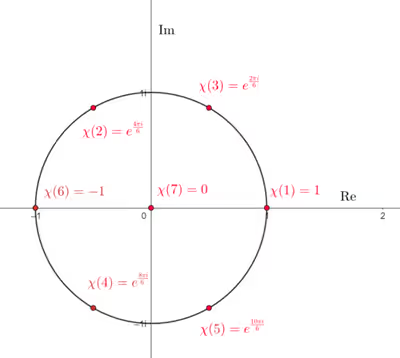
The nonzero values of the characters mod 3 are
2 is a primitive root mod 5. ()
so the values of are
- .
The nonzero values of the characters mod 5 are
3 is a primitive root mod 7. ()
so the values of are
- .
The nonzero values of the characters mod 7 are ()
- .
2 is a primitive root mod 9. ()
so the values of are
- .
The nonzero values of the characters mod 9 are ()
- .
Powers of 2
is the trivial group with one element. is cyclic of order 2. For 8, 16, and higher powers of 2, there is no primitive root; the powers of 5 are the units and their negatives are the units For example
Let ; then is the direct product of a cyclic group of order 2 (generated by −1) and a cyclic group of order (generated by 5). For odd numbers define the functions and by
For odd and if and only if and For odd the value of is determined by the values of and
Let be a primitive -th root of unity. The possible values of are These distinct values give rise to Dirichlet characters mod For odd define by
Then for odd and and all and
- showing that is a character and
- showing that
Examples m = 2, 4, 8, 16
The only character mod 2 is the principal character .
−1 is a primitive root mod 4 ()
The nonzero values of the characters mod 4 are
−1 is and 5 generate the units mod 8 ()
- .
The nonzero values of the characters mod 8 are
−1 and 5 generate the units mod 16 ()
- .
The nonzero values of the characters mod 16 are
- .
Products of prime powers
Let where be the factorization of into prime powers. The group of units mod is isomorphic to the direct product of the groups mod the :
This means that 1) there is a one-to-one correspondence between and -tuples where and 2) multiplication mod corresponds to coordinate-wise multiplication of -tuples:
- corresponds to
- where
The Chinese remainder theorem (CRT) implies that the are simply
There are subgroups such that
- and
Then and every corresponds to a -tuple where and Every can be uniquely factored as
If is a character mod on the subgroup it must be identical to some mod Then
showing that every character mod is the product of characters mod the .
For define
Then for and all and
- showing that is a character and
- showing an isomorphism
Examples m = 15, 24, 40
The factorization of the characters mod 15 is
The nonzero values of the characters mod 15 are
- .
The factorization of the characters mod 24 is
The nonzero values of the characters mod 24 are
- .
The factorization of the characters mod 40 is
The nonzero values of the characters mod 40 are
- .
Summary
Let , be the factorization of and assume
There are Dirichlet characters mod They are denoted by where is equivalent to The identity is an isomorphism
Each character mod has a unique factorization as the product of characters mod the prime powers dividing :
If the product is a character where is given by and
Also,
Orthogonality
The two orthogonality relations are
- and
The relations can be written in the symmetric form
- and
The first relation is easy to prove: If there are non-zero summands each equal to 1. If there is some Then
- implying
- Dividing by the first factor gives QED. The identity for shows that the relations are equivalent to each other.
The second relation can be proven directly in the same way, but requires a lemma
- Given there is a
The second relation has an important corollary: if define the function
- Then
That is the indicator function of the residue class . It is basic in the proof of Dirichlet's theorem.
Classification of characters
Conductor; Primitive and induced characters
Any character mod a prime power is also a character mod every larger power. For example, mod 16
has period 16, but has period 8 and has period 4: and
We say that a character of modulus has a quasiperiod of if for all , coprime to satisfying mod . For example, , the only Dirichlet character of modulus , has a quasiperiod of , but not a period of (it has a period of , though). The smallest positive integer for which is quasiperiodic is the conductor of . So, for instance, has a conductor of .
The conductor of is 16, the conductor of is 8 and that of and is 4. If the modulus and conductor are equal the character is primitive, otherwise imprimitive. An imprimitive character is induced by the character for the smallest modulus: is induced from and and are induced from .
A related phenomenon can happen with a character mod the product of primes; its nonzero values may be periodic with a smaller period.
For example, mod 15,
- .
The nonzero values of have period 15, but those of have period 3 and those of have period 5. This is easier to see by juxtaposing them with characters mod 3 and 5:
- .
If a character mod is defined as
- , or equivalently as
its nonzero values are determined by the character mod and have period .
The smallest period of the nonzero values is the conductor of the character. For example, the conductor of is 15, the conductor of is 3, and that of is 5.
As in the prime-power case, if the conductor equals the modulus the character is primitive, otherwise imprimitive. If imprimitive it is induced from the character with the smaller modulus. For example, is induced from and is induced from
The principal character is not primitive.
The character is primitive if and only if each of the factors is primitive.
Primitive characters often simplify (or make possible) formulas in the theories of L-functions and modular forms.
Parity
is even if and is odd if
This distinction appears in the functional equation of the Dirichlet L-function.
Order
The order of a character is its order as an element of the group , i.e. the smallest positive integer such that Because of the isomorphism the order of is the same as the order of in The principal character has order 1; other real characters have order 2, and imaginary characters have order 3 or greater. By Lagrange's theorem the order of a character divides the order of which is
Real characters
is real or quadratic if all of its values are real (they must be ); otherwise it is complex or imaginary.
is real if and only if ; is real if and only if ; in particular, is real and non-principal.
Dirichlet's original proof that (which was only valid for prime moduli) took two different forms depending on whether was real or not. His later proof, valid for all moduli, was based on his class number formula.
Real characters are Kronecker symbols; for example, the principal character can be written .
The real characters in the examples are:
Principal
If the principal character is
Primitive
If the modulus is the absolute value of a fundamental discriminant there is a real primitive character (there are two if the modulus is a multiple of 8); otherwise if there are any primitive characters they are imaginary.
Imprimitive
Applications
L-functions
The Dirichlet L-series for a character is
This series converges absolutely for . If the character is non-principal then furthermore it converges (but not absolutely) for and it can be analytically continued to an entire function, defined and differentiable on the whole complex plane. If the character is principal then the series it converges only for ; in this case, it can be analytically continued to a meromorphic function with simple pole at .
Dirichlet introduced the -function along with the characters in his 1837 paper.
Modular forms and functions
Dirichlet characters appear several places in the theory of modular forms and functions. A typical example is
Let and let be primitive.
If
define
- ,
Then
- . If is a cusp form so is
See theta series of a Dirichlet character for another example.
Gauss sum
The Gauss sum of a Dirichlet character modulo N is
It appears in the functional equation of the Dirichlet L-function.
Jacobi sum
If and are Dirichlet characters mod a prime their Jacobi sum is
Jacobi sums can be factored into products of Gauss sums.
Kloosterman sum
If is a Dirichlet character mod and the Kloosterman sum is defined as
If it is a Gauss sum.
Sufficient conditions
It is not necessary to establish the defining properties 1) – 3) to show that a function is a Dirichlet character.
From Davenport's book
If such that
- 1)
- 2) ,
- 3) If then , but
- 4) is not always 0,
then is one of the characters mod
Sárközy's Condition
A Dirichlet character is a completely multiplicative function that satisfies a linear recurrence relation: that is, if
for all positive integers , where are not all zero and are distinct then is a Dirichlet character.
Chudakov's Condition
A Dirichlet character is a completely multiplicative function satisfying the following three properties: a) takes only finitely many values; b) vanishes at only finitely many primes; c) there is an for which the remainder
is uniformly bounded, as . This equivalent definition of Dirichlet characters was conjectured by Chudakov in 1956, and proved in 2017 by Klurman and Mangerel.
Some notable special moduli
- 8, the smallest modulus whose Dirichlet characters need more than one generator.
- 13, the smallest modulus whose Dirichlet characters contain numbers such that there is no primes p in which are still primes in .
- 19, the smallest modulus whose Dirichlet characters contain numbers whose real and imaginary parts are not constructible numbers.
- 24, the largest modulus whose Dirichlet characters are all real (the Dirichlet characters of the number n are all real if and only if n is divisor of 24).
- 47, the smallest modulus whose Dirichlet characters contain numbers such that the class number of the cyclotomic field is greater than 1.
- 120, the smallest modulus whose Dirichlet characters need more than three generators.
- 149, the smallest modulus whose Dirichlet characters contain numbers such that the full class number of the cyclotomic field is not coprime to the smallest number such that (related to irregular prime).
- 240, the largest modulus whose Dirichlet characters are all Gaussian integers (the Dirichlet characters of the number n are all Gaussian integers if and only if n is divisor of 240).
- 383, the smallest modulus whose Dirichlet characters contain numbers such that the class number of the cyclotomic field is greater than 1.
- 504, the largest modulus whose Dirichlet characters are all Eisenstein integers (the Dirichlet characters of the number n are all Eisenstein integers if and only if n is divisor of 504).
- 840, the smallest modulus whose Dirichlet characters need more than four generators.