


Related on Lably
Taxonomy
The family Emberizidae was formerly much larger and included the species now placed in the Passerellidae (New World sparrows) and Calcariidae (longspurs and snow buntings). Molecular phylogenetic studies found that the large family consisted of distinct clades that were better treated as separate families.
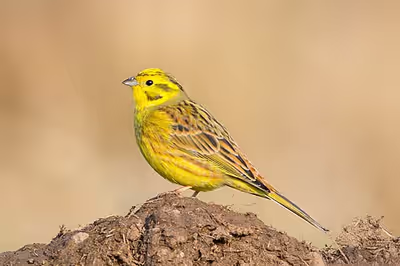
The genus Emberiza is now the only genus placed in the family Emberizidae. The genus was introduced by the Swedish naturalist Carl Linnaeus in 1758 in the tenth edition of his Systema Naturae. The type species was subsequently designated as the yellowhammer (Emberiza citrinella). The genus name Emberiza is from Old German Embritz, a bunting. The origin of the English "bunting" is unknown. Species in the New World genus Passerina include the word "bunting" in their common names, but are now classed in the family Cardinalidae.
A 2008 genetic study found that three emberizid species that were placed in their own monotypic genera clustered within the Emberiza. These were the crested bunting (Melophus lathami), the slaty bunting (Latouchiornis siemsseni), and the corn bunting (Miliaria calandra). All three species are now included in the genus Emberiza.
A large DNA-based study of the passerines published in 2019 found that the buntings are most closely related to the longspurs and snow buntings in the family Calcariidae.
Ornithologists Edward Dickinson and Leslie Christidis in the fourth edition of the Howard and Moore Complete Checklist of the Birds of the World chose to split up Emberiza and recognise the genera Fringillaria, Melophus, Granativora, Emberiza, and Schoeniclus. Their example has not been followed by the online version of the Handbook of the Birds of the World nor by Frank Gill and David Donsker in the list of world birds that they maintain on behalf of the International Ornithologists' Union. The British Ornithologists' Union has argued that splitting the genus provides little benefit and destabilizes the nomenclature.
A comprehensive 2021 genetic study that incorporated DNA samples of all but two Emberiza species found that the genus' ancestor came from the New World, from where it colonised eastern Asia via the Bering Strait during the late Miocene. From there, the genus then radiated into four clades. This radiation was linked to a global cooling event that led to a reduction of forest cover and the expansion of open habitats, including grasslands, to which the Emberiza buntings adapted. Clade I is primarily African and includes mostly resident species such as the golden-breasted bunting, the Cape bunting, and the house bunting. The next clade to diverge — Clade II — is strongly migratory, and adapted to open taiga forests. This clade includes the yellow-breasted and the little bunting, but also the common reed bunting and Pallas's reed bunting, which breed near standing water. Clade III is the smallest, comprising three species, and is found in arid regions of South Asia; it includes the crested bunting, the red-headed bunting and the black-headed bunting. Clade IV comprises sedentary, partially migratory and strongly migratory species, most of which are adapted to drylands and shrublands. Examples include the yellowhammer, the corn bunting, the meadow bunting, and the ortolan bunting.
The cladogram below is based on a study published in 2021. The phylogenetic relationships of two African species, the brown-rumped bunting (Emberiza affinis) and Vincent's bunting (Emberiza vincenti), were not determined.
Sign in to keep reading
One more chapter is free with a Lably account.
List of species
The genus contains 44 species.
Extinct species have been described:
- † Long-legged bunting (Emberiza alcoveri) (Late Quaternary)
- † Emberiza shaamarica (Late Pliocene of Central Asia)
- † Emberiza polgardiensis (Upper Miocene of Hungary)
- † Emberiza media (Pliocene of Hungary)
- † Emberiza parva (Pliocene of Hungary)
- †Emberiza gaspariskii (Pliocene of Hungary)
- †Emberiza bartoki (Middle Miocene of Hungary) (Nomen dubium)
Emberiza pannonica from the upper Miocene of Hungary is also referred to this genus, but was later found to be a member of Muscicapidae.