

Ensis
Genus of bivalves
- 1 min read
- 3 chapters

Explore on Lably
ToursExplore Lably’s 3D toursDescription
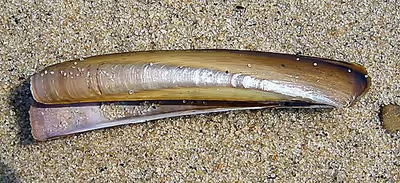
The shells are long, narrow, and parallel-sided. This shape resembles a closed, old-fashioned straight razor (a cut-throat razor), or a closed jackknife (pocket knife) and sometimes these clams are known as razor shells or jackknives. The shells in these species are fragile and can easily be damaged when digging for these clams.
Sign in to keep reading
2 more chapters are free with a Lably account.
Ecology
Ensis species live in clean sand on exposed beaches. They are capable of digging very rapidly; see the description under the Atlantic jackknife clam. Some clammers catch jackknives by pouring salt on the characteristic keyhole-shaped breathing holes. The clam then tries to escape the salt by coming up out of its hole, and at this point it is possible to gently grab the shell and pull it out of the ground.
Species
Thirteen species are currently recognised:
- Ensis californicus (Dall, 1899)
- Ensis directus (Conrad, 1843) – Atlantic jackknife clam
- Ensis ensis (Linnaeus, 1758)
- Ensis goreensis (Clessin, 1888)
- Ensis macha (Molina, 1782)
- Ensis magnus (Schumacher, 1817)
- Ensis megistus (Pilsbry & McGinty, 1943)
- Ensis minor (Chenu, 1843)
- Ensis myrae (Berry, 1954)
- Ensis nitidus (Clessin, 1888)
- Ensis siliqua (Linnaeus, 1758) – pod razor
- Ensis terranovensis (Vierna & Martínez-Lage, 2012)
- Ensis tropicalis (Hertlein & Strong, 1955)