

Exocrine gland
Gland that secretes substances onto an epithelial surface by way of a duct
- 2 min read
- 2 chapters
- 2 labs on Lably

Learn it on Lably
Classification
Structure
Exocrine glands contain a glandular portion and a duct portion, the structures of which can be used to classify the gland.
- The duct portion may be branched (called compound) or unbranched (called simple).
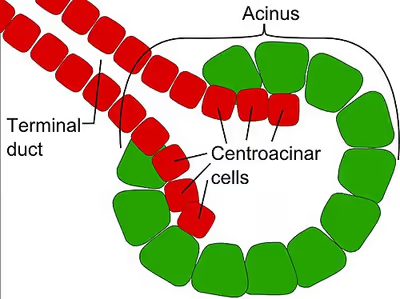
- The glandular portion may be tubular or acinar, or may be a mix of the two (called tubuloacinar). If the glandular portion branches, then the gland is called a branched gland.
Method of secretion
Depending on how their products are secreted, exocrine glands are categorized as merocrine, apocrine, or holocrine.
- Merocrine – the cells of the gland excrete their substances by exocytosis into a duct; for example, pancreatic acinar cells, eccrine sweat glands, salivary glands, goblet cells, intestinal glands, tear glands, etc.
- Apocrine – the apical portion of the cytoplasm in the cell membrane, which contains the excretion, buds off. Examples are sweat glands of arm pits, pubic region, skin around anus, lips and nipples; mammary glands, etc.
- Holocrine – the entire cell disintegrates to excrete its substance; for example, sebaceous glands of the skin and nose, meibomian gland, zeis gland, etc.
Product secreted
- Serous cells secrete proteins, often enzymes. Examples include gastric chief cells and Paneth cells
- Mucous cells secrete mucus. Examples include Brunner's glands, esophageal glands, and pyloric glands
- Seromucous glands (mixed) secrete both protein and mucus. Examples include the salivary glands: although the parotid gland (saliva secretion 25%) is predominantly serous, the sublingual gland (saliva secretion 5%) mainly mucous gland, and the submandibular gland (saliva secretion 70%) is a mixed, mainly serous gland.
- Sebaceous glands secrete sebum, a lipid product. These glands are also known as oil glands, e.g. Fordyce spots and Meibomian glands.
Sign in to keep reading
One more chapter is free with a Lably account.
Additional images
More in Biology
GenusTaxonomic rank above species and below familyFamily (taxonomy)Taxonomic rank between genus and orderEndemismState of species being unique to a locationCladeGroup of a common ancestor and all of their descendantsGenomeAll genetic material of an organismOrder (taxonomy)Taxonomic rank between class and family