

Fibonacci
Italian mathematician (c. 1170 – c. 1240/50)
- 3 min read
- 4 chapters
- 1 lab on Lably

Learn it on Lably
The name he is commonly called, Fibonacci, is first found in a modern source in a 1838 text by the Franco-Italian mathematician Guglielmo Libri and is short for filius Bonacci ('son of Bonacci'). However, even as early as 1506, Perizolo, a notary of the Holy Roman Empire, mentions him as "Lionardo Fibonacci".
Fibonacci popularized the Indo–Arabic numeral system in the Western world primarily through his composition in 1202 of Liber Abaci (Book of Calculation) and also introduced Europe to the sequence of Fibonacci numbers, which he used as an example in Liber Abaci.
Biography
Fibonacci was born around 1170 to Guglielmo, an Italian merchant and customs official who directed a trading post in Bugia, modern-day Béjaïa, Algeria. Fibonacci travelled with him as a young boy. He was educated in Bugia, where he learned about the Hindu–Arabic numeral system.
Fibonacci travelled around the Mediterranean coast, meeting with many merchants and learning about their systems of doing arithmetic. He soon realised the many advantages of the Hindu-Arabic system, which, unlike the Roman numerals used at the time, allowed easy calculation using a place-value system. In 1202, he completed the Liber Abaci (Book of Abacus or The Book of Calculation), which popularized Hindu–Arabic numerals in Europe.
Fibonacci was a guest of Emperor Frederick II, who enjoyed mathematics and science. A member of Frederick II's court, John of Palermo, posed several questions based on Arab mathematical works for Fibonacci to solve. In 1240, the Republic of Pisa honored Fibonacci (referred to as Leonardo Bigollo) by granting him a salary in a decree that recognized him for the services that he had given to the city as an advisor on matters of accounting and instruction to citizens.
Fibonacci is thought to have died between 1240 and 1250, in Pisa.
Sign in to keep reading
3 more chapters are free with a Lably account.
Liber Abaci
In the Liber Abaci (1202), Fibonacci introduced the so-called modus Indorum (method of the Indians), today known as the Hindu–Arabic numeral system, with ten digits including a zero and positional notation. The book showed the practical use and value of this by applying the numerals to commercial bookkeeping, converting weights and measures, calculation of interest, money-changing, and other applications. The book was well-received throughout educated Europe and had a profound influence on European thought. Replacing Roman numerals, its ancient Egyptian multiplication method, and using an abacus for calculations, was an advance in making business calculations easier and faster, which assisted the growth of banking and accounting in Europe.
The original 1202 manuscript is not known to exist. In a 1228 copy of the manuscript, the first section introduces the numeral system and compares it with others, such as Roman numerals, and methods to convert numbers to it. The second section explains uses in business, for example converting different currencies, and calculating profit and interest, which were important to the growing banking industry. The book also discusses irrational numbers and prime numbers.
Fibonacci sequence
Liber Abaci posed and solved a problem involving the growth of a population of rabbits based on idealized assumptions. The solution, generation by generation, was a sequence of numbers later known as Fibonacci numbers. Although Fibonacci's Liber Abaci contains the earliest known description of the sequence outside of India, the sequence had been described by Indian mathematicians as early as the sixth century.
In the Fibonacci sequence, each number is the sum of the previous two numbers. Fibonacci omitted the "0" and first "1" included today and began the sequence with 1, 2, 3, ... . He carried the calculation up to the thirteenth place, the value 233, though another manuscript carries it to the next place, the value 377. Fibonacci did not speak about the golden ratio as the limit of the ratio of consecutive numbers in this sequence.
Legacy
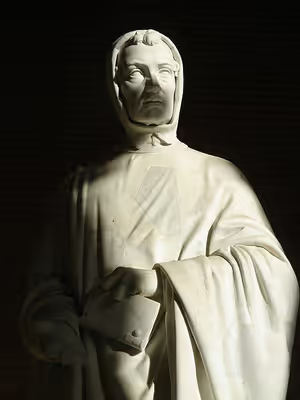
In the 19th century, a statue of Fibonacci was set in Pisa. Today it is located in the western gallery of the Camposanto, historical cemetery on the Piazza dei Miracoli.
There are many mathematical concepts named after Fibonacci because of a connection to the Fibonacci numbers. Examples include the Brahmagupta–Fibonacci identity, the Fibonacci search technique, and the Pisano period. Beyond mathematics, namesakes of Fibonacci include the asteroid 6765 Fibonacci and the art rock band The Fibonaccis.