

Freight transport
Physical process of transporting commodities and merchandise goods and cargo
- 5 min read
- 5 chapters

Learn it on Lably
History
Prehistoric era
Initial human civilization relied heavily on domesticated animals, such as horses, camels, and donkeys, to transport their goods. The invention of the wheel in Mesopotamia in 5000 B.C.E improved this efficiency by allowing for carts and carriages to be created, which animals could pull.
Water transport also developed, with a terra-cotta model of a boat from the Ubaid period, circa 4000 BCE, providing some of the earliest evidence for sailboats.
Classical era
Romans
The Romans built a vast network of roads, which facilitated trade across the numerous cities in its empire.
Silk Road
Transport along the silk road, a land-based route, was generally done through caravans, equipped with camels that would carry goods. It was uncommon for traders to traverse the entirety of the silk road - they would pass on their goods to other traders along different legs of the journey.
While silk flowed westward from China, other goods such as wools, gold, and silver were transported east from the West.
Medieval period
Modern period
Industrial Revolution
Freight transport in the UK was shaped significantly by the Industrial Revolution. The midlands of England saw a sophisticated canal system, which allowed freight to be transported easily over long distances. Additionally, railway systems were popularized, initially consisting of horse-drawn carts, but switched to steam powered trains later on.
Aviation
After the invention of the plane by the Wright Brothers, the first air freight shipment was delivered in 1910. While the industry and demand for air freight delivery remained low throughout much of the 20th century, the creation of FedEx in 1973 revolutionised the industry by introducing specialised cargo flights, rather than aggregating passenger and cargo flights in one trip.
Autonomous transportation
Presently, autonomous vehicles have been trialled by many companies as a method of transportation, intending to reduce labour costs. Additionally, robots designed to automate the 'last-mile delivery' stage have also been considered by businesses.
Sign in to keep reading
4 more chapters are free with a Lably account.
Modes of shipment
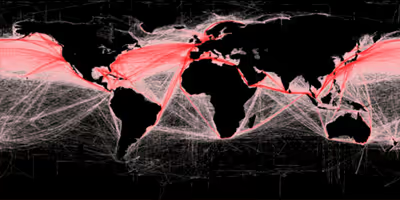
In 2015, 108 trillion tonne-kilometers were transported worldwide (anticipated to grow by 3.4% per year until 2050 (128 Trillion in 2020)): 70% by sea, 18% by road, 9% by rail, 2% by inland waterways and less than 0.25% by air.
Grounds
Land or "ground" shipping can be made by train or by truck (British English: lorry). Ground transport is typically more affordable than air, but more expensive than sea, especially in developing countries, where inland infrastructure may not be efficient. In air and sea shipments, ground transport is required to take the cargo from its place of origin to the airport or seaport and then to its destination because it is not always possible to establish a production facility near ports due to the limited coastlines of countries.
Ship
Much freight transport is done by cargo ships. An individual nation's fleet and the people that crew it are referred to as its merchant navy or merchant marine. According to a 2018 report from the United Nations Conference on Trade and Development (UNCTAD), merchant shipping (or seaborne trade) carries 80–90% of international trade and 60–70% by value. On rivers and canals, barges are often used to carry bulk cargo.
Air
Cargo is commonly transported by air in specialized cargo aircraft and in the luggage compartments of passenger aircraft, while sometimes helicopters and drones become the alternative air transportations. Air freight is typically the fastest mode for long-distance freight transport, but it is also the most expensive.
Space
Multimodal
Cargo is exchanged between different modes of transportation via transport hubs, also known as transport interchanges or Nodes (e.g. train stations, airports, etc.). Cargo is shipped under a single contract but performed using at least two different modes of transport (e.g. ground and air). Cargo may not be containerized.
Intermodal
Multimodal transport featuring containerized cargo (or intermodal container) that is easily transferred between ship, rail, plane and truck.
For example, a shipper works together with both ground and air transportation to ship an item overseas. Intermodal freight transport is used to plan the route and carry out the shipping service from the manufacturer to the door of the recipient.
Terms of shipment
The Incoterms (or International Commercial Terms) published by the International Chamber of Commerce (ICC) are accepted by governments, legal authorities, and practitioners worldwide for the interpretation of the most commonly used terms in international trade. Common terms include:
- Free on Board (FOB)
- Cost and Freight (CFR, C&F, CNF)
- Cost, Insurance and Freight (CIF)
The term "best way" generally implies that the shipper will choose the carrier that offers the lowest rate (to the shipper) for the shipment. In some cases, however, other factors, such as better insurance or faster transit time, will cause the shipper to choose an option other than the lowest bidder.
Door-to-door shipping
Door-to-door (DTD or D2D) shipping refers to the domestic or international shipment of cargo from the point of origin (POI) to the destination while generally remaining on the same piece of equipment and avoiding multiple transactions, trans-loading, and cross-docking without interim storage.
International DTD is a service provided by many international shipping companies and may feature intermodal freight transport using containerized cargo. The quoted price of this service includes all shipping, handling, import and customs duties, making it a hassle-free option for customers to import goods from one jurisdiction to another. This is compared to standard shipping, the price of which typically includes only the expenses incurred by the shipping company in transferring the object from one place to another. Customs fees, import taxes and other tariffs may contribute substantially to this base price before the item ever arrives.
Digitalization and logistics marketplaces
The freight transport industry has witnessed a substantial change with the rise of integrated digital marketplaces. International freight transport is a traditionally fragmented industry; however, with the rise of global digital marketplaces, the industry is witnessing a move towards a centralized platform. Such a move is enabling the integration of maritime, air, and land freight into a single marketplace. This is enabling small and medium-sized enterprises (SMEs) to access international supply chains through Less than Container Load (LCL) and multimodal solutions traditionally adopted by industrial shippers.