


Related on Lably
Through Employment and NITI Aayog
Definition
The term "gig" comes from the slang term for individual appearances by performing artists like musicians and comedians. Instead of being paid a regular salary, gig workers are paid for individual gigs performed.
While the definition varies, the gig economy is mainly defined as a labor market with short-term, flexible work arrangements, primarily through digital platforms that connect service providers with customers for different types of tasks or jobs, rather than traditional long-term employment. Gig workers are typically classified as independent contractors, without the benefits or job security associated with standard employment.
Corporate entities employ the services of the workers for short-term commitments for temporary work assignments. They are often able to provide a different type of service or product because the gig business model does not burden them with costs such as sick leave and health insurance benefits as well as office space, equipment and training. Sometimes this enables them to hire expertise that they could not otherwise afford. Workers often enjoy greater flexibility in terms of scheduling control and work-life balance.
Sign in to keep reading
2 more chapters are free with a Lably account.
Description
Gig workers may have professional, semiprofessional or minimal qualifications for their employment.
In the design industry, gig workers are increasingly seeking legal protections around intellectual property (IP) and contract terms. Freelancers often face challenges with clients claiming ownership over creative work without proper compensation or acknowledgment. A 2022 survey conducted by Freelancers Union in partnership with the Authors Guild and other organizations found that 62% of freelancers in New York had experienced wage theft at least once in their careers, with 53% reporting losses of up to $10,000 from nonpayment. Legal developments like California's AB5 law continue to influence the gig economy, aiming to reclassify some design freelancers as employees, ensuring legal protections like minimum wage and benefits.
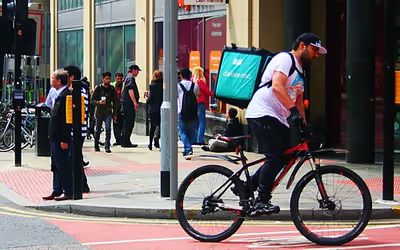
Among the common types of digital platforms in the gig economy are those which provide ridesharing services, food- or package-delivery services, crafts and handmade-item marketplaces, on-demand labor and repair services, property and space rentals. A study completed in 2016 by Lawrence Katz and Alan Krueger showed an increase in gig workers, freelancers, and independent contractors of 50 percent between 2005 and 2015. These jobs accounted for 94 percent of all employment growth in the United States during those ten years. As of 2021, 16% of all adults in the United States had earned income through the gig economy, with higher levels of gig economy experience having accrued to younger demographics, according to the Pew Research Center. As of 2017, 55 million Americans contributed services to the gig economy. As of 2018, 150 million people were active in the gig economy in North America and Western Europe, according the Harvard Business Review.
The size of the gig economy depends on how one defines it and whose statistics one uses. The Bureau of Labor Statistics uses the term "electronically mediated work" to represent "short jobs or tasks that workers find through websites or mobile apps that both connect them with customers and arrange payment for the tasks." A work published in September 2018 determined that such work accounted for 1.0 percent of total employment in May 2017. At about the same time the Government Accountability Office stated that the definition and the data source variations support claims from below 5% to over one-third of the labor force engage in non-traditional employment. According to a 2021 Forbes article the gig economy was a $1 trillion sector of the United States economy.
Regardless of the definition used, the gig economy is growing. CNBC reported that during the 2010s, the gig economy grew by 15%. Forbes describes the growth as "slow and steady".
As of November 2022 the 10 largest gig-economy companies by market capitalization included Intuit (tax preparation software), PayPal (online payments), Airbnb (hosting marketplace), Uber (ride-sharing) and Shopify (e-commerce). Other leading companies include Lyft, OnlyFans (content-subscription service), DoorDash, and Instacart.
Demographics
United States
16% of adults in the United States say that they have done any type of gig work. Hispanic Americans are the largest group in the gig economy with around 30% of Hispanics saying they have done some type of gig work. Black Americans are 20%, Asian Americans 19%, and White Americans are 12%.
India
India has one of the fastest-growing gig economies in the world, driven by rapid smartphone penetration, a large young working-age population, and the expansion of digital platforms. According to a 2022 report by NITI Aayog, India's gig workforce stood at approximately 7.7 million workers in 2020–21 and is projected to reach 23.5 million by 2029–30, representing around 6.7% of the non-agricultural workforce.
India's gig economy is broadly divided into two categories. The first comprises transport and delivery work, including ride-hailing through platforms such as Ola and Uber, and food delivery through Swiggy and Zomato. The second comprises sales and distribution work, where gig workers act as on-ground agents for banks, financial institutions, and consumer internet companies, completing tasks such as merchant onboarding, credit card sales, and savings account acquisition on a per-task commission basis.
The COVID-19 pandemic accelerated adoption of gig-based work, as reverse migration from cities to smaller towns created a supply of workers in Tier-2 and Tier-3 locations, while demand from digital companies for scalable, low-cost customer acquisition grew simultaneously.
Regulation
India's Code on Social Security, 2020 was the first legislative framework to formally define gig workers and platform workers, and to extend limited social security protections to them. Under Section 2(35) of the Code, a gig worker is defined as "a person who performs work or participates in a work arrangement and earns from such activities outside of traditional employer-employee relationship." The Code mandated a Social Security Fund under Section 109, with aggregator platforms required to contribute 1–2% of annual turnover toward worker welfare, subject to government notification."The Code on Social Security, 2020" (PDF). Ministry of Labour and Employment, Government of India. Retrieved June 10, 2026.
The Union Budget 2025–26 announced additional measures including identity cards for gig workers and nationwide registration drives to extend social security coverage to the sector.
Notable platforms
Prominent gig economy platforms operating in India include Swiggy and Zomato in food delivery, Ola and Uber in ride-hailing, Urban Company in home services, and platforms such as PickMyWork in sales distribution and fintech customer acquisition.