

Glory (optical phenomenon)
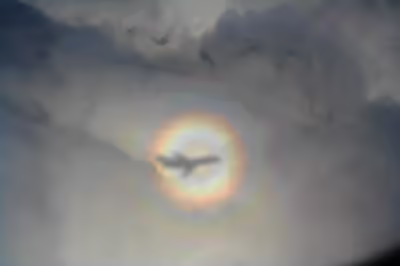
Halo seen about the observer's shadow
- 5 min read
- 4 chapters

Related on Lably
Glories arise due to wave interference of light internally refracted within small droplets.
Appearance and observation
Depending on circumstances (such as the uniformity of droplet size in the clouds), one or more of the glory's rings can be visible. The rings are rarely complete, being interrupted by the shadow of the viewer. The angular size of the inner and brightest ring is much smaller than that of a rainbow, about 5° to 20°, depending on the size of the droplets. In the right conditions, a glory and a rainbow can occur simultaneously.
"Glories can be seen on mountains and hillsides, from aircraft and in sea fog and even indoors."
Like a rainbow, outdoor glories are centred on the antisolar (or, in case of the moon, antilunar) point, which coincides with the shadow of the observer's head. Because this point is diametrically opposite to the sun's (or moon's) position in the sky, it usually lies below the observer's horizon except at sun (or moon) rise and set. Outdoor glories are commonly observed from aircraft. In the latter case, if the plane is flying sufficiently low for its shadow to be visible on the clouds, the glory always surrounds it. This is sometimes called The Glory of the Pilot.
In 2024 astronomers suggested that the existence of glory might explain certain observations of the exoplanet WASP-76b. If this interpretation could be confirmed, it would become the first extrasolar glory-like phenomenon to be discovered.
Brocken spectre
When viewed from a mountain or tall building, glories are often seen in association with a "Brocken spectre": the apparently enormously magnified shadow of an observer, cast (when the sun is low) on clouds below the mountain or tall building on which the viewer is standing. The name derives from the Brocken, the tallest peak of the Harz mountain range in Germany. Because the peak is above the cloud level and the area is frequently misty, conditions conducive to casting a shadow on a cloud layer are common. Giant shadows that seemed to move by themselves due to movement of the cloud layer (this movement is another part of the definition of the Brocken spectre), and that were surrounded by glories, may have contributed to the reputation the Harz mountains hold as a refuge for witches and evil spirits. In Goethe's Faust, the Brocken is called the Blocksberg and is the site of the Witches' Sabbath on Walpurgis Night.
Ulloa's halo
Before the first reports of the phenomenon in Europe, two members of the French Geodesic Mission to the Equator, Antonio de Ulloa and Pierre Bouguer, reported that while walking near the summit of the Pambamarca mountain, in the Ecuadorian Andes, they saw their shadows projected on a lower-lying cloud, with a circular "halo or glory" around the shadow of the observer's head. Ulloa noted that
The most surprising thing was that, of the six or seven people that were present, each one saw the phenomenon only around the shadow of his own head, and saw nothing around other people’s heads.
This was then called "Ulloa's halo" or "Bouguer's halo". Ulloa reported that the glories were surrounded by a larger ring of white light, which would today be called a fog bow. On other occasions, he observed arches of white light formed by reflected moonlight, whose explanation is unknown but which may have been related to ice-crystal halos.
Sign in to keep reading
3 more chapters are free with a Lably account.
Theory
Modern theories of light, first described by Henri Poincaré in 1887, are able to explain the phenomenon of glories through the complex angular momentum (rotation) of the electromagnetic field of a light wave, and do not need quantum theories. A summary of rainbowlike phenomena was provided in Scientific American in 1977, and states:
It is gratifying to discover in the elegant but seemingly abstract theory of complex angular momentum an explanation for these two natural phenomena [Glories and 10th order Rainbows], and to find there an unexpected link between them.
— H.M Nussenzveig
Most 20th century work on the phenomenon of rainbows and glories has focused on determining the correct intensity of light at each point in the phenomenon, which does require quantum theories. In 1947, the Dutch astronomer Hendrik van de Hulst suggested that surface waves are involved. He speculated that the brightness of the coloured rings of the glory are caused by two-ray interference between "short" and "long" path surface waves—which are generated by light rays entering the droplets at diametrically opposite points (both rays suffer one internal reflection). A theory by Brazilian physicist Herch Moysés Nussenzveig suggests that the light energy beamed back by a glory originates mostly from classical wave tunneling (synonymous in the paper to the evanescent wave coupling), which is an interaction between an evanescent light wave traveling along the surface of the drop and the waves inside the drop.
In culture
C. T. R. Wilson saw a glory while working as a temporary observer at the Ben Nevis weather station. Inspired by the impressive sight, he decided to build a device for creating clouds in the laboratory, so that he could make a synthetic, small-scale glory. His work led directly to the cloud chamber, a device for detecting ionizing radiation for which he and Arthur Compton received the Nobel Prize for Physics in 1927.
In China, the phenomenon is called Buddha's light (or halo). It is often observed on cloud-shrouded high mountains, such as Huangshan and Mount Emei. Records of the phenomenon at Mount Emei date back to A.D. 63. The colourful halo always surrounds the observer's own shadow, and thus was often taken to show the observer's personal enlightenment (associated with Buddha or divinity).
Stylized glories appear occasionally in Western heraldry. Two glories appear on the Great Seal of the United States: A glory breaking through clouds surrounding a cluster of 13 stars on the obverse, and a glory surrounding the Eye of Providence surmounting an unfinished pyramid on the reverse.
Additional reading
- Mayes, Lawrence (1 September 2003), Glories – an Atmospheric Phenomenon, archived from the original on 16 August 2007, retrieved 4 September 2007
- Nave, R (n.d.), Glories, retrieved 4 September 2007
- Nussenzveig, H. Moysés (2012). "The Science of the Glory". Scientific American. 306 (1): 68–73. Bibcode:2011SciAm.306f..68N. doi:10.1038/scientificamerican0112-68. PMID 22279838. S2CID 38936268. Wikidata Q83329963.