


Related on Lably
Through Goat, Animal husbandry and Livestock
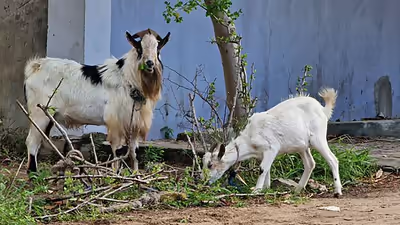
Goat farming can be very suited to production alongside other livestock (such as sheep and cattle) on low-quality grazing land. Goats efficiently convert sub-quality grazing matter that is less desirable for other livestock into quality lean meat. Furthermore, goats can be farmed with a relatively small area of pasture and with limited resources.
Pasture
As with other herbivores, the number of animals that a goat farmer can raise and sustain is dependent on the quality of the pasture. However, since goats will eat vegetation that most other domesticated livestock decline, they will subsist even on very poor land. Therefore, goat herds remain an important asset in regions with sparse and low quality vegetation. However, goats also show preference to certain browse and grasses, such as Multiflora Rose, Briar, Ironweed, Ragweed, Spiny Amaranth, and Pigweed among others. They are less fond of grasses such as Tall Fescue, Bermuda Grass, Orchard Grass, and Crab Grass.
Sign in to keep reading
2 more chapters are free with a Lably account.
Worldwide goat population statistics
As of 2022, India is the largest producer of goat's milk. In 2024, the United States of America was the largest importer of goat's milk, and in the same year, New Zealand was the top exporter.
In the US
Meat goats are farmed in all US states, although most meat goat production occurs in the Southeast. As of 2016, Texas is the primary producer of meat goats, representing 38% of US production.
Male goats are generally not required for the dairy-goat industry and are usually slaughtered for meat soon after birth. In the UK, approximately 30,000 billy goats from the dairy industry are slaughtered each year.
In Africa
In Tanzania and Kenya, the Maasai rely on goat and cow milk, but increased droughts limited resources for cattle, so goats are increasing.
Goat Milk Production
In 2017, 18.7 million tonnes of goats milk was produced globally, a 16% increase since 2007 .