


Related on Lably
Through Extinction, Carnivore and Fossil
Gorgonopsians were an extinct clade of carnivorous therapsids that first appeared either during the Middle or (Early) Permian. They were the first group of therapsids to evolve saber-like canines. They were subordinate to dinocephalians and basal therocephalians during the Middle Permian, with the exception of the Phorcyidae, which were the top predators of their localities. Gorgonops would appear in the fossil record shortly after the primary phase of the Capitanian mass extinction.
Classification
History of discovery
The holotype of the type species, Gorgonops torvus, was one of the first therapsids discovered. It was described by Richard Owen, who also coined the name "Dinosauria" on the basis of the first known dinosaur fossils. G. torvus was also used as the type for the family Gorgonopsidae, which was described by Richard Lydekker in 1890. Five years later, in 1895, Harry Govier Seeley used this genus to establish the larger clade of Gorgonopsia. In later years, a large number of further species and genera were designated, though many of these were later determined to be synonyms.
Gorgonops is known from the Endothiodon and most of the Cistecephalus Assemblage Zones.
Species
Gorgonops torvus (Owen, 1876)
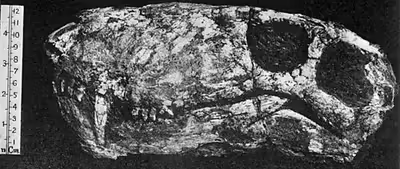
The type species. The holotype is an incomplete and flattened skull, allegedly found at Mildenhall's farm (Xlu Xlu), on the Queen's Road south of Fort Beaufort, in the Eastern Cape of South Africa. A number of other specimens have been found since, all from the Tropidostoma and/or Cistecephalus Assemblage Zone(s). This was a medium-sized therapsid, with a skull about 22 cm in length. It is distinguished from other species by a longer snout, and other details of the bones of the skull. Originally considered rather simple, it is actually (according to Sigogneau-Russell) a rather specialised member of the group.
Gorgonops whaitsi (Broom, 1912)
Larger than G. torvus, with the rear of the skull wider, and other details of proportion. Originally the type species of Scymnognathus. Despite being known from a large number of specimens from the Karoo Basin, Beaufort West (Tropidostoma/Cistecephalus Assemblage Zone), the species remains poorly known. Watson and Romer placed Gorgonops and Scymnognathus in two different families, while Sigogneau-Russell placed the two species in the same genus, and considers G. whaitsi a more primitive (less derived) form. Synonyms: Scymnognathus whaitsi (Broom, 1912)
Gorgonops longifrons (Haughton, 1915)
A large specimen known from an incomplete and flattened skull about 35 centimetres (14 in) long. Orbit larger and snout longer than G. whaitsi, from which it may have descended. Beaufort West, Tropidostoma/Cistecephalus Assemblage Zone. Synonyms: Gorgonognathus longifrons (Haughton, 1915)
Gorgonops? eupachygnathus (Watson, 1921)
A flattened, incomplete, medium-sized skull, probably a juvenile of either G. torvus or G. whaitsi. Synonyms: Leptotrachelus eupachygnathus (Watson, 1921); Leptotracheliscops eupachygnathus (Watson, 1921)
Gorgonops? dixeyi (Haughton, 1926)
A large, incomplete and flattened skull, from Chiweta Beds, Nyassaland. Placement uncertain. Probably Low Cistecephalus Assemblage Zone equivalent (= middle of the Wuchiapingian Stage). Synonyms: Chiwetasaurus dixeyi (Haughton, 1926)
Gorgonops? kaiseri (Broili & Schroeder, 1934)
A large (about 35 centimetres (14 in) long), incomplete skull, with a high snout and narrower in the rear than other species, from the "High Tapinocephalus zone" (earlier than the other species, most probably Pristerognathus Assemblage Zone) Synonyms: Pachyrhinos kaiseri (Broili & Schroeder, 1934)
Taxonomy
Below is a cladogram from Gebauer's 2007 phylogenetic analysis.
Phylogenetic modeling by Gorgonops to Kammerer and Masyutin (2018) and onwards recovered Gorgonops as a member of the African clade, a clade of gorgonopsians that consisted of almost all African gorgonopsians with the exception of Inostrancevia africana. Cladogram recovered by Macungo et al. (2026):
Evolution
The oldest definitive gorgonopsian was recovered from the Mediterranean island of Mallorca, and which probably dates to the earliest Wordian of the Middle Permian. However, stratigraphic position of the gorgonopsian, as well as surrounding fossil track record may suggest it is significantly older, potentially Roadian stage of the Middle Permian. With a possibility of dating to the Kungurian or Artinskian stages of the Early Permian. Gorgonopsians were the first group of therapsids to evolve sabertooth canines, before the appearance of dinosaurs or mammals. During the Middle Permian, gorgonopsians were subordinate to basal therocephalians, another group of sabertooth therapsids, and dinocephalians. However, Phorcyidae were an exception as they were likely being the apex predators of their locality. Following the extinction of dinocephalians and basal therocephalians, gorgonopsians would become the dominant predators of the Late Permian.
Sign in to keep reading
2 more chapters are free with a Lably account.
Description
Gorgonops was a medium-sized gorgonopsian, with a skull length of 22–35 centimetres (8.7–13.8 in), depending on the species. They ranged from 1.2–2 metres (3.9–6.6 ft) long from nose to tail. Bendel et al. (2023) estimated SAM-PK-K10591, a specimen of G. torvus, had a body mass between 72.9–145.6 kg (161–321 lb), with the mean body mass being 98.1 kg (216 lb). Although, the authors noted there currently isn't no mass regression based Gorgonopsia postcranial. Kulik (2025) suggested a significantly smaller size for the same specimen, weighing 22.8 kg (50 lb), ranging from 17.1–28.5 kg (38–63 lb).
Skull
Relative to body size, Gorgonops had a deep skull with a triangular profile when viewed from above. Perhaps the most distinctive features were two enlarged canine teeth that were so big (12 centimetres (4.7 in) long) they almost protruded beyond the lower jaw. To help protect these teeth, the lower jaws grew in such a shape so that the anterior (front) portion was thicker than the posterior (rear) portion. This form would have protected the enlarged canine teeth from accidental damage, and was similar in bone function to the flanges of bone of sabre-toothed cats in the Cenozoic.
Paleobiology
Biomechanical analysis of various sabertooth predators by Lautenschlager et al. (2020) found G. torvus had a maximum jaw gap of 68.11° and an effective jaw gape of 48°. The authors concluded due to the actual jaw gapes were below 80° and effective jaw gape below 60°, gorgonopsians were likely specialized on prey either smaller or similar in size. Their model size estimates that G. torvus had a bite force of 116 newtons.