


Related on Lably
Features
The Great Salt Desert forms part of a 4,000 km2 (1,500 sq mi) protected ecological zone, the Kavir National Park.
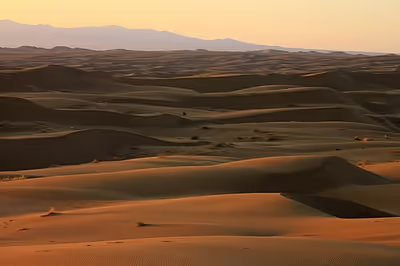
The Kavir Desert also contains the Rig-e Jenn, an area of sandy dunes traditionally associated with jinn and other evil spirits.
In the center of the desert lies the salt marshes of Kavir Buzurg (Great Kavir), which is about 320 km (200 mi) long and 160 km (99 mi) wide.
On the western edge of the desert lies the 1,800 km2 (690 sq mi) Namak Lake ("salt lake").
Sign in to keep reading
4 more chapters are free with a Lably account.
Climate and structure
Dasht-e Kavir has an arid climate with little precipitation. However, there is usually some rainfall in winter, as well as the mountains that surround it, provide plenty of runoff—enough to create vast seasonal lakes, marshlands and playas. Daytime and nighttime temperatures can vary by as much as 70 °C (130 °F) over the course of a year. The weather can get quite cold during the nighttime in winter, routinely dropping to below 0 °C (32 °F) in some areas.
The desert soil is covered with sand and pebbles; there are marshes, seasonal lakes and seasonal river beds. The high temperatures and low humidity cause extreme vaporization, which leaves the marshes and mud grounds with large crusts of salt.
Post-glacial lake system
Almost 3,000 years ago, at the start of the post-glacial era, the Kavir was a series of vast lakes.
Wildlife
Vegetation in the Dasht-e Kavir is adapted to the hot and arid climate as well as to the saline soil in which it is rooted.
Goitered gazelles live in parts of steppe and desert areas of the central plateau. Mouflon, dromedaries, wild goats and Persian leopards are common in mountainous areas. Night life brings on Arabian wildcats, Indian wolves, foxes, and other carnivores.
Cultivation
The extreme heat and many storms in Dasht-e Kavir cause extensive erosion, which makes it almost impossible to cultivate the lands. The desert is almost uninhabited and knows little exploitation.