

Groin
Area between the torso and the thigh
- 2 min read
- 2 chapters

Related on Lably
Through Anatomical terms of motion and Immune system
Gross anatomy
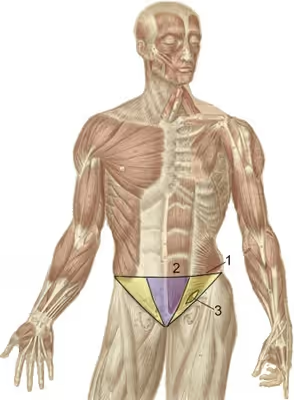
Where the lower part of the anterior abdominal wall meets the thigh, a crease is formed known as the inguinal groove or crease. The junction is the area of the medial compartment of the thigh that contains the attachments of the adductor muscles of the hip, also known as the groin muscles.
The adductor muscles that make up the groin consist of the adductor brevis, adductor longus, adductor magnus, gracilis, and pectineus. These groin muscles adduct the thigh (bring the thigh and knee closer to the midline).
The groin is innervated by branches of the lumbar plexus. The pectineus muscle is innervated by the femoral nerve, and the hamstring portion of adductor magnus is innervated by the tibial nerve.
In the groin, underneath the skin, there are three to five deep inguinal lymph nodes that play a role in the immune system. A chain of superficial inguinal lymph nodes drain to the deep nodes.
There are two depressions called fossae in an area called the inguinal triangle—the lateral inguinal fossa and the medial inguinal fossa.
The inguinal ligament runs from the pubic tubercle to the anterior superior iliac spine, and its anatomy is important for hernia operations.
Sign in to keep reading
One more chapter is free with a Lably account.
Clinical significance
A pulled groin muscle usually refers to a painful strain of the hip adductor muscles. This type of injury is related to risk factors including overuse and previous injury.
An inguinal hernia is a hernia of the groin and can be either a direct hernia, or an indirect hernia, according to its particular location. Sometimes a direct hernia may be present with an indirect hernia on the same side when it is known as a saddlebag hernia.
Like other flexion surfaces of large joints (popliteal fossa, armpit, cubital fossa), it is an area where blood vessels and nerves pass relatively superficially, and with an increased amount of lymph nodes.
In a venography procedure, the groin is the preferred site for incisions to enter a catheter into the vascular system.