


Explore on Lably
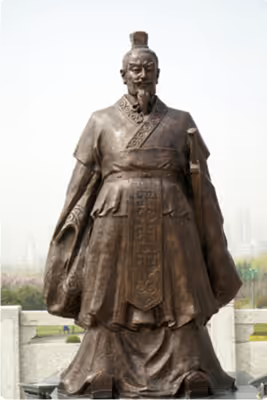
ToursExplore Lably’s 3D toursHan Fei is often considered the greatest representative of Legalism for the Han Feizi, a later anthology of writings traditionally attributed to him, which synthesized the methods of his predecessors. Han Fei's ideas are sometimes compared with those of Niccolò Machiavelli, author of The Prince. Zhuge Liang is said to have attached great importance to the Han Feizi.
After the early demise of the Qin dynasty, the Legalist school was officially vilified by the Han dynasty that succeeded it. Despite its outcast status throughout the history of imperial China, Han Fei's political theory and Legalist ideas continued to heavily influence every dynasty thereafter, and the Confucian ideal of rule without laws was never to be realized.
Han Fei borrowed Shang Yang's emphasis on laws, Shen Buhai's emphasis on administrative technique, and Shen Dao's ideas on authority and prophecy, emphasizing that the autocrat will be able to achieve firm control over the state with the mastering of his predecessors' methodologies: his position of 'power' (勢 shì), 'technique' (術 shù), and 'law' (fa). He stressed the importance of the concept of holding actual outcome accountable to speech (刑名 xingming), coupled with the "two handles" system of punishment and reward, as well as wu wei ('non-exertion').
Names
Han Fei is also known respectfully as Hanzi ('Master Han') or as Han Feizi ('Master Han Fei'). In Wade–Giles transcription, his same name is written Han Tzu, Han-tzu, Han Fei Tzu, or Han Fei-tzu. The same name—sometimes as "Hanfeizi" or "Han-fei-tzu"—is used to denote the later anthology traditionally attributed to him.
Sign in to keep reading
4 more chapters are free with a Lably account.
Han Feizi
As chancellors of neighboring states, doctrines associated with Shang Yang of the Qin state, and Shen Buhai of the Han state, would have intersected before imperial unification. The Han Feizi is the first preserved reference for writings associated with Shang Yang outside Qin, with the Book of Lord Shang possibly going into broad circulation alongside the Guanzi in the late Warring States period.
Geographically, it is plausible for there to have been someone like a real Han Fei. A scion of the Han state, a real Han Fei would have been well positioned to learn of Shang Yang and Shen Buhai, and then write at least part of the Han Feizi, most notably chapter 43, which discusses the two figures together. It is also plausible to have been familiar with chapter 40's Shen Dao, who was better known in the Warring States period.
Legitimacy
While early scholarship was not very open the idea there was a real Han Fei, modern scholarship has been more open to the idea. Sinologist Goldin (2013) was open to the idea that details of Han Fei's life were "probably not far from the truth"; that Han Fei was "descended from the ruling house of Hán", and seeking office in Qin, was "executed in 233 B.C.E., after being entrapped by Li Si".
Masayuki Sato (2013) doubted that all of Sima Qian's details of Han Fei's life are historically accurate, dramatically setting up Han Fei as a tragic figure with Li Si as a destined opponent.
Sima Qian recounts that Qin Shi Huang went to war with the state of Han to obtain an audience with Han Fei, but was ultimately convinced to imprison him, whereupon he committed suicide. In the Stratagems of the Warring States, Han Fei supposedly slanders Qin diplomat Yao Jia, and the Qin king orders Han Fei's execution after Yao Jia successfully defends himself.
Life
The exact year of Han Fei's birth remains unknown, however, scholars have placed it at c. 280 BC.
Unlike the other famed philosophers of the time, Han Fei was a member of the ruling aristocracy, having been born into the ruling family of Han during the end phase of the Warring States period. In this context, his works have been interpreted by some scholars as being directed to his cousin, the King of Han. The Records of the Grand Historian say that Han Fei studied together with future Qin chancellor Li Si under the Confucian philosopher Xun Kuang. It is said that because of his stutter, Han Fei could not properly present his ideas in court, but Sima regards him as having been very intelligent. His advice otherwise being ignored, but observing the slow decline of his Han state, he developed "one of the most brilliant (writing) styles in ancient China."
Sima Qian's biography of Han Fei is as follows:
Han Fei was an imperial clansman of Han, in favor of the study of name/form and law/art, which Sima Qian dubiously espoused as taking root in the Huang-Lao philosophy. He was born a stutterer and was not able to dispute well, but he was good at writing papers. Together with his friend, Li Si, he served Xun Qing, and Si himself admitted that he was not as competent as Fei. Seeing Han was on the decline, he often remonstrated with the king of Han by submitting papers, but the king did not agree to employ him. At this, Han Fei was frustrated with the reality that, in governing a state, the king did not endeavor to refine and clarify the juridical system of the state, to control his subjects by taking over power, to enhance state property and defense, or to call and employ the wise by enhancing the state.
Rather, the king employed the corrupted and treacherous and put them in higher positions over the wise. He regarded the intellectuals as a disturbance to the law by employing their literature and thought that knights violate the prohibition of the state by using armed forces. While the state was in peace, the king liked to patronize the honored; while in need, he employed warriors with armor and helmet. So the cultivated men could not be employed and the men employed could not be cultivated. Severely distressed over the reality that men of high integrity and uprightness were not embraced by the subjects with immorality and corruption, he observed the changes in the gaining and losing of the past.
Therefore, he wrote several papers like "Solitary Indignation", "Five Vermin", "Inner and Outer Congeries of Sayings", "Collected Persuasions", and "Difficulties in the Way of Persuasion", which amount to one hundred thousand words. However, while Han Fei himself knew well of the difficulty of persuasion for his work on the difficulties in the way of persuasion was very comprehensive, he eventually met an untimely death in Qin. He could not escape the trap of words for himself.
His works ultimately ended up in the hands of King Ying Zheng of Qin, who commented, "If I can meet and make friends with this person [Han Fei], I may die without regrets." and invited Han Fei to the Qin court. Han Fei presented the essay "Preserving the Han" to ask the king not to attack his homeland, but Yao Gu and Li Si (his ex-friend and rival) used that essay to have Han Fei imprisoned on account of his likely loyalty to Han. Han Fei responded by writing another essay named "In the first time of meeting Qin king", hoping to use his writing talent to win the king's heart. Han Fei did win the king's heart, but not before Li Si forced him to commit suicide by drinking poison. The Qin king afterward regretted Han Fei's death.
Summary of his legalism
Xunzi formed the hypothesis that human nature is evil and virtueless, therefore suggesting that human infants must be brought to their virtuous form through social-class-oriented Confucian moral education. Without such, Xunzi argued, man would act virtueless and be steered by his own human nature to commit immoral acts. Han Fei's education and life experience during the Warring States period, and in his own Han state, contributed his synthesis of a philosophy for the management of an amoral and interest-driven administration, to which morality seemed a loose and inefficient tool. Han agreed with his teacher's theory of "virtueless by birth", but as in previous Legalist philosophy, pragmatically proposed to steer people by their own interest-driven nature.