


Related on Lably
Through Redox, Isotope and World War II
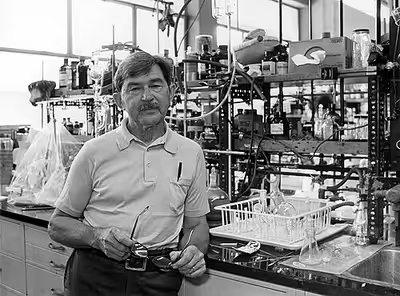
In addition to the Nobel Prize, Taube also received many other major scientific awards, including the Priestley Medal in 1985 and two Guggenheim Fellowships early in his career (1949 and 1955), as well as numerous honorary doctorates. His research focused on redox reactions, transition metals and the use of isotopically labeled compounds to follow reactions. He had over 600 publications including one book, and had mentored over 200 students during his career. Taube and his wife Mary had three children; his son Karl is an anthropologist at the University of California Riverside.
Education
At 12, Taube left his hometown and moved to Regina to attend Luther College where he completed high school. After graduating, Taube stayed at Luther College and worked as laboratory assistant for Paul Liefeld, allowing him to take first year university classes. Taube attended the University of Saskatchewan, receiving his BSc in 1935 and his MSc in 1937. His thesis advisor at the University of Saskatchewan was John Spinks. While at the University of Saskatchewan, Taube studied with Gerhard Herzberg, who would be awarded the 1971 Nobel Prize in Chemistry. He moved to University of California, Berkeley, where he completed his PhD studies in 1940. His PhD mentor was William C. Bray. Taube's graduate research focused on the photodecomposition of chlorine dioxide and hydrogen peroxide in solution.
Sign in to keep reading
2 more chapters are free with a Lably account.
Research and academic career
Academic posts
After completing his education, Taube remained in the United States, becoming an instructor in chemistry at Berkeley until 1941. He initially wanted to return to Canada to work, but did not receive a response when he applied for jobs at the major Canadian universities. From Berkeley, he served as an instructor and assistant professor at Cornell University until 1946. During World War II, Taube served on the National Defense Research Committee. Taube spent time at the University of Chicago as an assistant professor, associate professor and as a full professor from 1946 to 1961. He served as chair of the chemistry department in Chicago from 1956 to 1959, but did not enjoy administrative work. After leaving Chicago, Taube worked as a professor at Stanford University until 1986, a position that allowed him to focus on research, while also teaching classes at the undergraduate and graduate levels. He became a Professor Emeritus at Stanford in 1986, but he continued to perform research until 2001, and visited his labs every day until his death in 2005. In addition to his academic duties, Taube also served as a consultant at Los Alamos National Laboratory from 1956 until the 1970s.
Research interests
Taube's initial research at Cornell University focused on the same areas he studied as a graduate student, oxidizing agents containing oxygen and halogens, and redox reactions featuring these species. He used isotopically labeled oxygen-18 and radioactive chlorine to study these reactions. He was recognized by the American Chemical Society in 1955 for his isotope studies.
Taube's interest in coordination chemistry was sparked when he was chosen to develop a course on advanced inorganic chemistry while at the University of Chicago. He was unable to find much information in the textbooks available at the time. Taube realized that his work on the substitution of carbon in organic reactions could be related to inorganic complexes. In 1952, Taube published a key paper relating the rates of chemical reactions to electronic structure in Chemical Reviews. This research was the first to recognize the correlation between the rate of ligand substitution and the d-electron configuration of the metal. Taube's key discovery was the way molecules build a type of "chemical bridge" rather than simply exchanging electrons, as previously thought. Identifying this intermediate step explained why reactions between similar metals and ions occurred at different rates. His paper in Chemical Reviews was developed while on sabbatical in the late 1940s. An article in Science called this paper "one of the true classics in inorganic chemistry" after his Nobel Prize was announced. Taube researched ruthenium and osmium, both elements have a high capacity for back bonding. This type of electron donation was key when studying the way electrons are transferred between molecules in a chemical reaction.
When looking back on his research, Taube explained that he sometimes had difficulty finding graduate students willing to work on electron transfer reactions, as they preferred to work on more "exciting" projects in his laboratory focusing on the effects of isotopic tracers and kinetics. Taube felt that a "primary flaw" with his correlation between electron configuration and ligand substitution was that it was described mainly in terms of valence bond theory, as crystal field theory and ligand field theory were not well established when he published his work in 1952.
Personal life
Taube was born November 30, 1915, in Neudorf, Saskatchewan, as the youngest of four boys. His parents were ethnic Germans from Ukraine who had immigrated to Saskatchewan from Ukraine in 1911. Growing up, his first language was Low German. In the 18th century, Catherine the Great encouraged Central European farmers to settle in Russia. As the rights afforded to these settlers by Catherine were gradually diminished, many of the settlers headed to North America, with Saskatchewan offering good farmland, and other incentives for immigrants. Taube reflected fondly on his experiences growing up in Saskatchewan, noting: "Certainly, there is nothing about my first 21 years in Saskatchewan, taken in the context of those times that I would wish to be changed. The advantages that I enjoyed include: the marvelous experience of growing up on a farm, which taught me an appreciation of nature, and taught me also to discipline myself to get necessary jobs done..."
After completing his graduate studies, Taube became a naturalized citizen of the United States in 1942. Taube married his wife Mary in 1952. They had three children, Karl, Heinrich, and Linda. His stepdaughter Marianna died of cancer in 1998. When he stopped his active research projects in 2001, Taube continued to be available as a reviewer and consultant, but his main goal was "enjoying life". Away from chemistry, Taube had varied interests including gardening and classical music, mainly opera. In 2003 he was one of 22 Nobel laureates who signed the Humanist Manifesto.
Taube died at his home in Palo Alto, California on November 16, 2005, at the age of 89.