

Historical geology
Study of the geological history of Earth
- 3 min read
- 7 chapters

Related on Lably
Through Geology, Earth and Plate tectonics
Historical development
During the 17th century, Nicolas Steno was the first to observe and propose a number of basic principles of historical geology, including three key stratigraphic principles: the law of superposition, the principle of original horizontality, and the principle of lateral continuity.
18th-century geologist James Hutton contributed to an early understanding of the Earth's history by proposing the theory of uniformitarianism, which is now a basic principle in all branches of geology. Uniformitarianism describes an Earth formed by the same natural phenomena that are at work today, the product of slow and continuous geological changes. The theory can be summarized by the phrase "the present is the key to the past." Hutton also described the concept of deep time. The prevailing conceptualization of Earth history in 18th-century Europe, grounded in a literal interpretation of Christian scripture, was that of a young Earth shaped by catastrophic events. Hutton, however, depicted a very old Earth, shaped by slow, continuous change. Charles Lyell further developed the theory of uniformitarianism in the 19th century. Modern geologists have generally acknowledged that Earth's geological history is a product of both sudden, cataclysmic events (such as meteorite impacts and volcanic eruptions) and gradual processes (such as weathering, erosion, and deposition).
The discovery of radioactive decay in the late 19th century and the development of radiometric dating techniques in the 20th century provided a means of deriving absolute ages of events in geological history.
Sign in to keep reading
6 more chapters are free with a Lably account.
Use and importance
Geology is considered a historical science; accordingly, historical geology plays a prominent role in the field.
Historical geology covers much of the same subject matter as physical geology, the study of geological processes and the ways in which they shape the Earth's structure and composition. Historical geology extends physical geology into the past.
Economic geology, the search for and extraction of fuel and raw materials, is heavily dependent on an understanding of the geological history of an area. Environmental geology, which examines the impacts of natural hazards such as earthquakes and volcanism, must rely on a detailed knowledge of geological history.
Methods
Stratigraphy
Layers of rock, or strata, represent a geologic record of Earth's history. Stratigraphy is the study of strata: their order, position, and age.
Structural geology
Structural geology is concerned with rocks' deformational histories.
Paleontology
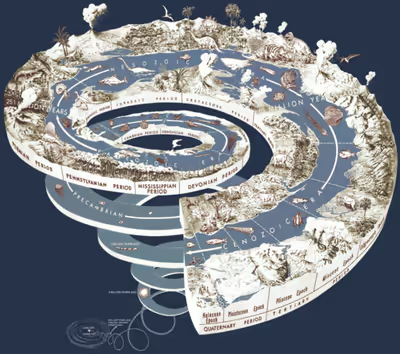
Fossils are organic traces of Earth's history. In a historical geology context, paleontological methods can be used to study fossils and their environments, including surrounding rocks, and place them within the geologic time scale.
Sedimentology
Sedimentology is the study of the formation, transport, deposition, and diagenesis of sediments. Sedimentary rocks, including limestone, sandstone, and shale, serve as a record of Earth's history: they contain fossils and are transformed by geological processes, such as weathering, erosion, and deposition, through deep time.
Relative dating
Historical geology makes use of relative dating in order to establish the sequence of geological events in relation to each another, without determining their specific numerical ages or ranges.
Absolute dating
Absolute dating allows geologists to determine a more precise chronology of geological events, based on numerical ages or ranges. Absolute dating includes the use of radiometric dating methods, such as radiocarbon dating, potassium–argon dating, and uranium–lead dating. Luminescence dating, dendrochronology, and amino acid dating are other methods of absolute dating.
Plate tectonics
The theory of plate tectonics explains how the movement of lithospheric plates has structured the Earth throughout its geological history.
Weathering, erosion, and deposition
Weathering, erosion, and deposition are examples of gradual geological processes, taking place over large sections of the geologic time scale. In the rock cycle, rocks are continually broken down, transported, and deposited, cycling through three main rock types: sedimentary, metamorphic, and igneous.
Paleoclimatology
Paleoclimatology is the study of past climates recorded in geological time.