

Houndshark
Family of sharks
- 1 min read
- 1 chapter

Related on Lably
Through Species
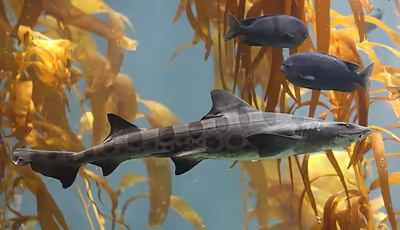
Houndsharks are distinguished by possessing two large, spineless dorsal fins, an anal fin and oval eyes with nictitating eyelids. They are small to medium in size, ranging from 37 to 220 cm (1.21 to 7.22 ft) in adult length. They are found throughout the world in warm and temperate waters, where they feed on small fish and invertebrates on the seabed and in midwater.
Fossil records of this group date back to the Cenomanian.
Genera
Houndsharks are classified into subfamilies and genera as follows:
- Galeorhininae Gill, 1862
- Furgaleus Whitley, 1951 (whiskery shark)
- Galeorhinus Blainville, 1816 (school shark)
- Gogolia Compagno, 1973 (sailback houndshark)
- Hemitriakis Herre, 1923
- Hypogaleus J. L. B. Smith, 1957 (blacktip tope)
- Iago Compagno & Springer, 1971
- Triakinae Gray, 1851
- Mustelus H. F. Linck, 1790 (smooth-hound)
- Scylliogaleus Boulenger, 1902
- Triakis J. P. Müller & Henle, 1839
The following fossil genera are also known:
- ?†Archaeotriakis Case, 1978 (alternatively placed in Pseudotriakidae)
- †Gomphogaleus Adnet & Cappetta, 2008
- †Kallodentis Engelbrecht, Mörs, Reguero & Kriwet, 2017
- †Khouribgaleus Noubhani & Cappetta, 1997
- †Meridiogaleus Engelbrecht, Mörs, Reguero & Kriwet, 2017
- †Pachygaleus Cappeta, 1992
- †Palaeogaleus Gurr, 1962
- †Palaeotriakis Guinot, Underwood, Cappetta & Ward, 2013
- †Paratriakis Herman, 1977
- †Rhaibodus Böhm, 1926
- †Squatigaleus Cappetta, 1989
- †Xystrogaleus Adnet, 2006
More in Animals
Monotypic taxonTaxonomic group with only one subordinate taxonSpecies descriptionFormal description of a discovered speciesParaphylyType of taxonomic groupIUCN Red ListInventory of the global conservation status of biological speciesSubtropicsGeographic and climate zoneCommon nameName generally used for a taxon, group of taxa or organism(s)