

Hour angle
Coordinates used in the equatorial coordinate system
- 3 min read
- 3 chapters

Related on Lably
Through Astronomy, Meridian (astronomy) and Axial tilt
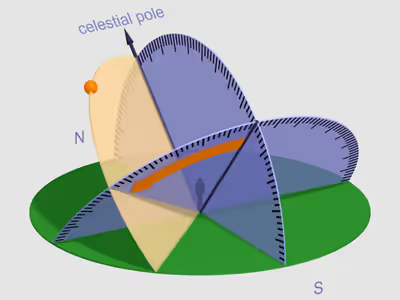
It may be given in degrees, time, or rotations depending on the application. The angle may be expressed as negative east of the meridian plane and positive west of the meridian plane, or as positive westward from 0° to 360°. The angle may be measured in degrees or in time, with 24h = 360° exactly. In celestial navigation, the convention is to measure in degrees westward from the prime meridian (Greenwich hour angle, GHA), from the local meridian (local hour angle, LHA) or from the first point of Aries (sidereal hour angle, SHA).
The hour angle is paired with the declination to fully specify the location of a point on the celestial sphere in the equatorial coordinate system.
Relation with right ascension
The local hour angle (LHA) of an object in the observer's sky is or where LHAobject is the local hour angle of the object, LST is the local sidereal time, is the object's right ascension, GST is Greenwich sidereal time and is the observer's longitude (positive east from the prime meridian). These angles can be measured in time (24 hours to a circle) or in degrees (360 degrees to a circle)—one or the other, not both.
Negative hour angles (−180° < LHAobject < 0°) indicate the object is approaching the meridian, positive hour angles (0° < LHAobject < 180°) indicate the object is moving away from the meridian; an hour angle of zero means the object is on the meridian.
Right ascension is frequently given in sexagesimal hours-minutes-seconds format (HH:MM:SS) in astronomy, though may be given in decimal hours, sexagesimal degrees (DDD:MM:SS), or, decimal degrees.
Because the earth rotates 365.2564 times in a sidereal year whereas fixed stars appear to go around one time more, the hour angle of a fixed star increases by 366.2564/365.2564 (about 1.0027) per hour, or in other words it takes 59 minutes and 50.17 seconds for the hour angle to increase by one hour.
Sign in to keep reading
2 more chapters are free with a Lably account.
Solar hour angle
Observing the Sun from Earth, the solar hour angle is an expression of time, expressed in angular measurement, usually degrees, from solar noon. At solar noon the hour angle is zero degrees, with the time before solar noon expressed as negative degrees, and the local time after solar noon expressed as positive degrees. For example, at 10:30 AM local apparent time the hour angle is −22.5° (15° per hour times 1.5 hours before noon).
The solar hour angle increases on average by one hour per hour, but because of the equation of time this varies with time of year. In mid-September a solar day is about 22 seconds less than 24 hours, meaning that the solar hour angle increases by 1.00025 hours per hour, whereas in late December a solar day is about 28 seconds more than 24 hours, so the solar hour angle increases by 0.99968 hours per hour.
The cosine of the hour angle (cos(h)) is used to calculate the solar zenith angle. At solar noon, h = 0.000 so cos(h) = 1, and before and after solar noon the cos(± h) term = the same value for morning (negative hour angle) or afternoon (positive hour angle), so that the Sun is at the same altitude in the sky at 11:00AM and 1:00PM solar time.
Sidereal hour angle
The sidereal hour angle (SHA) of a body on the celestial sphere is its angular distance west of the March equinox generally measured in degrees. The SHA of a star can vary by around a minute of arc per year, due to precession, while the SHA of a planet varies significantly from night to night. SHA is often used in celestial navigation and navigational astronomy, and values are published in nautical almanacs.