

ISCC–NBS system
International system of color designation
- 4 min read
- 2 chapters

Related on Lably
Through Color, Pink and Orange (colour)
In 1939, the system's approach was published in the Journal of Research of the National Bureau of Standards, and the ISCC formally approved the system, which consisted of a set of blocks within the color space defined by the Munsell color system as embodied by the Munsell Book of Color. Over the following decades, the ISCC–NBS system's boundaries were tweaked and its relation to various other color standards were defined, including for instance those for plastics, building materials, botany, paint, and soil.
After the definition of the Munsell system was slightly altered by its 1943 renotations, the ISCC–NBS system was redefined in the 1950s in relation to the new Munsell coordinates. In 1955, the NBS published The Color Names Dictionary, which cross-referenced terms from several other color systems and dictionaries, relating them to the ISCC–NBS system and thereby to each other. In 1965, the NBS published Centroid Color Charts made up of color samples demonstrating the central color in each category, as a physical representation of the system usable by the public, and also published The Universal Color Language, a more general system for color designation with various degrees of precision from completely generic (13 broad categories) to extremely precise (numeric values from spectrophotometric measurement). In 1976, The Color Names Dictionary and The Universal Color Language were combined and updated with the publication of Color: Universal Language and Dictionary of Names, the definitive source on the ISCC–NBS system.
Color categories
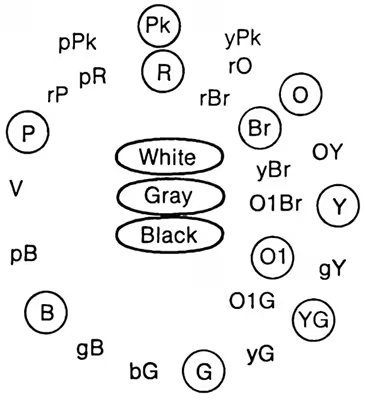
The backbone of the ISCC–NBS system is a set of 13 basic color categories, made up of 10 hue names and three neutral categories. This includes the 11 basic color terms defined by Berlin and Kay, plus olive and yellow green:
- pink (Pk)
- red (R)
- orange (O)
- brown (Br)
- yellow (Y)
- olive (Ol)
- yellow green (YG)
- green (G)
- blue (B)
- purple (P)
- white (Wh)
- gray (Gy)
- black (Bk)
Between these lie a further 16 intermediate categories:
- reddish orange (rO)
- orange yellow (OY)
- greenish yellow (gY)
- yellowish green (yG)
- bluish green (bG)
- greenish blue (gB)
- purplish blue (pB)
- violet (V)
- reddish purple (rP)
- purplish red (pR)
- purplish pink (pPk)
- yellowish pink (yPk)
- reddish brown (rBr)
- yellowish brown (yBr)
- olive brown (OlBr)
- olive green (OlGr)
These categories can be further subdivided into 267 named categories by combining a hue name with modifiers (the example centroids shown here are for the hue name "purple"):
- vivid (v.)
- brilliant (brill.)
- strong (s.)
- deep (deep)
- very deep (v. deep)
- very light (v.l.)
- light (l.)
- moderate (m.)
- dark (d.)
- very dark (v.d.)
- very pale (v.p.)
- pale or light grayish (p., l. gy.)
- grayish (gy.)
- dark grayish (d. gy.)
- blackish (bk.)
- -ish white (-ish Wh)
- light -ish gray (l. -ish Gy)
- -ish gray (-ish Gy)
- dark -ish gray (d. -ish Gy)
- -ish black (-ish Bk)
However, not all modifiers apply to every hue name. For example, there is no brilliant brown or very deep pink.
Each of the 267 ISCC–NBS categories is defined by one or more "blocks" within the color solid of the Munsell color system, where each block includes colors falling in a specific interval in hue, value, and chroma, resulting in a shape which "might be called a sector of a right cylindrical annulus (like a piece of pie with the point bitten off)". The blocks fill the color solid, and are non-overlapping, so that every point falls into exactly one block.
Sign in to keep reading
One more chapter is free with a Lably account.
The Color Names Dictionary
One of the primary original goals of the ISCC–NBS system was to relate several other common color systems and charts to a common frame of reference. To that end, in the late 1940s, the creators of the ISCC–NBS system measured several other significant color standards and charts, either spectrophotometrically or visually with reference to the Munsell Book of Color.