


Related on Lably
Through Belgium
Surviving records date his birth at around 1380 or 1390, in Maaseik (then Maaseyck, hence his name) by the Limburg in present-day Belgium. He took employment in The Hague around 1422, when he was already a master painter with workshop assistants, and was employed as painter and valet de chambre to John III the Pitiless, ruler of the counties of Holland and Hainaut. Some time after John's death in 1425, he was appointed as court painter to Philip the Good, Duke of Burgundy, and worked in Lille before moving to Bruges in 1429, where he lived until his death. He was highly regarded by Philip, and was dispatched on several diplomatic visits abroad, including one to Lisbon in 1428 to discuss the possibility of a marriage contract between the duke and Isabella of Portugal.
About 20 surviving paintings are confidently attributed to him, as well as the Ghent Altarpiece and the illuminated miniatures of the Turin-Milan Hours, all dated between 1432 and 1439. Ten are dated and signed with a variation of his motto ALS ICH KAN (As I (Eyck) can), a pun on his name, which he typically painted in Greek characters.
Van Eyck painted both secular and religious subjects. His works include altarpieces, painted panels—diptychs (dismantled), triptychs, and polyptychs—and commissioned portraits. He was well paid by Philip, who wanted the painter to have the financial security and artistic freedom to paint "whenever he pleased." Van Eyck's early work shows influence from the International Gothic style, which he soon eclipsed, in part through a greater emphasis on naturalism and realism. He achieved a new level of virtuosity through his developments in the use of oil paint. His style and techniques profoundly altered the development of the Early Netherlandish school.
Life and career
Early life
Little is known of Jan van Eyck's early life and neither the date nor place of his birth is documented. The first extant record of his life comes from the court of John of Bavaria at The Hague where, between 1422 and 1424, payments were made to Meyster Jan den malre (Master Jan the painter) who was then a court painter with the rank of valet de chambre, with at first one and then two assistants. This suggests a date of birth of 1395 at the latest. However, some scholars have argued it was closer to 1380. He was identified in the late 16th century as having been born in Maaseik, a borough of the prince-bishopric of Liège. His daughter Lievine was in a nunnery in Maaseik after her father's death. The notes on his preparatory drawing for Portrait of Cardinal Niccolò Albergati are written in the Maasland dialect.
Van Eyck is known to have had two brothers, Hubert, who died in 1426 and with whom Jan probably served his apprenticeship and Lambert (active between 1431 and 1442), both also painters. The order of their births has not been established, though Alfred Acres states that Hubert was probably older than Jan. Van Eyck may also have had a sister, Margaret, also a painter, though her existence is uncertain and "could reflect a historical confusion with Jan's wife" Margaret. Another significant, and rather younger, painter who worked in Southern France, Barthélemy van Eyck, is presumed to be a relation. It is not known where Jan was educated, but he had knowledge of Latin and used the Greek and Hebrew alphabets in his inscriptions, indicating that he was schooled in the classics. This level of education was rare among painters, and would have made him more attractive to the cultivated Philip.
Court painter
Van Eyck served as official to John of Bavaria-Straubing, ruler of Holland, Hainault and Zeeland. By this time he had assembled a small workshop and was involved in redecorating the Binnenhof palace in The Hague. After John's death in 1425 he moved to Bruges and came to the attention of Philip the Good c. 1425. His emergence as a collectable painter generally follows his appointment to Philip's court, and from this point his activity in the court is comparatively well documented. He served as court artist and diplomat, and was a senior member of the Tournai painters' guild. On 18 October 1427, the Feast of St. Luke, he travelled to Tournai to attend a banquet in his honour, also attended by Robert Campin and Rogier van der Weyden.
A court salary freed him from commissioned work, and allowed a large degree of artistic freedom. Over the following decade Van Eyck's reputation and technical ability grew, mostly from his innovative approaches towards the handling and manipulating of oil paint. Unlike most of his peers, his reputation never diminished and he remained well regarded over the following centuries. His revolutionary approach to oil was such that a myth, perpetuated by Giorgio Vasari, arose that he had invented oil painting.
His brother Hubert van Eyck collaborated on Jan's most famous work, the Ghent Altarpiece. Art historians believe it was begun c. 1420 by Hubert and completed in 1432 by Jan. Another brother, Lambert, is mentioned in Burgundian court documents and, probably in partnership with Jan's widow, may have overseen his brother's workshop after Jan's death.
Maturity and success
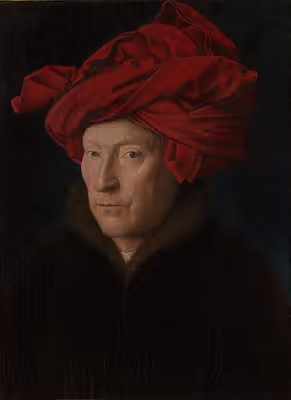
Considered revolutionary within his lifetime, Van Eyck's designs and methods were heavily copied and reproduced. His motto, one of the first and still most distinctive signatures in art history, ALS ICH KAN ("AS I CAN"), a pun on his name, first appeared in 1433 on Portrait of a Man in a Turban, which can be seen as indicating his emerging self-confidence. The years between 1434 and 1436, when he produced the Madonna of Chancellor Rolin, Lucca Madonna and Virgin and Child with Canon van der Paele, are generally considered his high point.
Around 1432, he married Margaret who was 15 years younger. At about the same time he bought a house in Bruges; Margaret is unmentioned before he relocated, when the first of their two children was born in 1434. Very little is known of Margaret; even her maiden name is lost – contemporary records refer to her mainly as Damoiselle Marguerite. She may have been of aristocratic birth, though from the lower nobility, as evidenced from her clothes in the portrait, which are fashionable but not of the sumptuousness worn by the bride in the Arnolfini Portrait. Later, as the widow of a renowned painter Margaret was afforded a modest pension by the city of Bruges. At least some of this income was invested in lottery.
Van Eyck undertook a number of journeys on Philip the Duke of Burgundy's behalf between 1426 and 1429, described in records as "secret" commissions, for which he was paid multiples of his annual salary. Their precise nature is still unknown, but they seem to involve his acting as envoy of the court. In 1426 he departed for "certain distant lands", possibly to the Holy Land, a theory given weight by the topographical accuracy of Jerusalem in The Three Marys at the Tomb, a painting completed by members of his workshop c. 1440.
A better documented commission was the journey to Lisbon along with a group intended to prepare the ground for the Duke's wedding to Isabella of Portugal. Van Eyck was tasked with painting the bride, so that the Duke could visualise her before their marriage. Because Portugal was ridden with plague, their court was itinerant and the Dutch party met them at the out-of-the-way castle of Avis. Van Eyck spent nine months there, returning to the Netherlands with Isabella as a bride to be; the couple married on Christmas Day of 1429. It would have been a challenging task in that Van Eyck would have to be honest as to Isabella’s appearance, whilst also pleasing the model herself. Typically he showed his sitters as dignified, yet did not hide their imperfections. After his return, he was preoccupied with completing the Ghent Altarpiece, which was consecrated on 6 May 1432 at Saint Bavo Cathedral during an official ceremony for Philip. Records from 1437 say that he was held in high esteem by the upper ranks of Burgundian nobility and was employed in foreign commissions.
Death and legacy
Jan van Eyck died on 9 July 1441, in Bruges. He was buried in the graveyard of the Church of St Donatian. As a mark of respect, Philip made a one-off payment to Jan's widow Margaret, to a value equal to the artist's annual salary. He left behind many unfinished works to be completed by his workshop journeymen. After his death, Lambert van Eyck ran the workshop, as Jan's reputation and stature steadily grew. Early in 1442 Lambert had the body exhumed and placed inside St. Donatian's Cathedral.
In 1449 he was mentioned by the Italian humanist and antiquarian Ciriaco de' Pizzicolli as a painter of note and ability, and was recorded by Bartolomeo Facio in 1456.
Sign in to keep reading
3 more chapters are free with a Lably account.
Style
Iconography
The small, subtle details often seen in the background of Van Eyck's works belong to a rich iconography embodying what he believed to be the co-existence of the spiritual and the material. This use of symbolism and biblical references is characteristic of his work, a handling of religious iconography he pioneered, with his innovations taken up and developed by Van der Weyden, Memling and Christus.
Craig Harbison describes the blending of realism and symbolism as perhaps "the most important aspect of early Flemish art". The placement of such symbols into a scene "was a deliberate strategy to create an experience of spiritual revelation". Van Eyck's religious paintings in particular "always present the spectator with a transfigured view of visible reality". To him the day-to-day is harmoniously steeped in symbolism, such that, according to Harbison, "descriptive data were rearranged [...] so that they illustrated not earthly existence but what he considered supernatural truth." This blend of the earthly and the heavenly points to Van Eyck's belief that the "essential truth of Christian doctrine" can be found in "the marriage of secular and sacred worlds, of reality and symbol". He depicts overly large Madonnas, whose unrealistic size shows the separation between the heavenly from the earthly, but placed them in everyday settings such as churches, domestic chambers or seated with court officials.
Yet the earthly churches are heavily decorated with heavenly symbols. A heavenly throne is clearly represented in some domestic chambers (for example in the Lucca Madonna). More difficult to discern are the settings for paintings such as Madonna of Chancellor Rolin, where the location is a fusion of the earthly and celestial. Van Eyck's iconography is often so densely and intricately layered that a work has to be viewed multiple times before even the most obvious meaning of an element is apparent. The symbols were often subtly woven into the paintings so that they only became apparent after close and repeated viewing, while much of the iconography reflects the idea that, according to John Ward, there is a "promised passage from sin and death to salvation and rebirth".
Signature
Van Eyck was the only 15th-century Netherlandish painter to sign his panels. His motto always contained variants of the words ALS ICH KAN (or a variant) – "As I Can", or "As Best I Can", which forms a pun on his name. The aspirated "ICH" instead of the Brabantian "IK" is derived from his native Limburgish. The signature is sometimes inscribed using Greek lettering such as AAE IXH XAN. The word Kan derives from the Middle Dutch word kunnen related to the Dutch word kunst or to the German Kunst ("art").
The words may be related to a type of formula of modesty sometimes seen in medieval literature, where the writer prefaces his work with an apology for its imperfections, although, given the typical lavishness of the signatures and mottos, it may merely be a playful reference. Indeed, his motto is sometimes recorded in a manner intended to mimic Christ's monogram IHC XPC, for example in his c 1440 Portrait of Christ. Further, as the signature is often a variant of "I, Jan van Eyck was here", it can be seen as a, perhaps somewhat arrogant, assertion of both the faithfulness and trustworthiness of the record and the quality of the work (As I (K)Can).
The habit of signing his work ensured that his reputation survived, and attribution has not been as difficult and uncertain as with other first generation artists of the early Netherlandish school. The signatures are usually completed in a decorative script, often of a kind reserved for legal documents, as can be seen in Léal Souvenir and the Arnolfini Portrait, the latter of which is signed "Johannes de eyck fuit hic 1434" ("Jan van Eyck was here 1434"), a way of recording his presence.
Inscriptions
Many of Van Eyck's paintings are heavily inscribed, in lettering of Greek, Latin or vernacular Dutch. Campbell sees in many examples a "certain consistency which suggest that he himself had painted them", rather than they are later additions. The letterings seem to serve different functions depending on the type of work on which they appear. In his single panel portraits they give voice to the sitter, most notably in Portrait of Margaret van Eyck, where the Greek lettering on the frame translates as "My husband Johannes completed me in the year 1439 on 17 June, at the age of 33. As I can."
By contrast, the inscriptions on his commissioned religious paintings are written from the point of view of the patron, and written to serve the patron's piousness, charity and dedication to the saint who the sitter is shown accompanying. An inscription on the Virgin and Child with Canon van der Paele, reads "Joris van der Paele, canon of this church, had this work made by painter Jan van Eyck. And he founded two chaplaincies here in the choir of the Lord. 1434. He only completed it in 1436, however."
Frames
Exceptionally for his time, Van Eyck often signed and dated his frames, then considered an integral part of the work – the two were often painted together, and while the frames were constructed by a body of craftsmen separate to the master's workshop, their work was often considered as equal in skill to that of the painter.
He designed and painted the frames for his single head portraits to look like imitation stone, with the signature or other inscriptions giving the impression that they had been chiseled into the stone. The frames serve other illusionistic purposes; in Portrait of Isabella of Portugal, described by the frame, her eyes gaze coyly but directly out of the painting, as she rests her hands on the edge of a faux stone parapet. With this gesture Isabella extends her presence out of the pictorial space and into that of the viewer.
Many of the original frames are lost and known only through copies or inventory records. The London Portrait of a Man was likely half of a double portrait or pendant; the last record of the original frames contained many inscriptions, but not all were original; the frames were often overpainted by later artists. Portrait of Jan de Leeuw also bears its original frame, which is painted over to look like bronze.
Many of his frames are heavily inscribed, which serves a dual purpose. They are decorative but also function to set the context for the significance of the imagery, similar to the function of margins in medieval manuscripts. Pieces such as the Dresden Triptych were usually commissioned for private devotion, and Van Eyck would have expected the viewer to contemplate text and imagery in unison. The interior panels of the small 1437 Dresden Triptych are outlined with two layers of painted bronze frames, inscribed with mostly Latin lettering. The texts are drawn from a variety of sources, in the central frames from biblical descriptions of the assumption, while the inner wings are lined with fragments of prayers dedicated to saints Michael and Catherine.
Workshop, unfinished or lost works
In the years after Van Eyck's death in the summer of 1441, members of his workshop executed works based on his designs. This was not unusual; the widow of a master would often carry on the business after his death. It is thought that either his wife, Margaret, or brother Lambert took over after 1441. Works thus created include the Ince Hall Madonna, Saint Jerome in His Study, a Madonna of Jan Vos (Virgin and Child with St Barbara and Elizabeth) c. 1443, and others. A number of designs were reproduced by second-generation Netherlandish artists of the first rank, including Petrus Christus, who painted a version of the Exeter Madonna.
After his death, members of his workshop also finished paintings that were incomplete. The upper portions of the right hand panel of the Crucifixion and Last Judgement diptych are generally considered the work of a weaker painter with a less distinctive style. It is thought that Van Eyck died leaving the panel unfinished but with completed underdrawings, so the upper area was finished by workshop members or followers.
There are three works confidently attributed to him but known only from copies. His Portrait of Isabella of Portugal dates to his 1428 visit to Portugal for Philip to draw up a preliminary marriage agreement with the daughter of John I of Portugal. From surviving copies, it can be deduced that there were two other "painted-on" frames apart from the actual oak frame, one of which was lettered with gothic inscription to the top, while a faux stone parapet provided support for her hands to rest upon.
Two extant copies of his Woman Bathing were made in the 60 years after his death, but it is known mostly through its appearance in Willem van Haecht's expansive 1628 painting The Gallery of Cornelis van der Geest, a view of a collector's gallery containing many other identifiable old masters. Woman Bathing bears many similarities to the Arnolfini Portrait, including an interior with a bed and a small dog, a mirror and its reflection, a chest of drawers and clogs on the floor; more broadly similar are the attendant woman's dress, the outline of her figure, and the angle from which she faces.
Reputation and legacy
In the earliest significant source on Van Eyck, a 1454 biography in Genoese humanist Bartolomeo Facio's De viris illustribus, Jan van Eyck is named "the leading painter" of his day. Facio places him among the best artists of the early 15th century, along with Rogier van der Weyden, Gentile da Fabriano, and Pisanello. It is particularly interesting that Facio shows as much enthusiasm for Netherlandish painters as he does for Italian painters. This text sheds light on aspects of Jan van Eyck's production now lost, citing a bathing scene owned by a prominent Italian, but mistakenly attributing to Van Eyck a world map painted by another.
Jan van Eyckplein in Bruges is named for him.