

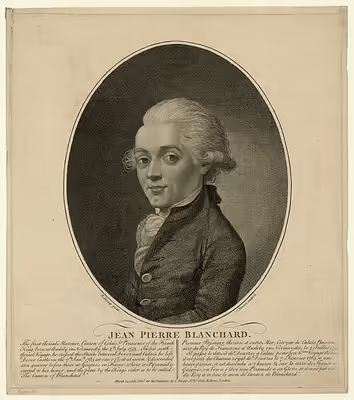
Jean-Pierre Blanchard
French inventor (1753–1809)
- 4 min read
- 3 chapters

Related on Lably
Through Paris, Palace of Versailles and Hot air balloon
Biography
1784 – Flights in Paris
Blanchard made his first successful balloon flight in Paris on 2 March 1784, in a hydrogen gas balloon launched from the Champ de Mars. The first successful manned balloon flight took place on 21 November 1783, when Pilâtre de Rozier and the Marquis d'Arlandes took off at the Palace of Versailles in a free-flying hot air balloon constructed by the Montgolfier brothers. The first manned hydrogen balloon flight took place on 1 December 1783, when Jacques Charles and Nicolas-Louis Robert launched the first gas balloon from the Jardin des Tuileries in Paris. Blanchard's flight nearly ended in disaster, when one spectator (Dupont de Chambon, a contemporary of Napoleon at the École militaire de Brienne) slashed at the balloon's mooring ropes and oars with his sword after being refused a place on board. Blanchard intended to "row" northeast to La Villette but the balloon was pushed by the wind across the Seine to Billancourt and back again, landing in the rue de Sèvres. Blanchard adopted the Latin tag Sic itur ad astra as his motto.
The early balloon flights triggered a phase of the public "balloonomania", with all manner of objects decorated with images of balloons or styled au ballon, from ceramics to fans and hats. Clothing au ballon was produced with exaggerated puffed sleeves, rounded skirts, or with printed images of balloons. Hair was coiffed à la montgolfier, au globe volant, au demi-ballon, or à la Blanchard.
1784 – Flights in London
Blanchard moved to London in August 1784, where he took part in a flight on 16 October 1784 with John Sheldon, just a few weeks after the first flight in Britain (and first outside France), when Italian Vincenzo Lunardi flew from Moorfields to Ware on 15 September 1784. Blanchard's propulsion mechanisms – flapping wings and a windmill – again proved ineffective, but the balloon flew some 115 kilometres (71 mi) from Lewis Lochée's military academy in Little Chelsea, landing in Sunbury and then taking off again to end in Romsey. Blanchard took a second flight on 30 November 1784, taking off with an American, John Jeffries, from the Rhedarium behind Green Street Mayfair, London to Ingress in Kent.
1785 – First flight over the English Channel
A third flight, again with Jeffries, was the first flight over the English Channel, taking about 2½ hours to travel from England to France on 7 January 1785, flying from Dover Castle to Guînes. Blanchard was awarded a substantial pension by Louis XVI. The King ordered the balloon and boat be hung up in the church of Église Notre-Dame de Calais. (A subsequent Channel crossing attempt in the opposite direction by Pilâtre de Rozier on 15 June 1785 ended unsuccessfully in a fatal crash.)
Flights in Europe
Blanchard toured Europe, demonstrating his balloons. He holds the record of first balloon flights in Belgium, Germany, the Netherlands, and Poland. Among the events that included demonstrations of his abilities as a balloonist was the coronation of Holy Roman Emperor Leopold II as King of Bohemia in Prague in September 1791.
Following the invention of the modern parachute in 1783 by Sébastien Lenormand in France, in 1785 Jean-Pierre Blanchard demonstrated it as a means of jumping safely from a balloon. While Blanchard's first parachute demonstrations were conducted with a dog as the passenger, he later had the opportunity to try it himself when in 1793 his hydrogen balloon ruptured and he used a parachute to escape. Subsequent development of the parachute focused on making it more compact. While the early parachutes were made of linen stretched over a wooden frame, in the late 1790s, Blanchard began making parachutes from folded silk, taking advantage of silk's strength and light weight.
1793 – Flights in America
On 9 January 1793, Blanchard conducted the first balloon flight in the Americas. He launched his balloon from the prison yard of Walnut Street Jail in Philadelphia, Pennsylvania and landed at the Clement Oak in Deptford Township, New Jersey. One of the flight's witnesses that day was President George Washington, and the future presidents John Adams, Thomas Jefferson, James Madison, and James Monroe were also present. Blanchard left the United States in 1797.
Sign in to keep reading
2 more chapters are free with a Lably account.
Personal life and death
He married Marie Madeleine-Sophie Armant (better known as Sophie Blanchard) in 1804. On 20 February 1808 Blanchard had a heart attack while in his balloon at The Hague. He fell from the balloon and died roughly a year later on 7 March 1809 due to severe injuries. His widow continued to support herself with ballooning demonstrations until doing so also killed her.