


Related on Lably
Through Atelier
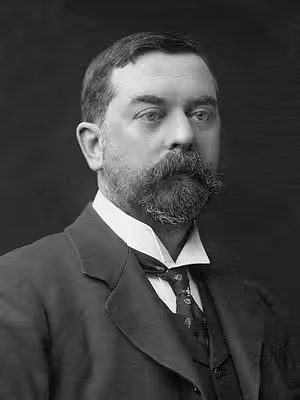
Born in Florence to American parents, he was trained there and in Paris before moving to London, living most of his life in Europe. He enjoyed international acclaim as a portrait painter. An early submission to the Paris Salon in the 1880s, his Portrait of Madame X, was intended to consolidate his position as a society painter in Paris but instead resulted in scandal. During the year following the scandal, Sargent departed for England, where he continued a successful career as a portrait artist.
From the beginning, Sargent's work is characterized by remarkable technical facility, particularly in his ability to draw with a brush, which in later years inspired admiration as well as criticism for its supposed superficiality. His commissioned works were consistent with the grand manner of portraiture, while his informal studies and landscape paintings displayed a familiarity with Impressionism. In later life, Sargent expressed ambivalence about the restrictions of formal portrait work and devoted much of his energy to mural painting and working en plein air. Art historians generally ignored society artists such as Sargent until the late 20th century.
The exhibition in the 1980s of Sargent's previously hidden male nudes served to spark a reevaluation of his life and work, and its psychological complexity. In addition to the beauty, sensation and innovation of his oeuvre, his same-sex interests, unconventional friendships with women and engagement with race, gender nonconformity, and emerging globalism are now viewed as socially and aesthetically progressive and radical.
Early life
Sargent was a descendant of Epes Sargent, a colonial military leader and jurist. Before John Singer Sargent's birth, his father, FitzWilliam (b. 1820 in Gloucester, Massachusetts), was an eye surgeon at the Wills Eye Hospital in Philadelphia from 1844 to 1854. After John's older sister died at the age of two, his mother, Mary Newbold Sargent (née Singer, 1826–1906), suffered a breakdown, and the couple decided to go abroad to recover. They remained nomadic expatriates for the rest of their lives. Although based in Paris, Sargent's parents moved regularly, spending seasons at the sea and at mountain resorts in France, Germany, Italy, and Switzerland.
While Mary was pregnant, they stopped in Florence, Tuscany, because of a cholera epidemic. Sargent was born there in 1856. A year later, his sister Mary was born. After her birth, FitzWilliam reluctantly resigned his post in Philadelphia and accepted his wife's request to remain abroad. They lived modestly on a small inheritance and savings, leading a quiet life with their children. They generally avoided society and other Americans, except for friends in the art world. Four more children were born abroad, of whom only two lived past childhood.
Although his father was a patient teacher of basic subjects, young Sargent was a rambunctious child, more interested in outdoor activities than his studies. As his father wrote home: "He is quite a close observer of animated nature." His mother was convinced that traveling around Europe, and visiting museums and churches, would give young Sargent a satisfactory education. Several attempts to have him formally schooled failed, owing mostly to their itinerant life. His mother was a capable amateur artist and his father was a skilled medical illustrator. Early on, she gave him sketchbooks and encouraged drawing excursions. Sargent worked on his drawings, and he enthusiastically copied images from The Illustrated London News of ships and made detailed sketches of landscapes. FitzWilliam had hoped that his son's interest in ships and the sea might lead him toward a naval career.
At thirteen, his mother reported that John "sketches quite nicely, & has a remarkably quick and correct eye. If we could afford to give him really good lessons, he would soon be quite a little artist". At the age of thirteen, he received some watercolor lessons from Carl Welsch, a German landscape painter. Although his education was far from complete, Sargent grew up to be a highly literate and cosmopolitan young man, accomplished in art, music, and literature. He was fluent in English, French, Italian, and German. At seventeen, Sargent was described as "willful, curious, determined and strong" (after his mother) yet shy, generous, and modest (after his father). He was well-acquainted with many of the great masters from first-hand observation, as he wrote in 1874: "I have learned in Venice to admire Tintoretto immensely and to consider him perhaps second only to Michelangelo and Titian."
Sign in to keep reading
8 more chapters are free with a Lably account.
Training
An attempt to study at the Academy of Florence failed, as the school was reorganizing at the time. After returning to Paris from Florence, Sargent began his art studies with the young French portraitist Carolus-Duran. Following a meteoric rise, the artist was noted for his bold technique and modern teaching methods; his influence would be pivotal to Sargent during the period from 1874 to 1878.
In 1874, Sargent passed on his first attempt the rigorous exam required to gain admission to the École des Beaux-Arts, the premier art school in France. He took drawing classes with Adolphe Yvon, which included anatomy and perspective, and gained a silver prize. He also spent much time in self-study, drawing in museums and painting in a studio he shared with James Carroll Beckwith. He became both a valuable friend and Sargent's primary connection with the American artists abroad. Sargent also took some lessons from Léon Bonnat.
Carolus-Duran's atelier was progressive, dispensing with the traditional academic approach, which required careful drawing and underpainting, in favor of the alla prima method of working directly on the canvas with a loaded brush, derived from Diego Velázquez. It was an approach that relied on the proper placement of tones of paint. Sargent would later create a painting in this style that prompted comments such as: "The student has surpassed the teacher."
This approach also permitted spontaneous flourishes of color not bound to an underdrawing. It was markedly different from the traditional atelier of Jean-Léon Gérôme, where Americans Thomas Eakins and Julian Alden Weir had studied. Sargent was the star student in short order. Weir met Sargent in 1874 and noted that Sargent was "one of the most talented fellows I have ever come across; his drawings are like the old masters, and his color is equally fine". Sargent's excellent command of French and his superior talent made him both popular and admired. Through his friendship with Paul César Helleu, Sargent would meet giants of the art world, including Degas, Rodin, Monet, and Whistler.
Sargent's early enthusiasm was for landscapes, not portraiture, as evidenced by his voluminous sketches full of mountains, seascapes, and buildings. Carolus-Duran's expertise in portraiture finally influenced Sargent in that direction. Commissions for history paintings were still considered more prestigious, but were much harder to get. Portrait painting, on the other hand, was the best way of promoting an art career, getting exhibited in the Salon, and gaining commissions to earn a livelihood.
Sargent's first major portrait was of his friend Fanny Watts in 1877, and was also his first Salon admission. Its particularly well-executed pose drew attention. His second salon entry was the Oyster Gatherers of Cancale, an impressionistic painting of which he made two copies, one of which he sent back to the United States, and both received warm reviews.
Early career
In 1879 at the age of 23, Sargent painted a portrait of his teacher Carolus-Duran; the virtuoso effort met with public approval and announced the direction his mature work would take. Its showing at the Paris Salon was both a tribute to his teacher and an advertisement for portrait commissions. Of Sargent's early work, Henry James wrote that the artist offered "the slightly 'uncanny' spectacle of a talent which on the very threshold of its career has nothing more to learn".
After leaving Carolus-Duran's atelier, Sargent visited Spain. There he studied the paintings of Velázquez with a passion, absorbing the master's technique, and in his travels gathered ideas for future works. He was entranced with Spanish music and dance. The trip also re-awakened his own talent for music (which was nearly equal to his artistic talent), and which found visual expression in his early masterpiece El Jaleo (1882). Music would continue to play a major part in his social life as well, as he was a skillful accompanist of both amateur and professional musicians. Sargent became a strong advocate for modern composers, especially Gabriel Fauré.
Trips to Italy provided sketches and ideas for several Venetian street-scene genre paintings, which effectively captured gestures and postures he would find useful in later portraiture.
Upon his return to Paris, Sargent quickly received several portrait commissions. His career was launched. He immediately demonstrated the concentration and stamina that enabled him to paint with workman-like steadiness for the next twenty-five years. He filled in the gaps between commissions with many non-commissioned portraits of friends and colleagues. His fine manners, perfect French, and great skill made him a standout among the newer portraitists, and his fame quickly spread. He confidently set high prices and turned down unsatisfactory sitters. He mentored his friend Emil Fuchs, who was learning to paint portraits in oils.
Relationships and personal life
Sargent was a life-long bachelor with a wide circle of friends, including Oscar Wilde (with whom he was neighbors for several years), gay author Vernon Lee, and his likely lover Albert de Belleroche. Biographers once portrayed him as staid and reticent. Recent scholarship has suggested he was a private, complex and passionate man whose homosexual identity was integral to shaping his art. This view is based on statements by his friends and associates, the general alluring remoteness of his portraits, the way his works challenge 19th-century notions of gender difference, his previously ignored male nudes, and some male portraits, including those of Thomas McKeller, Bartholomy Maganosco, Olimpio Fusco and that of aristocratic artist Albert de Belleroche, that hung in his Chelsea dining room. Sargent had a long friendship with Belleroche, whom he met in 1882 and traveled with frequently. A surviving drawing suggests Sargent might have used him as a model for Madame X, following a coincidence of dates for Sargent drawing each of them separately around the same time and the delicate pose suggestive more of Sargent's sketches of the male form than his often stiff commissions.
It has been suggested that Sargent's reputation in the 1890s as "the painter of the Jews" may have been due to his empathy with and complicit enjoyment of their mutual social foreignness. One Jewish client, Betty Wertheimer, wrote that when in Venice, Sargent "was only interested in the Venetian gondoliers". The painter Jacques-Émile Blanche, who was one of his early sitters, said after Sargent's death that his sex life "was notorious in Paris, and in Venice, positively scandalous. He was a frenzied bugger".
He had many friendships with women such as his sitters Rosina Ferrara, Virginie Gautreau, and Judith Gautier. Sargent's friends and supporters included Henry James and Isabella Stewart Gardner, of both of whom he painted portraits, and Gardner also commissioned and purchased works from Sargent and sought his advice on other acquisitions. Edward VII and Paul César Helleu were also friends and supporters of Sargent. His associations also included Prince Edmond de Polignac and Count Robert de Montesquiou. Other artists Sargent associated with were Dennis Miller Bunker, James Carroll Beckwith, Edwin Austin Abbey and John Elliott (who also worked on the Boston Central Library murals). He spent most of his life in Europe, where he was a close associate of his distant cousins, Francis Brooks Chadwick and Ralph Wormeley Curtis. Francis David Millet, Joaquín Sorolla and Claude Monet, whom Sargent portrayed with Monet's wife "by the edge of a wood". Between 1905 and 1914, Sargent's frequent traveling companions were the married artist couple Wilfrid de Glehn and Jane Emmet de Glehn. The trio would often spend summers in France, Spain, or Italy and all three would depict one another in their paintings during their travels.
Critical assessment
In a time when the art world focused, in turn, on Impressionism, Fauvism, and Cubism, Sargent practiced his own form of Realism, which made brilliant references to Velázquez, Van Dyck, and Gainsborough. His seemingly effortless facility for paraphrasing the masters in a contemporary fashion led to a stream of commissioned portraits of remarkable virtuosity (Arsène Vigeant, 1885, Musées de Metz; Mr. and Mrs. Isaac Newton Phelps-Stokes, 1897, Metropolitan Museum of Art, New York) and earned Sargent the moniker, "the Van Dyck of our times". In 1916, he was awarded an honorary degree by Harvard University.
Still, during his life his work engendered negative responses from some of his colleagues: Camille Pissarro wrote "he is not an enthusiast but rather an adroit performer", and Walter Sickert published a satirical turn under the heading "Sargentolatry". By the time of his death, he was dismissed as an anachronism, a relic of the Gilded Age and out of step with the artistic sentiments of post-World War I Europe. Elizabeth Prettejohn suggests that the decline of Sargent's reputation was due partly to the rise of anti-Semitism, and the resultant intolerance of 'celebrations of Jewish prosperity.' It has been suggested that the exotic qualities inherent in his work appealed to the sympathies of the Jewish clients whom he painted from the 1890s on.
Nowhere is this more apparent than in his portrait Almina, Daughter of Asher Wertheimer (1908), in which the subject is seen wearing a Persian costume, a pearl encrusted turban, and strumming an Indian tambura, accoutrements all meant to convey sensuality and mystery. If Sargent used this portrait to explore issues of sexuality and identity, it seems to have met with the satisfaction of the subject's father, Asher Wertheimer, a wealthy Jewish art dealer.
Foremost of Sargent's detractors was the influential English art critic Roger Fry, of the Bloomsbury Group, who at the 1926 Sargent retrospective in London dismissed Sargent's work as lacking aesthetic quality: "Wonderful indeed, but most wonderful that this wonderful performance should ever have been confused with that of an artist." In the 1930s, Lewis Mumford led a chorus of the severest critics: "Sargent remained to the end an illustrator ... the most adroit appearance of workmanship, the most dashing eye for effect, cannot conceal the essential emptiness of Sargent's mind, or the contemptuous and cynical superficiality of a certain part of his execution."
Part of Sargent's devaluation is also attributed to his expatriate life, which made him seem less American at a time when "authentic" socially conscious American art, as exemplified by the Stieglitz circle and by the Ashcan School, was on the ascent.
After such a long period of critical disfavor, Sargent's reputation has increased steadily since the 1950s. In the 1960s, a revival of Victorian art and new scholarship directed at Sargent strengthened his reputation. Sargent has been the subject of large-scale exhibitions in major museums, including a retrospective exhibition at the Whitney Museum of American Art in 1986 and a major 1999 traveling show John Singer Sargent that exhibited at the Museum of Fine Arts, Boston, the National Gallery of Art Washington, and the Tate Gallery, London.
In 1999, the Grey Art Museum exhibited John Singer Sargent, Draughtsman: Works from the Corcoran Gallery of Art. The exhibit featured over 90 drawings spanning Sargent's career and included ones for the Boston Public Library.
In 2000, the Metropolitan Museum of Art exhibited John Singer Sargent Beyond the Portrait Studio: Paintings, Drawings, and Watercolors from the Collection. The exhibit featured over 100 paintings, drawings, and watercolors from the Museum's collection.
In 2013, the Brooklyn Museum of Art and Museum of Fine Arts, Boston collaborated to exhibit John Singer Sargent Watercolors. The exhibit focused on his technique in producing his watercolors and included videos recreating them. The show also traveled to the Museum of Fine Arts, Houston. Erica E. Hirshler authored the catalog ISBN 978-0878467921
In 2015, the Metropolitan Museum of Art and National Portrait Gallery, London collaborated on Sargent: Portraits of Artists and Friends. The exhibit focused on Sargent's portraits of various artists, writers and actors from his artistic circle, painted in both oil and watercolors. The National Portrait Gallery, London, version exhibited over 70 of the portraits from February 12 – May 25, 2015. The Metropolitan Museum of Art version displayed over 90 of the portraits from June 30 – October 4, 2015. The catalog was written by Richard Ormond. ISBN 978-0-847-84527-9
From March 1 – May 14, 2017, the Philadelphia Museum of Art exhibited American Watercolor in the Age of Homer and Sargent. The catalog was written by Kathleen A. Foster ISBN 978-0-300-22589-1
In 2020, the National Portrait Gallery and the Morgan Library & Museum exhibited his works in John Singer Sargent: Portraits in Charcoal. The catalog was written by Richard Ormond. ISBN 978-1911282488
From October 8, 2021 – May 8, 2022 the Smithsonian American Art Museum exhibited his works in Sargent, Whistler, and Venetian Glass: American Artists and the Magic of Murano. The exhibit featured works by Sargent, James Whistler, Frank Duveneck, Thomas Moran, William Merritt Chase, Maurice Prendergast, Maxfield Parrish, Louise Cox, and Ellen Day Hale, along with Venetian glass works. The catalog by Crawford Alexander Mann, et al. was published with the exhibit. ISBN 9780691222677
In 2022, the National Gallery of Art in Washington, DC, and in 2023 the Legion of Honor in San Francisco, California, hosted an exhibition of Sargent and Spain that documented Sargent's fascination with Spain. The catalog was written by Sarah Cash, Elaine Kilmurray, and Richard Ormond. ISBN 978-0300266467 A companion exhibit Photography and Travel in Sargent's Spain was shown in the National Gallery's Library.
In 2023 the Museum of Fine Arts Boston and the Tate Britain presented Fashioned by Sargent. Sargent would choose the clothing his clients wore in their portraits. ISBN 978-0878468942
In 2025 the Metropolitan Museum of Art and Musée d'Orsay, Paris collaborated on Sargent and Paris focusing on his early career. The exhibit was shown at the Metropolitan Museum April 27– August 3, 2025 and the Musée d'Orsay, Paris (originally titled Sargent: The Paris Years, retitled Sargent: Dazzling Paris) September 23, 2025 – January 11, 2026. A catalog of the same name by Stephanie L. Herdrich was published in 2025. (ISBN 9781588397959) As a complement to Sargent and Paris the Metropolitan Museum of Art exhibited Emily Sargent: Portrait of a Family. The exhibit featured works by Sargent's sister Emily and focused on her watercolors, as well as those of her brother and mother, and was shown from July 1, 2025 – March 8, 2026.
In 1986, Andy Warhol commented to Sargent scholar Trevor Fairbrother that Sargent "made everybody look glamorous. Taller. Thinner. But they all have mood, every one of them has a different mood." In a Time magazine article from the 1980s, critic Robert Hughes praised Sargent as "the unrivaled recorder of male power and female beauty in a day that, like ours, paid excessive court to both".
Later life
Sargent lived in London from 1901 until his death in 1925, during which time he helped guide young artist David Bomberg who sat as model for Sargent in 1907 and whom Sargent helped get a place at the Slade School of Art in 1911. In 1922, Sargent co-founded New York City's Grand Central Art Galleries together with Edmund Greacen, Walter Leighton Clark, and others. Sargent actively participated in the Grand Central Art Galleries and their academy, the Grand Central School of Art, until his death in 1925. The Galleries held a major retrospective exhibit of Sargent's work in 1924. He then returned to England, where he died at his Chelsea home on April 14, 1925, of heart disease. Sargent is interred in Brookwood Cemetery (Plot 35) near Woking, Surrey.
Memorial exhibitions
Memorial exhibitions of Sargent's work were held in Boston in 1925, at the Metropolitan Museum of Art in New York and at the Royal Academy of Arts and Tate Gallery in London in 1926. The Grand Central Art Galleries also organized a posthumous exhibition in 1928 of previously unseen sketches and drawings from throughout his career.
Sales
Portrait of Robert Louis Stevenson and his Wife was sold in 2004 for US$8.8 million and is located at Crystal Bridges Museum of American Art at Bentonville, Arkansas.
In December 2004, Group with Parasols (A Siesta) (1905) sold for US$23.5 million, nearly double the Sotheby's estimate of $12 million. The previous highest price for a Sargent painting was US$11 million.
In popular culture
In 2018, Comedy Central star Jade Esteban Estrada wrote, directed, and starred in Madame X: A Burlesque Fantasy, a stage production (premiered in San Antonio, Texas) based on the life of Sargent and his famous painting, Portrait of Madame X.
The works of Sargent feature prominently in Maggie Stiefvater's 2021 novel Mister Impossible.
In 2024, Exhibition on Screen produced a documentary John Singer Sargent: Fashion & Swagger, filmed at the Museum of Fine Arts, Boston and the Tate Britain, London. It was based on the Sargent and fashion exhibits at those two museums in 2023 and 2024.
On July 13, 2024, the Des Moines Metro Opera premiered Damien Geter and Lila Palmer's "American Apollo", an opera about John Singer Sargent's supposed affair with Thomas McKeller (1890–1962), one of his favorite models.
Sargent, played by Bobby Steggert, appears as a fictional character in the third season of the 2022 HBO series The Gilded Age.