

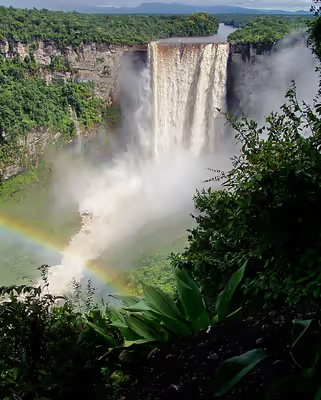
Kaieteur Falls
Waterfall in the Essequibo
- 3 min read
- 3 chapters

Related on Lably
Upriver from the falls, the Potaro Plateau stretches out to the distant escarpment of the Pakaraima Mountains. The Potaro River empties into the Essequibo River which is the 34th longest river in South America and the longest river in Guyana.
History and discovery
Long known about by Indigenous nations in the area, the falls were noticed by Europeans in 1870 by a party led by Charles Barrington Brown, a British geologist appointed as a government surveyor to the colony of British Guiana. Brown and his partner James Sawkins had arrived in Georgetown in 1867; they worked both together and independently, which resulted in Brown discovering the falls alone. He did not have time to investigate Kaieteur Falls closely, so he returned one year later to make comprehensive measurements. Brown's book Canoe and Camp life in British Guiana was published in 1876. Two years later, in 1878, he published Fifteen Thousand Miles on the Amazon and its tributaries.
According to a Patamona Indian legend, Kaieteur Falls was named for Kuik'tuwuk old man or man, a Toshao (chief) who sacrificed himself. Makonaima is a god for Patomana people so by paddling over the falls to save his people. Another legend though was told to Brown by indigenous people on the night of discovery of the falls. Thus, the fall was named "Kaieteur"(kuik-man, tu'wuk -large place, falls means e'me'lú which means "old-man-fall").
Sign in to keep reading
2 more chapters are free with a Lably account.
Tourism
Kaieteur Falls is a major tourist attraction in Guyana. It is in Kaieteur National Park in the centre of Guyana's rainforest. The park is served by Kaieteur International Airport, about a 15-minute walk from the top of Kaieteur falls, with frequent flights to Ogle Airport and Cheddi Jagan International Airport in Georgetown.
Popular culture
Kaieteur Falls is featured in:
- the documentary film The White Diamond by Werner Herzog and Animal Planet's River Monsters with Jeremy Wade.
- the science fiction animation television series G Gundam. The lead character trains and bathes under the falls before his final fight.
- the opening of the fourth season credits of the Discovery Channel's series Gold Rush (2013). It also features in the body of a few episodes of that season.
- episode 6 of David Attenborough's series Life on Earth in which the native frogs, which thrive in the moist conditions, are discussed.
- episode 1 of Steve Backshall's series Deadly Adventures where Steve abseils to the bottom and camps overnight.
- the ending of the final episode of the fourth season of River Monsters features the falls.
- Evelyn Waugh's 1934 travel book Ninety-two Days.