

Kenjiro Takayanagi
Japanese pioneer in the development of television (1899–1990)
- 2 min read
- 2 chapters

Related on Lably
Through Electricity and Signal
Career
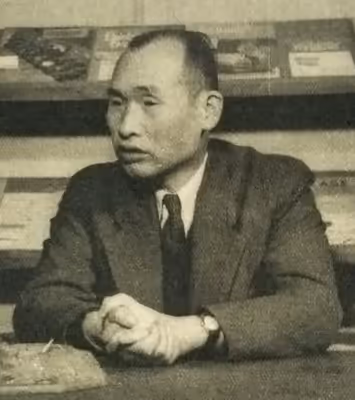
In 1925, Takayanagi began research on television after reading about the new technology in a French magazine. He developed a system similar to that of John Logie Baird, using a Nipkow disk to scan the subject and generate electrical signals. Unlike Baird's display method, Takayanagi used a cathode ray tube to display the received signal, thereby demonstrating electronic image reception. On December 25, 1926, Takayanagi successfully demonstrated his system at Hamamatsu Industrial High School, where he was teaching at the time (the school is now the Faculty of Engineering at Shizuoka University). The first picture he transmitted was of the Japanese katakana character イ made up of 40 scan lines. This was several months before Philo T. Farnsworth demonstrated his first fully electronic system in San Francisco on September 7, 1927, which did not require a Nipkow disk. (See History of television.)
In subsequent years, Takayanagi continued to play a key role in the development of television at NHK (the Japan Broadcasting Corporation), where he worked on higher-line electronic television systems, including a 40-line image of a human face by 1933, and then at JVC (Victor Company of Japan), where he eventually became vice president. In the late 1950s, he developed a two-head, helical scan video tape recorder. He was also involved in the development of color television. In 1984, he created his own foundation for the study of electronics. In 1988, he became the first Japanese person to become an honorary member of the Society of Motion Picture and Television Engineers He died of pneumonia in 1990 at the age of 91.
Sign in to keep reading
One more chapter is free with a Lably account.
Honours
From the corresponding article in the Japanese Wikipedia
- Medal of Honour with Purple Ribbon – 29 April 1955
- Person of Cultural Merit – 3 November 1980
- Order of Culture – 3 November 1981
- SMPTE Honorary member – October 1988
- Grand Cordon of the Order of the Sacred Treasure – 29 April 1989 (Second Class, Gold and Silver Star: 3 November 1974)
- Work on development of television named an IEEE Milestone in 2009.