


Related on Lably
Kernite is soluble in cold water and alters to tincalconite when it dehydrates. It undergoes a non-reversible alteration to metakernite (Na
2B
4O
7·5H
2O) when heated to above 100 °C.
Occurrence and history
The mineral occurs in sedimentary evaporite deposits in arid regions.
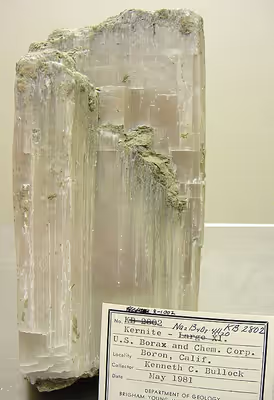
Kernite was discovered in 1926 in eastern Kern County, in Southern California, and later renamed after the county. The location was the US Borax Mine at Boron in the western Mojave Desert. This type material is stored at Harvard University, Cambridge, Massachusetts, and the National Museum of Natural History, Washington, D.C.
The Kern County mine was the only known source of the mineral for a period of time. More recently, kernite is mined in Argentina and Turkey.
The largest documented, single crystal of kernite measured 2.44 x 0.9 x 0.9 m3 and weighed ~3.8 tons.
Sign in to keep reading
One more chapter is free with a Lably account.