


Related on Lably
Through Constellation, Nebula and Light-year
Characteristics
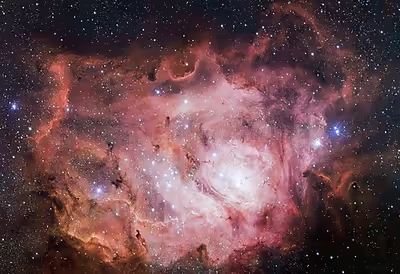
Located approximately 4,000–6,000 light-years from Earth, the nebula spans 110 by 50 light-years (appearing as 90' by 40' in Earth's sky). While appearing pink in long-exposure photographs, it typically appears gray when viewed through binoculars or telescopes due to the human eye's limited color sensitivity in low-light conditions. The nebula contains the young open cluster NGC 6530 within its structure.
The Lagoon Nebula features several distinctive structures, including:
- Multiple Bok globules cataloged by E. E. Barnard (B88, B89, and B296)
- A funnel-shaped structure formed by ultraviolet radiation from a hot O-type star
- The centrally-located Hourglass Nebula (named by John Herschel), distinct from the Engraved Hourglass Nebula in Musca
Observations in 2006 revealed four Herbig–Haro objects within the Hourglass structure, providing direct evidence of ongoing star formation through accretion processes.