


Related on Lably
Through Adaptive radiation and Biological interaction
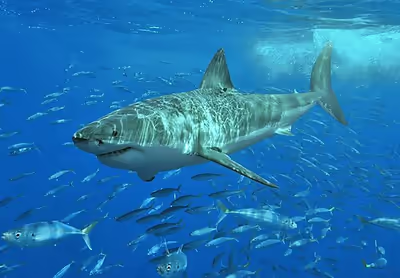
Members of the order are distinguished by possessing two dorsal fins, an anal fin, five gill slits, eyes without nictitating membranes, and a mouth extending behind the eyes. Species in two families of Lamniformes – Lamnidae and Alopiidae – are distinguished for maintaining a higher body temperature than the surrounding waters.
Members of the group include macropredators, generally of medium-large size, including the largest macropredatory shark ever, the extinct Otodus megalodon, as well as large planktivores.
Although some authors have argued that the Late Jurassic Palaeocarcharias should be considered the oldest known lamniform, this is disputed. The earliest unambiguous records of lamniformes are from the Early Cretaceous. Lamniformes underwent a major adaptive radiation during the Cretaceous and became prominent elements of oceanic ecosystems. They reached their highest diversity during the Late Cretaceous, but severely declined during the K-Pg extinction, before rebounding to a high but lower diversity peak during the Paleogene. Lamniformes have declined in diversity since the Eocene, with only 15 species alive today, compared to over 290 extant species in the Carcharhiniformes, which have evolved into medium and large body sizes during the same timeframe. The causes of the decline are uncertain, but are likely to have involved both biotic factors like competition and non-biotic factors like temperature and sea level.
Species
The order Lamniformes includes 10 families with 22 species, with a total of eight living families and 15 living species:
Order Lamniformes
- Family Alopiidae Bonaparte, 1838 (thresher sharks)
- Genus Alopias Rafinesque, 1810
- Alopias pelagicus Nakamura, 1935 (pelagic thresher)
- Alopias superciliosus R. T. Lowe, 1841 (bigeye thresher)
- Alopias vulpinus (Bonnaterre, 1788) (common thresher)
- Genus Alopias Rafinesque, 1810
- Family †Anacoracidae Capetta, 1987 (extinct, Cretaceous period)
- Genus †Squalicorax (crow sharks)
- Genus †Scindocorax
- Genus †Nanocorax
- Genus †Ptychocorax
- Family †Aquilolamnidae Vullo et al., 2021? (eagle sharks) (extinct, Late Cretaceous period)
- Genus †Aquilolamna Vullo et al., 2021
- †Aquilolamna milarcae Vullo et al., 2021
- Genus †Aquilolamna Vullo et al., 2021
- Family Carchariidae Müller & Henle, 1838
- Genus Carcharias Rafinesque, 1810
- Carcharias taurus Rafinesque, 1810 (sand tiger shark)
- Genus Carcharias Rafinesque, 1810
- Family Cetorhinidae Gill, 1862
- Genus Cetorhinus Blainville, 1816
- Cetorhinus maximus (Gunnerus, 1765) (basking shark)
- †Cetorhinus huddlestoni (Welton, 2014)
- †Cetorhinus piersoni (Welton, 2015)
- Genus †Keasius (Welton, 2013)
- Genus Cetorhinus Blainville, 1816
- Family †Eoptolamnidae (extinct, Late Cretaceous period)
- Genus †Eoptolamna
- †Eoptolamna eccentrolopha
- Genus †Leptostyrax
- †Leptostyrax macrorhiza
- Genus †Protolamna
- †Protolamna sokolovi
- †Protolamna borodini
- †Protolamna carteri
- †Protolamna compressidens
- †Protolamna gigantea
- †Protolamna roanokeensis
- Genus †Eoptolamna
- Family Lamnidae J. P. Müller and Henle, 1838 (mackerel sharks or white sharks)
- Genus Carcharodon A. Smith, 1838
- Carcharodon carcharias (Linnaeus, 1758) (great white shark)
- †Carcharodon hubbelli Ehret, Macfadden, Jones, Devries, Foster & Salas-Gismondi, 2012 (Hubbell's white shark)
- †Carcharodon caifassii Lawley, 1876
- †Carcharodon carcharias-f Linnaeus, 1758
- Genus Isurus Rafinesque, 1810
- Isurus oxyrinchus Rafinesque, 1810 (shortfin mako)
- Isurus paucus Guitart-Manday, 1966 (longfin mako)
- Genus Lamna Cuvier, 1816
- Lamna ditropis Hubbs & Follett, 1947 (salmon shark)
- Lamna nasus (Bonnaterre, 1788) (porbeagle)
- Genus Carcharodon A. Smith, 1838
- Family †Otodontidae Gluckman, 1964 (extinct, Late Cretaceous to Pliocene) (megatoothed sharks)
- Genus †Cretalamna Gluckman, 1958
- Genus †Otodus (Agassiz, 1843)
- †Otodus obliquus (Agassiz, 1838)
- †Otodus angustidens (Agassiz, 1843)
- †Otodus chubutensis (Agassiz, 1843)
- †Otodus megalodon (Agassiz, 1843) (megalodon)
- †Otodus auriculatus (Jordan, 1923)
- †Otodus sokolovi (Zhelezko and Kozlov, 1999)
- †Otodus poseidoni (Zhelezko and Kozlov, 1999)
- †Otodus minor (Giebel, 1943)
- †Otodus hastalis (Lawley, 1876)
- †Otodus limhamnensis (Davis, 1890)
- †Otodus debrayi (Leriche, 1906)
- †Otodus naidini (Zhelezko in Zhelezko & Kozlov)
- Genus †Megaselachus
- †Megaselachus subauriculatus? (Glickman, 1964)
- Genus †Megalolamna Shimada et al., 2016
- Genus †Palaeocarcharodon Casieer, 1960
- Genus †Kenolamna Siversson, 2017
- Family Megachasmidae Taylor, Compagno & Struhsaker, 1983
- Genus Megachasma Taylor, Compagno & Struhsaker, 1983
- Megachasma pelagios Taylor, Compagno & Struhsaker, 1983 (megamouth shark)
- Genus Megachasma Taylor, Compagno & Struhsaker, 1983
- Family Mitsukurinidae D. S. Jordan, 1898
- Genus Mitsukurina D. S. Jordan, 1898
- Mitsukurina owstoni D. S. Jordan, 1898 (goblin shark)
- Genus Mitsukurina D. S. Jordan, 1898
- Family Odontaspididae Müller & Henle, 1839
- Genus Odontaspis Agassiz, 1838
- Odontaspis ferox (Risso, 1810) (smalltooth sand tiger)
- Odontaspis noronhai (Maul, 1955) (bigeye sand tiger)
- Genus Odontaspis Agassiz, 1838
- Family Pseudocarchariidae Compagno, 1973
- Genus Pseudocarcharias Cadenat, 1963
- Pseudocarcharias kamoharai (Matsubara, 1936) (crocodile shark)
- Genus Pseudocarcharias Cadenat, 1963
- Family †Cardabiodontidae (extinct, Late Cretaceous period)
- Genus †Cardabiodon Siverson, 1999
- †Cardabiodon ricki Siverson, 1999
- †Cardabiodon venator Siverson and Lindgren, 2005
- Genus †Dwardius Siverson, 1999
- Genus †Parotodus? Cappetta, 1980
- Genus †Cardabiodon Siverson, 1999
- Family †Cretoxyrhinidae (extinct, Late Cretaceous period)
- Genus †Cretoxyrhina Agassiz, 1843
- †Cretoxyrhina vraconensis Zhelezko, 2000
- †Cretoxyrhina denticulata Glückman, 1957
- †Cretoxyrhina agassizensis Underwood and Cumbaa, 2010
- †Cretoxyrhina mantelli Agassiz, 1843 (ginsu shark)
- Genus †Cretoxyrhina Agassiz, 1843
- Family †Serratolamnidae
- Genus †Serratolamna
- Family †Ptychodontidae (extinct, Cretaceous period)
- Genus †Ptychodus (16+ species)