

Language isolate
Language that has no demonstrable genetic relationship with other languages
- 6 min read
- 5 chapters

Related on Lably
"Isolate" does not mean that a language has no relatives, only that any relationships are too distant to be detectable. Most established families of oral languages – including isolates – are assumed to be related to each other at a time depth too great for us to reconstruct. (See linguistic monogenesis.)
Another possibility is that the language arose independently and does not share a common linguistic genesis with any other language. This possibility is often posited for sign languages that are thought to have developed independently of other oral or sign languages.
In some classifications, a language may be counted as an isolate once all known relatives are extinct. An example is the Ket language spoken in central Siberia, which belongs to the wider Yeniseian family, all the others of which are now extinct. Ket is thus an isolate in the current context. However, most classifications do not count Ket as a language isolate because it does have demonstrable relatives, even if they no longer exist except in recorded data. If those relatives had gone extinct without being recorded, then Ket would be an isolate in the stricter sense.
Isolates may be reclassified as larger families if some of their purported dialects are later judged to be sufficiently different from each other to count as different languages. Examples include the erstwhile isolates of Japanese and Georgian: Japanese is now considered to be the Japonic language family (which includes the Ryukyuan languages), and Georgian to be the Kartvelian language family.
There is a difference between language isolates and unclassified languages, but they can be difficult to differentiate when data is limited. If comparative efforts do prove fruitful, a language previously considered an isolate may be reclassified as being part of a larger language family, as happened with the Yanyuwa language of northern Australia, now placed in the Pama–Nyungan family. Since linguists do not always agree on whether a genetic relationship has been demonstrated, it is often disputed whether a particular language is an isolate.
Genetic relationships
A genetic relationship is when two different languages are descended from a common ancestral language. This is what makes up a language family, which is a set of languages for which sufficient evidence exists to demonstrate that they descend from a single ancestral language and are therefore genetically related. For example, English is related to other Indo-European languages and Mandarin Chinese is related to other Sino-Tibetan languages. By this criterion, each language isolate constitutes a family of its own.
Isolates at the family level are not to be confused with lower-level isolates, single languages that form a primary branch of a larger language family. Examples are Armenian, an isolate within the Indo-European family, and Paiwan, an isolate within the Austronesian family.
Sign in to keep reading
4 more chapters are free with a Lably account.
Extinct isolates
Caution is required when speaking of extinct languages as language isolates. Despite their great age, Sumerian and Elamite can be safely classified as isolates, as the languages are well enough documented that, if modern relatives existed, they would be recognizably related. A language thought to be an isolate may turn out to be related to other languages once enough material is recovered, but this is unlikely for extinct languages whose written records have not been preserved.
Many extinct languages are very poorly attested, which may lead to them being considered unclassified languages (or even unclassifiable languages) rather than language isolates. This occurs when linguists do not have enough information on a language to classify it as either a language isolate or as a part of another language family.
Isolates v. unclassified languages
Unclassified languages are different from language isolates in that they have no demonstrable genetic relationships to other languages due to a lack of sufficient data. In order to be considered a language isolate, a language needs to have sufficient data for comparisons with other languages through methods of historical-comparative linguistics to show that it does not have any detectable genetic relationships.
Many extinct and living languages today are very poorly attested, and the fact that they cannot be linked to other languages may be a reflection of linguists' poor knowledge of them. Hattic, Gutian, and Kassite are all considered unclassified languages, but their status is disputed by a minority of linguists who count them as isolates. Many extinct languages of the Americas such as Cayuse and Majena may likewise have been isolates.
Oral language isolates
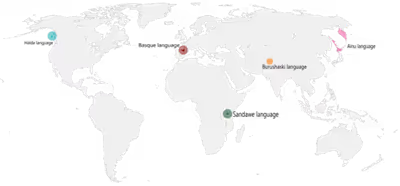
Below is a list of spoken language isolates, arranged by continent, along with notes on possible relationships to other languages.
The status column indicates the degree of endangerment of the language, according to the definitions of the UNESCO Atlas of the World's Languages in Danger. "Vibrant" languages are those in full use by speakers of every generation, with consistent native acquisition by children. "Vulnerable" languages have a similarly wide base of native speakers, but a restricted use and the long-term risk of language shift. "Endangered" languages are either acquired irregularly or spoken only by older generations. "Moribund" languages have only a few remaining native speakers, with no new acquisition, highly restricted use, and near-universal multilingualism. "Extinct" languages have no native speakers, but are sufficiently documented to be classified as isolates.
Africa
All of Africa's languages had once been gathered into four major phyla: Afroasiatic, Niger–Congo, Nilo-Saharan and Khoisan. Of these, only Afroasiatic has been established as a valid family, and even there there are doubts that some of the peripheral languages are actually Afroasiatic. Khoisan has been completely abandoned, the two major branches of Niger–Congo (as well as several smaller branches) cannot be shown to be related, and there has been persistent doubt about Nilo-Saharan. Data for several African languages, especially extinct ones like Kwisi, is not sufficient for classification. In addition, Jalaa, Shabo, Laal, Kujargé, and a few other languages within Nilo-Saharan and Afroasiatic-speaking areas may turn out to be isolates upon further investigation. Defaka and Ega are highly divergent languages located within Niger–Congo-speaking areas, and may also possibly be language isolates.
Asia
Oceania
Current research considers that the "Papuasphere" centered in New Guinea includes as many as 37 isolates. (The more is known about these languages in the future, the more likely it is for these languages to be later assigned to a known language family.) To these, one must add several isolates found among non-Pama-Nyungan languages of Australia:
Europe
North America
South America
Sign language isolates
A number of sign languages have arisen independently, without any ancestral language, and thus are true language isolates. (See linguistic polygenesis.) These include Nicaraguan Sign Language, a well-documented case of what has happened in schools for the deaf in many countries. In Tanzania, for example, there are seven schools for the deaf, each with its own sign language with no connection to any other language. Sign languages have also developed outside schools, in communities with high incidences of deafness, such as Kata Kolok in Bali, and half a dozen sign languages of the hill tribes in Thailand including the Ban Khor Sign Language, or in cities when people immigrate from the countryside and deaf children meet other deaf people for the first time, even without attending a school for the deaf.
These and more are all presumed to be absolute isolates or small independent families, because many deaf communities are made up of people whose hearing parents do not use sign language, and have manifestly, as shown by the language itself, not borrowed their sign language from other deaf communities during the recorded history of these languages.