

Liancourt Rocks
Group of disputed islets in the Sea of Japan
- 7 min read
- 8 chapters

Related on Lably
Through Korea, Fishery and Natural gas
South Korea exercises sovereignty over the islets, while Japan claims sovereignty over them. South Korean government's stated position is that the islets are integral part of Korean territory historically, geographically and under international law, that no territorial dispute exists over them, and that they are therefore not a matter to be dealt with through diplomatic negotiation or judicial settlement. North Korea formerly claimed the territory, but has reportedly ceased its claim, following the country's abandoning of all goals of reunification with the South. South Korea classifies the islets as Dokdo-ri, Ulleung-eup, Ulleung County, North Gyeongsang Province, while Japan classifies the islands as part of Okinoshima, Oki District, Shimane Prefecture.
Geography
The Liancourt Rocks consist of two main islets and numerous surrounding rocks. The two main islets, called Seodo (서도; 西島; lit. 'western island') and Dongdo (동도; 東島; lit. 'eastern island') in Korean and Ojima (男島; "Male Island") and Mejima (女島; "Female Island") in Japanese, are 151 metres (495 ft) apart. The Western Island is the larger of the two, with a wider base and higher peak, while the Eastern Island offers more usable surface area.
Altogether, there are about 90 islets and reefs, volcanic rocks formed in the Cenozoic era, more specifically 4.6 to 2.5 million years ago. A total of 37 of these islets are recognized as permanent land.
The total area of the islets is about 187,554 square metres (46.346 acres), with their highest point at 168.5 metres (553 ft) on the West Islet. The western islet is about 88,740 square metres (21.93 acres); the eastern islet is about 73,300 square metres (18.1 acres). The western islet consists of a single peak and features many caves along the coastline. The cliffs of the eastern islet are about 10 to 20 metres (33 to 66 ft) high. There are two large caves giving access to the sea, as well as a crater.
In 2006, a geologist reported that the islets formed 4.5 million years ago and are (in a geological sense) quickly eroding.
Sign in to keep reading
7 more chapters are free with a Lably account.
Tourism
Restricted public access to the rocks for a variety of purposes is provided by ferry from Ulleungdo. In 2025, 192,122 tourists visited the islands, averaging 500 visitors per day.
Distances
The Liancourt Rocks are located at about 37°14′N 131°52′E / 37.233°N 131.867°E. The western islet is located at 37°14′31″N 131°51′55″E / 37.24194°N 131.86528°E and the Eastern Islet is located at 37°14′27″N 131°52′10″E / 37.24083°N 131.86944°E.
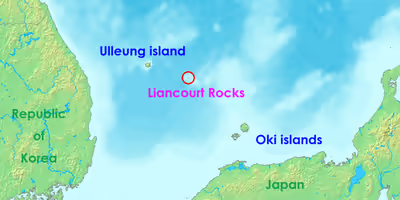
The Liancourt Rocks are situated at a distance of 211 kilometres (114 nmi) from the main island of Japan (Honshu) and 216.8 kilometres (117.1 nmi) from mainland South Korea. The nearest Japanese island, Oki Islands, is at a distance of 157 kilometres (85 nmi), and the nearest Korean island, Ulleungdo, is 87.4 kilometres (47.2 nmi).
Climate
Owing to their location and small size, the Liancourt Rocks can have harsh weather. If the swell is greater than 3 to 5 metres, then landing is not possible, so on average ferries can only dock about once in forty days. Overall, the climate is warm and humid, and heavily influenced by warm sea currents. Precipitation is high throughout the year (annual average—about 1,048 to 1,400 millimetres or 41.3 to 55.1 inches), with occasional snowfall. Fog is common. In summer, southerly winds dominate. The water around the islets is about 10 °C (50 °F) in early spring, when the water is coldest, warming to about 24 °C (75 °F) in late summer.
Ecology
The islets are volcanic rocks, with only a thin layer of soil and moss. About 49 plant species, 107 bird species, and 93 insect species have been found to inhabit the islets, in addition to local marine life with 160 algal and 368 invertebrate species identified. Although between 1,100 and 1,200 litres of fresh water flow daily, desalination plants have been installed on the islets for human consumption because existing spring water suffers from guano contamination. Since the early 1970s trees and some types of flowers were planted. According to historical records, there used to be trees indigenous to Liancourt Rocks, which have supposedly been wiped out by overharvesting and fires caused by bombing drills over the islets. A recent investigation, however, identified ten spindle trees aged 100–120 years. Cetaceans such as minke whales, orcas, and dolphins are known to migrate through these areas.
Environmental protection
Records of the human impact on the Liancourt Rocks before the late 20th century are scarce, although both Japanese and Koreans claim to have felled trees and captured Japanese sea lions there for many decades.
It is ecologically significant as a habitat for numerous seabirds as well as diverse plant and marine life. Because of its unique vegetation, geological features, and wildlife habitat, the Republic of Korea designated it as Natural Monument in November 1982, recognizing its high natural and scientific value under the country’s cultural heritage protection framework. There has been on-going efforts to protect and preserve the surrounding environment.
Natural Monument of South Korea
The Liancourt Rocks were designated as a breeding ground for band-rumped storm petrels, streaked shearwaters, and black-tailed gulls as Natural Monument #336 of South Korea on November 29, 1982.
Construction
South Korea has carried out construction work on the Liancourt Rocks; by 2009, the islands had a lighthouse, helicopter pad, and a police barracks. In 2007, two desalination plants were built capable of producing 28 tons of clean water every day. Both of the major South Korean telecommunications companies have installed cellular telephone towers on the islets.
History
Whaling
U.S. and French whaleships cruised for right whales off the rocks between 1849 and 1892.
Demographics and economy
As of March 2026, there are three office staff, two lighthouse managers, and twenty police personnel living on the islets. Since the South Korean coast guard was sent to the islets, civilian travel has been subject to South Korean government approval; they have stated that the reason for this is that the islet group is designated as a nature reserve.
In March 1965, Choi Jong-duk moved from the nearby Ulleungdo to the islets to make a living from octopus fishing. He also helped install facilities from May 1968. In 1981, Choi Jong-duk changed his administrative address to the Liancourt Rocks, making himself the first person to officially live there. He died there in September 1987. His son-in-law, Cho Jun-ki, and his wife also resided there from 1985 until they moved out in 1992. Meanwhile, in 1991, Kim Sung-do and Kim Shin-yeol transferred to the islets as permanent residents. In October 2018, Kim Sung-do died, followed by Kim Shin-yeol in March 2026, meaning there are currently no resident civilians.
The South Korean government gave its approval to allow 1,597 visitors to visit the islets in 2004. Since March 2005, more tourists have received approval to visit. The South Korean government lets up to 70 tourists land at any given time; one ferry provides rides to the islets every day. Tour companies charge around 350,000 Korean won per person (about US$310 as of 2019).
Sovereignty dispute
Sovereignty over the islands has been an ongoing point of contention in Japan–South Korea relations. There are conflicting interpretations about the historical state of sovereignty over the islets.
South Korean claims are partly based on references to an island called Usando (우산도; 于山島; 亐山島) in various medieval historical records, maps, and encyclopedia such as Samguk Sagi, Annals of Joseon Dynasty, Dongguk Yeoji Seungnam, and Dongguk munhon bigo. According to the South Korean view, these refer to today's Liancourt Rocks. Japanese researchers of these documents have claimed the various references to Usan-do refer at different times to Jukdo, its neighboring island Ulleungdo, or a non-existent island between Ulleungdo and Korea. The logbook of the Japanese warship Niitaka, dated 25 September 1904, records that Koreans wrote the name of the islets as Dokdo. South Korea cites this entry as evidence that the Korean name was in use, and known to Japanese officials, several months before Japan incorporated the islets into Shimane Prefecture in 1905.
North Korea formerly claimed the islands as its own and contested Japan's claim to the islands alongside South Korea's. However, it is said that following North Korea's abandoning of its long-term goal of reunification with South Korea in 2024, so has their claims on the Liancourt Rocks; this is evident through the omission of territories administered by the South from its maps, including geographical points such as Marado and Dokdo (Liancourt Rocks).