

Ligand cone angle
Measure of the steric bulk of a ligand in a coordination complex
- 2 min read
- 3 chapters

Related on Lably
Through Coordination complex, Ligand and Cone
Asymmetric cases
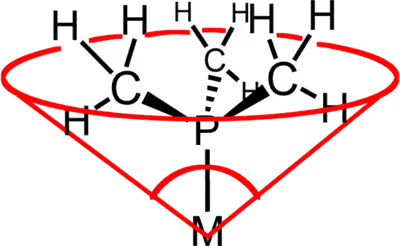
The concept of cone angle is most easily visualized with symmetrical ligands, e.g. PR3. But the approach has been refined to include less symmetrical ligands of the type PRR′R″ as well as diphosphines. In such asymmetric cases, the substituent angles' half angles, θi/2, are averaged and then doubled to find the total cone angle, θ. In the case of diphosphines, the θi/2 of the backbone is approximated as half the chelate bite angle, assuming a bite angle of 74°, 85°, and 90° for diphosphines with methylene, ethylene, and propylene backbones, respectively. The Manz cone angle is often easier to compute than the Tolman cone angle:
Sign in to keep reading
2 more chapters are free with a Lably account.
Variations
The Tolman cone angle method assumes empirical bond data and defines the perimeter as the maximum possible circumscription of an idealized free-spinning substituent. The metal-ligand bond length in the Tolman model was determined empirically from crystal structures of tetrahedral nickel complexes. In contrast, the solid-angle concept derives both bond length and the perimeter from empirical solid state crystal structures. There are advantages to each system.
If the geometry of a ligand is known, either through crystallography or computations, an exact cone angle (θ) can be calculated. No assumptions about the geometry are made, unlike the Tolman method.
Application
The concept of cone angle is of practical importance in homogeneous catalysis because the size of the ligand affects the reactivity of the attached metal center. In an example, the selectivity of hydroformylation catalysts is strongly influenced by the size of the coligands. Despite being monovalent, some phosphines are large enough to occupy more than half of the coordination sphere of a metal center. Recent research has found that other descriptors—such as percent buried volume—are more accurate than cone angle at capturing the relevant steric effects of the phosphine ligand(s) when bound to the metal center.