


Related on Lably
Through Oxygen, VSEPR theory and Copper
Production
Lithium oxide forms along with small amounts of lithium peroxide when lithium metal is burned in the air and combines with oxygen at temperatures above 100 °C:
- 4Li + O
2 → 2Li
2O.
Pure Li
2O can be produced by the thermal decomposition of lithium peroxide, Li
2O
2, at 450 °C
- 2Li
2O
2 → 2Li
2O + O
2
Sign in to keep reading
3 more chapters are free with a Lably account.
Structure
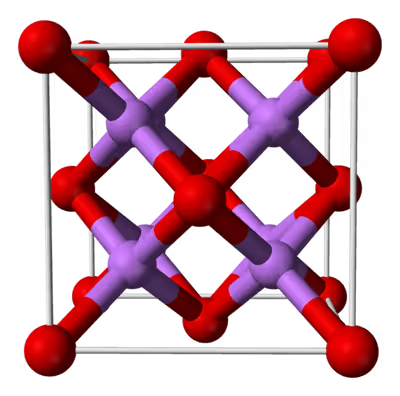
Solid lithium oxide adopts an antifluorite structure with four-coordinated Li+ centers and eight-coordinated oxides.
The ground state gas phase Li
2O molecule is linear with a bond length consistent with strong ionic bonding. VSEPR theory would predict a bent shape similar to H
2O.
Uses
Lithium oxide is used as a flux in ceramic glazes; and creates blues with copper and pinks with cobalt. Lithium oxide reacts with water and steam, forming lithium hydroxide and should be isolated from them.
Reactions
Lithium oxide absorbs carbon dioxide forming lithium carbonate:
- Li
2O + CO
2 → Li
2CO
3
The oxide reacts slowly with water, forming lithium hydroxide:
- Li
2O + H
2O → 2LiOH