

Mehmed Paša Sokolović Bridge
Historic bridge in Višegrad, Bosnia and Herzegovina
- 2 min read
- 4 chapters

Related on Lably
Through UNESCO
Characteristics
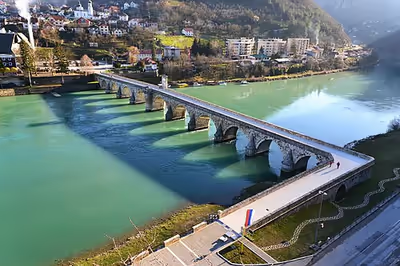
The bridge is characteristic of the apogee of Turkish monumental architecture and civil engineering. It comprises 11 masonry arches, with spans of 11 to 15 meters, and a right-angled approach ramp on the west bank of the river.
The 179.5-meter-long (589 ft) bridge was designed by Mimar Sinan, one of the greatest architects and engineers of the classical Ottoman period and a contemporary of the Italian Renaissance. The UNESCO summary states: The unique elegance of proportion and monumental nobility of the property as a whole bear witness to the greatness of this style of architecture.
Sign in to keep reading
3 more chapters are free with a Lably account.
History
The Višegrad Bridge was commissioned by Grand Vizier Mehmed Pasha Sokolović, who exercised power over a long period at the summit of the Ottoman Empire during the reigns of three sultans, as a tribute to his native region and a symbol of trade and prosperity. Construction of the bridge took place between 1571 and 1577. Major renovations of the bridge have taken place in 1664, 1875, 1911, 1940 and 1950–52. Three of its 11 arches were destroyed during World War I and five were damaged during World War II but subsequently restored.
Renovation
The bridge received UNESCO World Heritage Listing in 2007.
The Turkish International Co-operation and Development Agency (TIKA) provided 3.5 million euros for the restoration of the Mehmed Paša Sokolović Bridge. Representatives of TIKA, the BiH Commission for Co-operation with UNESCO, the Republika Srpska Cultural Ministry and the Višegrad municipality signed an agreement to renovate the bridge on 19 April 2010.
In literature
The bridge is widely known because of the 1945 book The Bridge on the Drina, by Nobel Prize–winning Yugoslav writer Ivo Andrić.
Relevant literature
- Ševo, Ljiljana. "Stari Višegradski most u narodnoj tradiciji, putopisima i umjetnosti." Baština II (2006): 173-191.