

Mesa
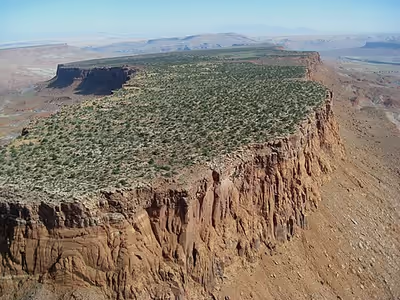
Elevated area of land with a flat top and sides, usually much wider than buttes
- 5 min read
- 4 chapters

Related on Lably
Unlike a plateau, which is a broader, elevated region that may not have horizontal bedrock (e.g., Tibetan Plateau), a mesa is defined by flat-lying strata and steep-sided isolation. Large, flat-topped plateaus with horizontal strata, less isolated and often part of extensive plateau systems, are called tablelands. A butte is a smaller, eroded mesa with a limited summit, while a cuesta has a gentle dip slope and one steep escarpment due to tilted strata.
Names, definition and etymology
As noted by geologist Kirk Bryan in 1922, mesas "...stand distinctly above the surrounding country, as a table stands above the floor upon which it rests". It is from this appearance that the term mesa was adopted from the Spanish word mesa, meaning "table".
A mesa is similar to, but has a more extensive summit area than, a butte. There is no agreed size limit that separates mesas from either buttes or plateaus. For example, the flat-topped mountains which are known as mesas in the Cockburn Range of North Western Australia have areas as large as 350 km2 (140 mi2). In contrast, flat topped hills with areas as small as 0.1 km2 (0.039 mi2) in the Elbe Sandstone Mountains, Germany, are described as mesas.
Less strictly, a very broad, flat-topped, usually isolated hill or mountain of moderate height bounded on at least one side by a steep cliff or slope and representing an erosion remnant also have been called mesas.
In the English-language geomorphic and geologic literature, other terms for mesa have also been used. For example, in the Roraima region of Venezuela, the traditional name, tepui, from the local Pomón language, and the term table mountains have been used to describe local flat-topped mountains. Similar landforms in Australia are known as tablehills, table-top hills, tent hills, or jump ups (jump-ups). The German term Tafelberg has also been used in the English scientific literature in the past.
Sign in to keep reading
3 more chapters are free with a Lably account.
Formation
Mesas form by weathering and erosion of horizontally layered rocks that have been uplifted by tectonic activity. Variations in the ability of different types of rock to resist weathering and erosion cause the weaker types of rocks to be eroded away, leaving the more resistant types of rocks topographically higher than their surroundings. This process is called differential erosion. The most resistant rock types include sandstone, conglomerate, quartzite, basalt, chert, limestone, lava flows and sills. Lava flows and sills, in particular, are very resistant to weathering and erosion, and often form the flat top, or caprock, of a mesa. The less resistant rock layers are mainly made up of shale, a softer rock that weathers and erodes more easily.
The differences in strength of various rock layers are what give mesas their distinctive shape. Less resistant rocks are eroded away on the surface into valleys, where they collect water drainage from the surrounding area, while the more resistant layers are left standing out. A large area of very resistant rock, such as a sill, may shield the layers below it from erosion while the softer rock surrounding it is eroded into valleys, thus forming a caprock.
Differences in rock type also reflect on the sides of a mesa, as instead of smooth slopes, the sides are broken into a staircase pattern called "cliff-and-bench topography". The more resistant layers form the cliffs, or stairsteps, while the less resistant layers form gentle slopes, or benches, between the cliffs. Cliffs retreat and are eventually cut off from the main cliff, or plateau, by basal sapping. When the cliff edge does not retreat uniformly but instead is indented by headward eroding streams, a section can be cut off from the main cliff, forming a mesa.
Basal sapping occurs when water flowing around the rock layers of the mesa erodes the underlying soft shale layers, either as surface runoff from the mesa top or from groundwater moving through permeable overlying layers, which leads to slumping and flowage of the shale. As the underlying shale erodes away, it can no longer support the overlying cliff layers, which collapse and retreat. When the caprock has caved away to the point where only little remains, it is known as a butte.
Examples and locations
Australia
- Cockburn Range, Western Australia
- Mount Conner, Northern Territory
Czechia
- Děčínský Sněžník, Ústí nad Labem Region
France
- Mont Aiguille, Auvergne-Rhône-Alpes
Germany
- Königstein, Saxony
- Lilienstein, Saxony
- Papststein, Saxony
- Pfaffenstein, Saxony
- Quirl, Saxony
India
- Several near Owk mandal, Andhra Pradesh
Iraq
- Amadiya, Kurdistan Region
Ireland
- Benbulbin, County Sligo
- Knocknarea, County Sligo
- Knocknashee, County Sligo
Israel
- Masada, Southern District
- Har Qatum
Italy
- Monte Santo, Sardinia
Poland
- Szczeliniec Wielki, Lower Silesian Voivodeship
United Kingdom
England
- Castle Folds, Cumbria
- Cross Fell, Cumbria
- Goldsborough Carr, County Durham
- Higger Tor, South Yorkshire
- Ingleborough, North Yorkshire
- Pen-y-ghent, North Yorkshire
- Shacklesborough, County Durham
Scotland
- Healabhal Mhòr, Isle of Skye
United States
Many but not all American mesas lie within the Basin and Range Province.
Arizona
- Anderson Mesa
- Black Mesa (Apache-Navajo Counties)
- Black Mesa (Navajo County)
- Black Mesa (Warm Springs)
- Black Mountain
- Cummings Mesa
- First Mesa
- Horseshoe Mesa
- Indian Mesa
- Second Mesa
Arkansas
- Mount Magazine
California
- Redonda Mesa
Colorado
- Battlement Mesa
- Grand Mesa - largest flat-topped mountain in the world.
- Green Mountain
- Log Hill Mesa
- North Table Mountain
- Raton Mesa
Nevada
- Mormon Mesa
- Pahute Mesa
Oklahoma
- Black Mesa
- Mesa de Maya
Texas
- Floating Mesa
- Llano Estacado
Utah
- Checkerboard Mesa
- Crazy Quilt Mesa
- Hurricane Mesa
- Sams Mesa
- Smith Mesa
- South Caineville Mesa
- Thompson Mesa
- Wildcat Mesa
- Wingate Mesa
Wisconsin
- Gibraltar Rock
- Grandad Bluff
- Mile Bluff
- Quincy Bluff
- Rattlesnake Mound
On Mars
A transitional zone on Mars, known as fretted terrain, lies between highly cratered highlands and less cratered lowlands. The younger lowland exhibits steep walled mesas and knobs. The mesa and knobs are separated by flat lying lowlands. They are thought to form from ice-facilitated mass wasting processes from ground or atmospheric sources. The mesas and knobs decrease in size with increasing distance from the highland escarpment. The relief of the mesas range from nearly 2 km (1.2 mi) to 100 m (330 ft) depending on the distance they are from the escarpment.